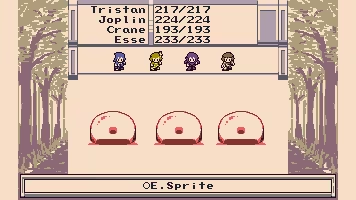
Create a party, layer on new classes, and uncover the mystery behind the seeming reappearance of a long-gone city in this classicly-styled RPG.
Modeled estimate, not a reported figure. How we estimate →
About


Genres
Stats
All-time low is the lowest price we've recorded for this game since we started tracking it.
Languages: English
Engagement
Hours played at review time, across 40 reviews with recorded playtime.
Reviews
Themes across 40 recent reviews and how positive each mention is. A keyword signal, not full sentiment analysis.
positive critical· bar length = how often the theme comes up
Reviews
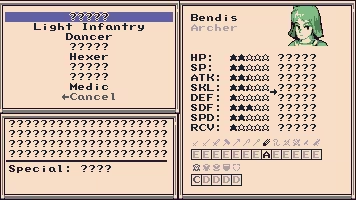
I enjoy a lot of retro JRPGs and modern games made in the style, but False Skies just doesn't do it for me. I wouldn't go so far as to say it's bad, but I don't like the design on several levels and there's nothing that appeals to me enough to make me want to continue. To start off with, I think the graphics, music, and sound design are all good. I've certainly played and enjoyed games that were much worse in all of these areas. At 15 hours in, not a whole lot had happened in the story yet, but I found it to be charming in a way similar to the old gameboy SaGa/Final Fantasy Legends games. That is to say, I enjoyed these aspects of the game, but didn't find them to be compelling reasons to play the game on their own. The biggest issue I have with the game is a classic JRPG issue in general -- a high random encounter rate in large dungeons. Basic combat here just isn't that interesting, so frequent random encounters while trying to explore a dungeon are obnoxious. Running isn't a great option since attempts happen at a heavily delayed initiative, meaning you'll be eating a full round of attacks from the enemy before you run. Regular attacks don't cut it, so you'll be constantly spending your skill points to kill enemies. Relying on consumables isn't realistic in the first 15 hours -- I frequently couldn't even afford to upgrade all of my gear, much less stock up on HP/MP curatives or Repel items to prevent combat in the first place. The class system discourages grinding (discussed below), so grinding for money felt like a one step forward, two step back situation. So, the best way to manage MP, and thus HP, is a blood sacrifice ability that can only be used during combat. This means that dragging out a combat with a weakened enemy to spam the MP restoration ability and party heals is the best way to play, despite the tedium. None of this amounts to much real difficulty, but it does amount to a slog. The class system is what had me excited for False Skies, but, in the end, it's a miss for me. The basic idea is that there are several tiers of classes and you choose one class from each tier over the course of the game. When available, higher tier classes offer a higher stat total per level, but staying in your lower tier class for extra levels can net useful skills that aren't available elsewhere. It's a decent idea, but there's a few flaws that sucked out all of the fun for me. First, the game doesn't give you any information about what anything is. If you press left at the class change menu (which isn't explained anywhere as far as I could tell), you can see that a Sorcerer learns "Foca", but you don't know what the skill does. Thus, you have to consult outside guides to see if staying in a lower tier class is worth it or just hope for the best. Since there's no respeccing, I chose to consult the guides, which is a bit of a downer. That's annoying, but the bigger issue is that you not only have to reach a level threshold for higher tier classes, but you also have to unlock them by finding them in the world. With the high encounter rate and limited early game options for avoiding combat, you're almost guaranteed to be leveling past where you'd prefer to be by the time you unlock new classes. This creates an issue like in FF6 and FF8, where, optimally, you want to keep your level low until late game. Like in those games, the difficulty isn't so high that it's necessary, but it's an issue that really detracts from my enjoyment of the systems. I believe the intended way to play is to either not worry about it or just hire a new member and grind them up to have a better build, but it just wasn't enjoyable for me. The other, equally big problem with classes is that they aren't very interesting. Classes have a special ability and weapon proficiencies that only apply while you are currently that class. Long term, they supply active abilities and stat growths. There are no passives to pass on -- you can't learn to use a bow long term by taking some early levels in archer or get a passive counter attack skill, for example. Passive differences in how a character functions gives a lot more identity in combat. It's not necessary, but it's something I really miss when its not there. The active ability sets are frequently quite one-dimensional, though I think the "choose four" nature of the class system somewhat naturally leads to that. A lot of the class issues seem like nitpicks, but the class system was the only part of the game I felt drawn to. Since I ended up not liking it and the game otherwise felt like quite a slog with the random encounters and MP management, there just wasn't enough here for me to want to continue on. I think if everything were paired down to a 15-20 hour adventure, I'd have finished the game and though that it was ok. As it is, I've played nearly 15 hours and it looks like I'm at most 1/3 of the way in, so I'm cutting my losses and moving on.
I am genuinely frustrated by how overlooked this game is. False Skies is an RPG full to the brim with (well-made) content. Fun classes and abilities to experiment with, a surprisingly catchy soundtrack (that's annoyingly hard to find, would be nice to see a full YouTube upload or something of the sort, rather than the handful of tracks that are up), an interesting story that - while not groundbreaking by any means - managed to genuinely engage me, superbly designed dungeons, and secrets galore. Shockingly low price tag and player numbers given all there is to this game. Exploration and discovery is the game's strongest point. Nothing outside of where you need to go next for the main story is signposted, and there are a lot of things off the beaten path. Unique loot which can greatly strengthen or change your builds, new classes, new bosses, pieces of lore, better transport between areas (like unlocking additional teleport points), and far more that I'm sure I'm forgetting. It's brilliantly fun to try and track down all the classes, figure out where to use a mysterious item you've found, and figure out how to please an NPC who "only talks to those close with death". This keeps the game engaging and novel throughout the entirety of its playtime, but it also serves as a weakness (which I mention slightly later). Its next best strength is the class system itself. There's not too much to say here if you know how job systems in JRPGs or multiclassing in western RPGs works, though it is a little different from those I've played in the past. You have a starting class that aligns with typical RPG archetypes (Rogue/Healer/Defensive Melee Character/Offensive Melee Character/Healer/etc.) with a generalist that gets a bit of everything for your first character, and get more specific as you move on in classes (which you unlock with aforementioned exploration). Classes are made of their regular abilities, a unique class specific ability, and sometimes a passive or two like increased evasion growth or being good at using any elemental weapon regardless of your usual weapon proficiencies. A lot of the classes do exactly what you expect (the Gunner is good at using guns, go figure) and others have very unique interactions, like the Evoker, whose skills can be changed by equipping "pacts" you find in the world (that normally have a puzzle or requirement associated with them). You can switch out party members to experiment, but my favourite feature is exp sharing. You have a usual JRPG 4-member party, but if you choose to have a smaller party (1, 2, or 3 members) each member gets increased exp, meaning you can beat the game with any number of characters. My current playthrough (approaching what I assume is the end) has had 2 members the entire time. Not a necessary or essential feature with its own downsides (each party member is much stronger than they would be in a full group, but you have lesser role variety and are more vulnerable to certain enemy abilities), but just having the option is nice. The game's biggest flaws are mostly QoL and size related. There are some quality of life design decisions that can be rather frustrating during play. The map requires you to open the menu and enter a second menu screen to access rather than being its own hotkey, when you're moving long distances in the overworld it can feel like you're moving incredibly slowly (there's a teleport system and repels are very cheap, but it still gets annoying regardless), some dungeons overstay their welcome (second trip into the palace in particular has felt tedious, and my two biggest gripes: lack of ability information and a notes system/quest log. The former issue is downright bizarre, unless I completely missed something in my ~50 hours of play, you can see what abilities a class would gain (assuming you've unlocked the class) but you cannot see what those abilities do until you pick the class. Given you can't just switch classes like in other job based games (class choices are permanent), you're faced with either having a vague idea of what a class does or just looking up a guide to actually read what "Unmover" does or how the Elementalist's skill tree system works, risking spoilers in the process. The latter issue is my biggest gripe. False Skies is a big game with a ton of things for you to discover and unlock, but there is absolutely zero way to note things down in-game. There are lots of locations you'll want to return to, NPCs who imply they'll change their dialogue with more plot progression, mini-bosses you'll need to get stronger to fight, locked doors you don't yet have the key too (and won't for many hours), etc. and you have to remember (or write it down IRL) it all yourself. You can't even mark locations of interest on your map. It's a really baffling decision that somewhat punishes you if you take long breaks playing the game. Good luck remembering which NPC off-handedly mentioned the location of a mini-boss or gave instructions for a sidequest when you haven't played in a week. And I wish you even more luck for when you realise some of the locked doors you see right from the start of the game won't have keys until dozens of hours later. It really turns the game's greatest strength into a weakness, and it could have been resolved with an in-game way to type memos. But the game's features massively outweigh all of its flaws. Please, please, please play False Skies.
I really thought I already left a review, I'm so sorry. False Skies is a phenomenal jrpg. I genuinely place it just below the SNES final fantasies in ranking in my brain, and I grew up on those ♥♥♥♥♥♥♥ so it's competing with nostalgia. The art? GREAT The OST? Those battle tracks go hard yo I would say the thing keeping it down a bit for the lay person would be the Create a party, taking away main character development that carries a lot of games. But it's also a strength, allowing the balance of pacing between gameplay and story to really hit a sweetspot where you're never dragged down by characters chat chat chatting for the sake of it, but regularly rewarded with great story, lore, and fun bits with the enemy faction. While your playable characters don't have, well, character, everyone else in the world does and the frenemies you make along the way and an amazing bunch. I miss Lisse already. I played on Normal Mode and found it a bit easy because I grew my characters into AOE monsters but apparently the intended difficulty is Hard, so I plan on returning to it soon to replay it and explore character building options more. There's so many cool classes and the ability to mix and match as you grow your characters rock!!! I want to play with it more!!! <- completely ignored summoning whoops Anyways, yeah, amazing game that needs much more attention. This easily places up there in my favorite jrpgs. Please take the leap and jump into this amazing title.
False Skies is basically a modern take on the old school RPG style from the Game Boy/GBC days; it caught my eye because it looked very similar to Final Fantasy Legend 3/SaGa 3, and that wasn't unwarranted. It's a fun little story that starts with the obligatory archaeological excavation of ruins tied to an ancient kingdom that vanished 2000 years ago, but goes in some clever directions as it becomes increasingly more obvious that they're actually still around in some capacity. The aesthetics are on point, music's catchy, battles are a lot of fun and move quickly. The real winner here is the class system. At its core it's a job-change system with five tiers of jobs that you can unlock and swap into at particular breakpoints, but it's freeform in interesting ways; you can choose when you promote someone to the next tier (jobs can learn their final skill anywhere from 15 levels of experience all the way up to 45 in a very extreme case). There's no strict job prerequisites, so if you want your healer to go gunner next tier and then shift into a paladin type later, sure, have at it. While there's the usual 'normal' jobs you'd expect, there's some really niche and clever ones; the Havenmaker is a healer job that can let your party create new save spots in particular locations by doing an optional boss fight; the Seer gets a variety of strong "hit on subsequent turns" delay spells; the Soul Stealer takes a fraction of an enemy's stats as direct buffs and has a raw damage attack that scales based on enemy parameters, and the Elementalist gets strong magical and physical elemental attacks but only those reflecting the elements that character learned skills from in a lower tier job. There's even a gimmick tradeoff for the Tier 5 endgame jobs; if you swap into one of those, you actually erase that character's T1 class entirely (levels, stats, and abilities) in exchange for the T5 unlock with new abilities and massive stat growth potential. It's a cool system, ultimately; party building is neat, there's a lot of variety, and you don't have to actually promote anyone before you're ready to (or pick a T5 job when you get there). You can even have a bunch of party members in reserve that get XP passively so you can build up alternate party members or experimental builds without any real commitment. Very cool little experience, perfect on Steam Deck since it feels like a lost handheld title, only nine bucks full price. There are far worse ways to spend 40ish hours if you dig the 8-16 bit era of RPGs.
Really conflicted about this game The first half was really amazing but the level design gets increasingly more annoying as you go on The encounter rate would have really needed some more fine tuning Same goes with the puzzles I love the game but I won't play it further it just feels like the game wants me to waste time on purpose and that's not good level design
This is really for fans of the classic JRPG. With a fresh set of unique classes, many classes, and many with very original move sets. If you like turn-based, big world exploring, random encounters, not mindless but not 100% constantly demanding strategy combat, and a story that tells you "do this, now this, go here, now there" than this is perfect for you. I love it
An absolutely phenomenal indie RPG! Nothing else compares, I mean it.
A very long and enjoyable JRPG with speedy combat and a lot of very pretty sprite work, though with some flaws that make it more fussy to play than it needs to be. Very much recommended, but only if you have 60+ hours to dedicate to it. There are quite a few varied dungeons in the game, some with puzzles to solve and some that are more straightforward. The major themed puzzles seem obtuse at first, but they have a logic to them that emerges once you experiment a bit, which makes them very satisfying to solve. Many of the dungeons can be a bit mazey, but there are usually shortcuts to unlock that make backtracking or multiple trips a lot easier. Combat runs quickly and tends to favor buffs/debuffs and big-hitting combos. The tactics available to you will shift (for better and worse) as you change classes. Many enemies have counterattacks, special defenses, or strong buffs, so it's necessary to prioritize targets and tailor your attacks to each encounter. Unfortunately, some skills don't make a lot of sense, don't work as advertised, or just aren't very useful compared to other options. The world and story are creative and interesting and go in some unexpected directions, but the narrative is hindered a bit by some uneven character work. The main group of NPCs that you'll encounter throughout the game are difficult to distinguish from each other, and their attitudes towards you feel somewhat arbitrary for the first chunk of the game; there are reasons for their conflicted behavior, but they sometimes feel motivated more by plot convenience. Several other NPCs are set up to be important, but end up disappearing from the story without making much impact on it. Traveling can be unnecessarily annoying. The game often teases you with a new form of transportation, only to quickly take it away and leave you traveling on foot again. There are also several points in the story where you'll be unable to return to previous areas for quite a while. It's not until late in the game that you finally gain a fast and (mostly) hassle-free mode of transport. My biggest complaints center around the game's distinguishing feature: the class system. With dozens of classes to choose from, it sounds like you have a lot of freedom to build your team as you please, but in practice, it's rather finicky and not as flexible as it sounds. I didn't feel like I was theorycrafting the best strategy so much as just making the best of my available options. - There are multiple tiers of eight classes each, and you can only move from one tier to the next. So, you can create a fighter/light infantry or a fighter/medic, but not a fighter/recon. - Each tier doesn't necessarily overlap much with the last and many classes have very narrow behavior or skill sets, so the next tier may not have anything that synergizes with your build. There were a number of times when I couldn't decide what class to choose next for a character, not because there were so many appealing options, but because there were so few. Some class changes brought little or nothing to the character's skill set. - Stat gains at each level vary by class, and your current stats do not change when you change classes. This means that e.g. switching a career fighter into a healing class, or vice versa, is likely to give poor results. - There is at least one class that immediately loses most of its skills upon promotion to the next tier. I have no clue what the developer was thinking with this. - Most classes are inaccessible until you track down the appropriate sidequest somewhere in the world. This is a cool idea and wouldn't normally be a problem, but it leads into my next point: - You gain both character levels (up to 99) and individual class levels. You must reach a certain character level to be promoted, while new skills unlock with class levels. Often, it may be advantageous to stick with a lower tier for longer than required to pick up stronger skills. However, more often, you will be stuck gaining unwanted levels in a class because you haven't yet unlocked an appropriate class of the next tier, or just because you have no access to a class promotion desk. This puts you behind on stat gains and learning new skills, and may even lock you out of some high-level skills entirely. This design not only punishes grinding, but actively encourages avoiding fights, so that you don't accidentally level up too much. If you choose to keep reserve party members, this can quickly become way too much to keep track of. I kept several reserve members following alternate class paths, but I never ended up using them. Fortunately, the game is easy enough that you don't need a perfect party build to win. I finished hard mode at around level 80 with the same party I'd been using the entire game, so I ended up having plenty of breathing room. You always have the option of creating new characters to plan their development more precisely, but the game is long enough without adding extra grinding to it. It's probably best not to worry about it too much. I do feel like the game runs too long; there are probably enough good ideas here to fill two games. In particular, the extended multi-dungeon climax of the story and the final tier of classes make the game feel a bit overstuffed. Still, if you have the time to see it through, it's a very fun and satisfying journey.
Pretty solid game all in all. -Combat & Growth systems are great - lots of paths to take to get the job done. -Story and characters are ok - this isn't a bad thing, it feels very reminiscent of the nes/snes era stories that its paying tribute to. -Difficulty - overall the base game is easy so long as you are paying attention to the class paths you take. My two criticisms here is the last leg of the game drags on for too long. You feel like your going to the final battle a number of times and keep getting strung along. And that final dungeon was a bit tedious given how the rest of the game was balanced, fortunately for me I'm a hoarder.
Short Version : A superb JRPG. Great use of the GBC-esque limited palette, the art is lovely from start to finish. Meaty length(took me a bit over 60 hours) with good pacing. Genuinely interesting story and setting. A Class/Job system with some real creativity and twists. Thoughtful enemy design that keeps the classic turn-based battle system engaging. Some of the better dungeons you'll find in any JRPG. Quirky soundtrack that fits the game really well. Highly recommended for anybody who wants a quality old-school style JRPG, but one clearly made with plenty of game design chops. Additional Notes: Your player characters are just kind of blank slate stand-ins for the heroes of the story. I cant say this is my favorite choice, as it's hard to get emotionally attached to characters who only really have implied dialogue, but I will say the game did a pretty great job of making the surrounding cast of characters fun and appealing to interact with, enough to keep me invested in the world and story as a whole. And moreso, this choice is probably a necessary one in order to make the class/job system work. Because the game *will* let you mess up your characters builds as you progress through new tiers of jobs, but because you can always train up new blank characters whenever you want or have ones in reserve ready to take over if needed, you're never completely screwed or anything. And the fact that you can mess up your builds if you're being careless is also part of what makes it so interesting, because the classes/jobs aren't always straightforward and you are encouraged to play around a bit and not just make cliche archetypes. I will echo complaints from others though, that some of this would be helped if there were explanations for skills ahead of time, before you permanently pick your next tier class. And speaking of skills, there's a lot of fairly unique and creative stuff going on here. Moreso than many JRPG's, you will not get away with just spamming 'Attack' and then healing every once in a while, at least beyond the beginning stages of the game. You'll have access to lots of different types of skills and you'll need them, because your enemies will have access to many of these same skills as well. This helps keep the combat mentally engaging and mildly challenging(or fairly challenging on Hard difficulty) throughout, helped by the game constantly throwing new enemies at you to keep things fresh. Yea, there's a fair number of color swap designs, but these usually always have new abilities and aren't just higher stat versions. Dungeons are something I need to touch on, cuz I think it's easily one of the best reasons to pick up this game. They start out fairly straightforward in the beginning to ease you in, but it wont take long before the complexity goes up. And it keeps going up throughout the game for the most part, with some of the later game areas/dungeons being very easy to get lost in or dumbfounded with, not because they're just so huge so much as they're just quite intricate and packed with alternate routes and puzzle mechanics and verticality and whatnot(and secrets of course). And because the game has random encounters, this could potentially be very annoying except for the fact that the game lets you buy these cheap items that will basically turn these encounters off for a brief while. Which is just a really great solution, both to alleviate frustration with them, and also to help control leveling. Overall, just really impressed with this one, super glad I picked it up after seeing it recommended by somebody on Resetera. A lot of care clearly went into this in all areas. And lastly, shoutout to the developer and his friend sdmax on the Discussion board, for being responsive and helpful to questions.
Related
Related
Trends
Modeled estimate over time, reconstructed from Steam's monthly review histogram.
Momentum
Pace estimated from the game's recent review growth (our daily snapshots) at its own sales-per-review ratio — a momentum signal, not booked sales.
Audience
Estimated from the language of this game's reviews — a proxy for where players are, not official Steam demographics.
Related
| Black Myth: Wukong | $794.9M | 1.2M | 97% | $59.99 |
| ELDEN RING | $680.4M | 1.1M | 93% | $59.99 |
| DARK SOULS™ III | $467M | 437.9K | 94% | $59.99 |
| 7 Days to Die | $425.3M | 403.5K | 87% | $44.99 |
| Hogwarts Legacy | $323.6M | 369.9K | 90% | $59.99 |
| Mount & Blade II: Bannerlord | $309.8M | 293.9K | 88% | $49.99 |
Related
| Dig Deep | $20.6K | 141 | 70% | $4.99 |
| Vampire: The Masquerade - Reckoning of New York | $20.6K | 353 | 67% | $2.99 |
| Drive-By Hero | $20.6K | 269 | 52% | $4.54 |
| Last Man Sitting | $20.6K | 359 | 76% | $2.49 |
| Axis Football 2018 | $20.6K | 136 | 65% | $4.99 |
| Stocks: Main Force Simulator | $20.6K | 65 | 88% | $8.99 |