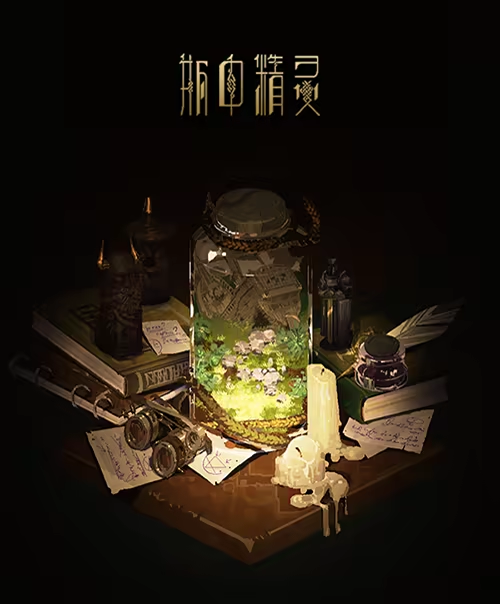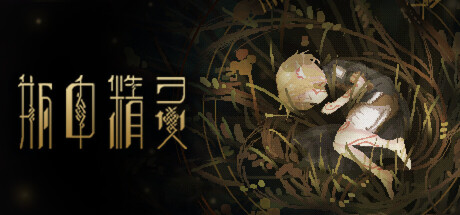
Fairy in a Jar is a short but enchanting fairytale. It tells the story of a fairy who lost their memory and was kept in a jar by a human...
Modeled estimate, not a reported figure. How we estimate →
Media

About

The fairy awakens in the glass enclosure with no memories. From the moment they open their eyes, the little fairy sees nothing but white lights. They meets Mr. Gaint, who is scary but also a bit clumsy...
In a completely unknown world, with limited living space and a captor who speaks a different language...What should the fairy choose? To escape this prison, or...?

Fairy
A polite and sweet fairy, who lost their memory. They appear timid, but surprisingly, the actions are bold.

Mr. Giant
A research student who keeps the fairy in the jar. He is tall, and not very forthright with his feelings. It seems that he bought the fairy from someone...
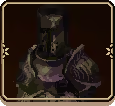
The Knight Statue
A mysterious statue which can somehow talk. He is a modest old gentleman with rich knowledge.

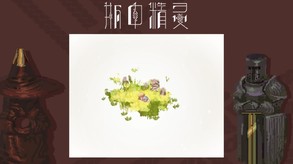
The Viking Statue
A mysterious statue which can somehow talk.. He is grumpy and often quarrels with the Wizard Statue. He loves flaunting the Viking history.

The Wizard Statue
Another talking statue. He is a little gloomy and often harasses the Viking Statue. He always seems to be considering some mysterious recipes for curses in his mind.

The ??? Statue
A mysterious statue that the fairy meets in a certain place. He talks like a lady though he appears to be a middle-aged man. Being an old friend of the Knight, he seems to know some secrets.
To proceed with the game, just check the arrows and make your choice.
Move >>>> Arrow keys
Decide/Check >>>> Z/Space/Enter
Cancel >>>> X/Esc
Save >>>> X/Esc
Skip Text >>>> Ctrl
Stats
All-time low is the lowest price we've recorded for this game since we started tracking it.
Languages: Simplified Chinese, English
Engagement
Hours played at review time, across 40 reviews with recorded playtime.
Reviews
Themes across 40 recent reviews and how positive each mention is. A keyword signal, not full sentiment analysis.
positive critical· bar length = how often the theme comes up
Reviews
可爱且刀
没看懂啥剧情,而且为什么精灵会爱上人类啊
Got this game cause I was curious what the story was gonna play out and I just left disappointed and confused. I didn't understand what I was supposed to do get the other endings since the game doesn't really give you much leeway outside of a handful of choices and I didn't feel like admiring my captor to get a "good" ending. I'm sure people who fantasize about fairies in jars falling in love with their captors are going to find some joy in this but I don't think anyone outside that demographic will care.
Fairy in a Jar, developed by 鸬鹚鱼塘 and published by Eternal Dream and 迷糊的安安, is a short but hauntingly beautiful narrative game that blends fairy-tale melancholy with minimalist design and emotional storytelling. It opens with a mysterious premise: a tiny fairy awakens inside a glass jar, stripped of memory and freedom, confronted by an unknown human presence who watches from beyond the glass. From this deceptively simple setup, the game unfolds as a quiet meditation on captivity, innocence, and the blurred lines between affection and control. The player’s role is less that of an active participant and more an observer or conscience, guiding the fairy through a confined but emotionally charged space where small choices shape the story’s outcome. At its heart, Fairy in a Jar is more about atmosphere than mechanics. The player navigates the confines of a small environment, interacting with objects, uncovering fragments of memory, and making choices that gradually reveal the nature of the fairy’s imprisonment. Each decision carries subtle moral weight—whether to seek escape, empathy, or understanding of the captor—and leads to one of several endings that recontextualize the story’s meaning. There are no combat systems, complex puzzles, or elaborate interfaces here; instead, the game relies on narrative progression, tone, and environment to evoke emotion. Its pacing is deliberately slow, encouraging reflection and interpretation rather than urgency. The result is a game that feels less like a traditional adventure and more like a fable or parable—a work designed to be felt rather than conquered. The visual presentation is among its most captivating qualities. Rendered in soft, hand-drawn pixel art, the world of Fairy in a Jar feels fragile and dreamlike, as if every frame were captured from a forgotten memory. The backgrounds shimmer with subdued color palettes—cool blues, dusty purples, and muted golds—that convey a mood of melancholy and wonder. Subtle animations, like the flicker of the fairy’s wings or the shimmer of light through the glass, add a delicate sense of life. Every visual element feels intentional, serving to heighten the contrast between beauty and confinement. This aesthetic sensitivity is what allows the game to transcend its technical simplicity; the player’s emotional response is guided not by spectacle but by texture, rhythm, and restraint. The soundtrack reinforces this sense of quiet introspection. Gentle piano melodies, soft ambient hums, and fleeting choral tones weave through the story like a ghostly lullaby. The music rarely asserts itself but instead lingers at the edges, enhancing the emotional rhythm of each scene. Even after the story ends, many players find its main theme lingering in their memory, a testament to how effectively the audio complements the visual tone. There is no voice acting, but the absence of speech feels deliberate—it leaves space for the player’s imagination to fill in the emotional subtext. This combination of minimalist sound design and expressive imagery creates a world that feels intimate and deeply personal. Narratively, the game’s strength lies in suggestion rather than exposition. The story hints at trauma, loneliness, and misplaced affection without spelling them out. Depending on the player’s choices, the relationship between the fairy and her captor can be read in many ways—symbiotic, tragic, or even romanticized in a twisted sense. Each ending offers a different emotional interpretation, from bittersweet acceptance to despairing liberation. The writing is spare but poetic, occasionally marred by small translation issues that reveal its indie origins, yet even these imperfections contribute to its sincerity. There is a certain vulnerability in the prose—a willingness to let silence and ambiguity carry emotional weight—that recalls the storytelling approach of art-house visual novels and short narrative experiments. While the experience is brief, often lasting less than an hour, its impact lingers. Fairy in a Jar is the kind of game that invites reflection long after it ends. Its themes of confinement, empathy, and moral ambiguity resonate because they are delivered through tone and atmosphere rather than explicit message. The game leaves space for interpretation: some may see it as a commentary on control and dependency, others as a metaphor for lost innocence or the fragile nature of memory. Whatever the reading, it manages to evoke emotion through restraint—a rare quality in a medium often defined by excess. Technically, the game runs smoothly and is accessible even on low-end systems. Its simplicity ensures few bugs or performance issues, though players have noted minor quirks in text formatting and localization. The interface is clean and intuitive, allowing focus to remain on the story and visuals. For a project of its scale, the polish is impressive, and the creative vision is clear. It never overreaches, instead choosing to stay within its limitations and refine what it does best. Ultimately, Fairy in a Jar stands as a quiet triumph of mood and storytelling economy. It distills the essence of interactive fiction into something intimate and emotionally resonant. While its short length and minimalist gameplay may leave some wanting more, those who approach it as an artful experience rather than a traditional game will find something memorable. It is a story told through glances, silences, and the soft shimmer of light against glass—a fragile, haunting reflection on the boundaries between love, captivity, and freedom. Rating: 9/10
被美术风格吸引而来,这是一款能够令人感动的游戏。 美术: [b] 优秀 [/b],场景细腻美好,以质量取胜,数量略有遗憾 音乐音效: [b] 及格的程度,音乐演出行为也较为合理。 [/b]UI音效很动听,[spoiler] 但是走路音效有点像在MC里用斧子拆木板 [/spoiler] 剧本: [b] 良好 [/b]。令人感动的故事。但是前期也存在谜语人和陈词滥调, 不是静下心来的话有可能产生不好的第一印象。角色说话方式有比较鲜明的特色这点我觉得很赞, [spoiler] 只是许多角色是嵌在插画里面的存在,这一点让人觉得生动性大打折扣[/spoiler] 游戏性: 我玩rm游戏较少,不知道rm游戏或此等剧情类游戏是否有不同的评判标准,我用严格的标准来判断,[b]这款游戏的游戏性不合格[/b],可以做出选择的地方很少,存在一定数量缺少价值的可选项。[b]将其视作为要讲的故事的让步则是可以接受的。[/b]
It has been a while since I played an RPG game like this, but I really enjoyed playing this. The storyline was interesting, though it did have a slower beginning. You had to gather the information since the Fairy you play as has amnesia, but once you started gathering the information, things did start getting more intense. Mr. Knight and the Wizard had a lot more contributions to make than the Viking, but every character's contributions eventually got us to the end. The endings were definitely all plausible, though I am glad that there was a good ending. The music was cute, the game was short, and honestly, it was a perfect way to spend a couple of hours. I will say though, the game initially started up in Chinese, and I unfortunately cannot read that, so anyone that speaks English will need to go into the Local Files for the game in order to find the English subtitle version. Other than that, this game was wonderful to play, and I am so glad I got the chance to play it!
只有一个he,其他三个be,但是唯一一个he感觉也像是一个美好而不切实际的童话[spoiler]一开始把小精灵买过来的就是人类,虽然精灵曾经帮过人类,但是最好的回报其实是不干扰他们的生活,毕竟精灵在人类世界无法长久生活,好在最后人和精灵都达成了契约,精灵也变成了人类。但是糟老头教授没受到惩罚只是退休了有点生气[/spoiler]。 小精灵很可爱!
Fairy in a Jar also wo fange ich am besten an, das Spiel ist super schön ich hatte meinen spaß damit und ich habe es geschafft das spiel zu platinieren obwohl die Achievments auf Steam alle auf Chinesisch sind. Das Einzige was ich nicht mochte wahr die Steuerung eine reine Steuerung nur auf der Tastatur ist nicht mein fall. Und ist leider etwas zu kurz gewesen für meinen Geschmack. Story: 10/10 Ich liebe die Welt und die Charaktere allgemein dieses Konzept der Geschichte gibt es definitiv zu wenig spiele in dieser Richtung. Ist leider nur ein Nischen spiel ich hoffe die Entwickler bringen mehr dieser spiele raus. Steuerung: 05/10 Die Steuerung ist nicht schlecht ich mag nur keine Tastatur Steuerung ich hatte damit leider meine Probleme wenn es eine Kontroller Steuerung gäbe währe es definitiv besser meiner Meinung nach. 100% Platintrophäe bereits erreicht Spiele Empfehlung geht raus.
Worth it for the gorgeous pixel art alone. The story was interesting, though the translation isn't great. There's a nice dose of Grimms fairytale darkness to it.
[h1]异种族爱情故事[/h1] 就算种族不同、语言不通,只要真心换真心,就能克服一切困难、通过一切考验! [spoiler] 救下的精灵变成人类来报恩啦![/spoiler]
Related
Related
Trends
Concurrent players on Steam, sampled daily since tracking started.
Audience
Estimated from the language of this game's reviews — a proxy for where players are, not official Steam demographics.
Related
| Garlic Builder | $7.6K | 319 | 93% | $0.87 |
| Path of Sacrifice | $7.6K | 113 | 93% | $3.99 |
| Evil Holiday | $7.6K | 218 | 80% | $2.24 |
| The Shopkeeper | $7.6K | 149 | 14% | $2.99 |
| Small Town Terrors: Livingston | $7.6K | 95 | 72% | $4.99 |
| Mexico, 1921. A Deep Slumber. | $7.6K | 55 | 87% | $19.99 |
Related
| Stardew Valley | $243.2M | 1M | 98% | $14.99 |
| Slay the Spire | $80.1M | 216.5K | 97% | $24.99 |
| DAVE THE DIVER | $67.1M | 158.8K | 97% | $19.99 |
| The Scroll of Taiwu : Beyond The Dome | $62.3M | 69.6K | 66% | $29.99 |
| Tabletop Simulator | $42.2M | 73.8K | 96% | $19.99 |
| Castle Crashers® | $41.4M | 139.7K | 96% | $14.99 |