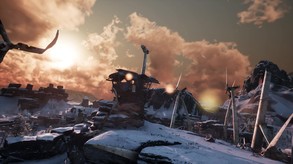
Fade to Silence is a single-player and co-op survival adventure set in a post-apocalyptic world that is frozen in an eternal winter. Snow and ice have shaped a merciless landscape. Nature is corrupted. Monstrous creatures out of an Eldritch horror dream roam the frozen wasteland.
Modeled estimate, not a reported figure. How we estimate →
Media

About
Genres
Stats
All-time low is the lowest price we've recorded for this game since we started tracking it.
Engagement
Hours played at review time, across 40 reviews with recorded playtime.
Reviews
Themes across 40 recent reviews and how positive each mention is. A keyword signal, not full sentiment analysis.
positive critical· bar length = how often the theme comes up
Reviews
Acayip kötü bir ambiyansı var. Farklılık olsun diye koyulan saçma sapan yaratıklar da olmamış. 5-10 dakika dayanamadım ya. Daha kötüsüne rastlamadım herhalde...Maalesef sayın yapımcılar, olmamış. Bunu kapattıktan sonra yeni aldığım Sons of Forest'e bir bakayım dedim... Mukayese bile edilemez, hakarettir. Saygılar
There's no one in the world who could make me start again everything from tutorial. No ***** way. Especially when I die because of the lousy, low responsive control mechanics. Nah. Instant delete.
👍🏻👍🏻
Fade to Silence, developed by Black Forest Games and published by THQ Nordic, is a survival game that leans heavily into atmosphere and tension, placing players in a frozen world where the environment itself feels like a constant, oppressive force. It blends open-world exploration, base management, and light narrative elements into a single experience that aims to capture both the physical and psychological strain of survival. What emerges is a game with a strong identity and clear ambition, though one that struggles at times to fully unify its ideas into a consistently polished whole. You step into the role of Ash, a survivor navigating a landscape locked in an endless winter, where basic necessities like warmth, food, and shelter become central concerns. The game immediately establishes a sense of vulnerability, not through overwhelming combat encounters, but through the quiet, persistent threat of the environment. Blizzards roll in with little warning, visibility drops to near zero, and the cold steadily drains your ability to function. These elements are not just visual flourishes—they directly impact gameplay, forcing you to plan routes carefully, manage resources, and constantly weigh risk against reward when venturing into the unknown. The survival mechanics form the backbone of the experience. Gathering materials, crafting tools, and maintaining your condition are ongoing priorities, and the game gradually expands this loop by introducing base-building and community management. Over time, you can rescue other survivors and bring them back to your camp, assigning them roles that help automate certain tasks or strengthen your position. This shift from individual survival to managing a small group adds a layer of strategy, as you balance your own needs with those of the community. While these systems are engaging in concept, they sometimes lack depth or clarity, leaving players to figure out their nuances through trial and error. Exploration plays a central role, with a large, snow-covered world divided into regions that must be carefully navigated. Traveling across this landscape is rarely straightforward, as environmental hazards, limited resources, and hostile entities all pose threats along the way. The use of sleds and companions gives these journeys a sense of scale and purpose, turning them into deliberate expeditions rather than casual wandering. However, the game often provides limited guidance, which can make progression feel uncertain. While this ambiguity can enhance immersion by reinforcing the sense of isolation, it can also lead to frustration when objectives are unclear or difficult to locate. Combat exists within this framework but feels secondary to the broader survival experience. Encounters with enemies can be tense, especially when resources are scarce, but the mechanics themselves are relatively basic. Attacks, dodges, and stamina management form the core of combat, yet the controls can feel unresponsive, and engagements sometimes lack the precision needed to feel consistently satisfying. As a result, players are often encouraged to avoid unnecessary fights, reinforcing the idea that survival is about endurance and caution rather than confrontation. One of the more interesting aspects of Fade to Silence is how it introduces risk through its progression systems. The game incorporates elements that increase the stakes of failure, encouraging careful decision-making and long-term planning. Combined with mechanics like base defense and environmental corruption, this creates a layered experience where multiple pressures are constantly at play. When these systems align, the game can feel deeply immersive, capturing the tension of trying to maintain stability in an unstable world. Atmosphere is where the game consistently excels. The frozen landscapes are bleak but striking, with shifting weather and subtle visual details creating a world that feels both beautiful and hostile. The presence of supernatural elements adds a layer of unease, giving the environment a sense of mystery that goes beyond simple survival. Audio design supports this effectively, using ambient sounds and minimalistic cues to reinforce the feeling of isolation. Even during quieter moments, there is an underlying tension that keeps players engaged. Visually, the game delivers mixed results. At times, the environments are impressive, with lighting and weather effects that enhance immersion. At other times, textures and animations feel uneven, revealing the limitations of its production. The interface and overall presentation are functional but not particularly refined, which can occasionally detract from the experience, especially when managing multiple systems at once. The game’s biggest challenge lies in how its ambition exceeds its execution. It attempts to combine several distinct genres—survival, base-building, exploration, and narrative—into a cohesive whole, but these elements do not always integrate smoothly. Some systems feel underdeveloped, while others are not explained clearly enough, leading to moments of confusion or frustration. The pacing can also be inconsistent, with periods of engaging activity followed by stretches where progress feels slow or directionless. Despite these issues, Fade to Silence offers something that many survival games struggle to achieve: a strong, memorable atmosphere that carries the experience even when its mechanics falter. It creates a world that feels genuinely hostile and isolating, and it asks players to adapt to that world rather than conquer it outright. For those willing to engage with its systems and overlook its rough edges, it provides moments of tension and immersion that are difficult to replicate. In the end, Fade to Silence is a game defined by its contrasts. It is compelling yet uneven, immersive yet occasionally frustrating, ambitious yet imperfectly realized. It may not fully deliver on all of its ideas, but it remains an experience that stands out for its tone and intent, offering a survival journey that feels as much about endurance as it is about exploration. Rating: 7/10
можно не плохо залипнуть в игре, чем то похожа на старые версии the long dark
nice
da sa
WOULD OF LIKE A LVLING SYSTEM BUT IT WORKS
trash game. after 3 hours i didnt know what to do
Interessantes Game . Hat mir gut gefallen und mich sogar ein /zwei mal erschreckt (klasse).
Related
Related
Trends
Modeled estimate over time, reconstructed from Steam's monthly review histogram.
Momentum
Pace estimated from the game's recent review growth (our daily snapshots) at its own sales-per-review ratio — a momentum signal, not booked sales.
Audience
Languages: English*, French, Italian, German*, Spanish - Spain, Polish, Russian, Japanese, Simplified Chinese*languages with full audio support
Estimated from the language of this game's reviews — a proxy for where players are, not official Steam demographics.
Related
| Field of Glory II: Medieval | $772.6K | 976 | 77% | $29.99 |
| Prey: Typhon Hunter | $772.6K | 860 | 33% | $39.99 |
| Darkest Hour: A Hearts of Iron Game | $772.8K | 2.1K | 90% | $9.99 |
| Dice Gambit | $773.1K | 1.1K | 88% | $24.99 |
| Thief Simulator VR | $771.9K | 1.5K | 69% | $19.99 |
| SPRAWL | $771.7K | 2.6K | 87% | $14.99 |
Related
| Grounded | $59.4M | 95K | 90% | $39.99 |
| Grounded 2 | $14M | 22.4K | 81% | $29.99 |
| How to Survive | $6.1M | 17.1K | 83% | $14.99 |
| HumanitZ | $4M | 13.6K | 74% | $12.99 |
| Dead Rising 3 Apocalypse Edition | $2.7M | 20.5K | 77% | $5.99 |
| How To Survive: Third Person Standalone | $269.4K | 1.1K | 57% | $9.99 |