Princess Daphne has been spirited away to a wrinkle in time by the Evil Wizard Mordroc who plans to force her into marriage. Only you, Dirk the Daring, can save her.
Modeled estimate, not a reported figure. How we estimate →
Media

About
Stats
All-time low is the lowest price we've recorded for this game since we started tracking it.
Languages: English*, French, Italian, German, Spanish - Spain*languages with full audio support
Engagement
Hours played at review time, across 81 reviews with recorded playtime.
Reviews
Themes across 81 recent reviews and how positive each mention is. A keyword signal, not full sentiment analysis.
positive critical· bar length = how often the theme comes up
Reviews
Более кинематографичная часть Dragon's Lair за счёт строго линейного связного набора частей. Сами части стали значительно длинней, но времени на реакцию даётся достаточно. Хороший мультик)
its a classic!
Legend
Dragon’s Lair II: Time Warp, developed and published by Digital Leisure Inc., is both a nostalgic return to one of gaming’s most unique eras and a testament to the enduring charm of Don Bluth’s animation. As the sequel to the legendary Dragon’s Lair, this title continues the tradition of interactive animation—a form that straddles the boundary between film and game. Originally conceived in the early 1990s and later brought to modern platforms like Steam through Digital Leisure’s remaster, Time Warp revisits Dirk the Daring, the bumbling but courageous knight who must once again embark on an improbable quest to rescue Princess Daphne. This time, however, the stakes are even higher, as Dirk must chase the evil wizard Mordroc through the twisting corridors of time itself before his beloved is forever bound to him by a cursed magical ring. The result is an eccentric, visually spectacular adventure that balances charm and frustration in equal measure. The first thing that strikes anyone playing Dragon’s Lair II today is how visually captivating it remains. Every frame of animation bursts with the hand-drawn artistry that defined Don Bluth’s studio, rendered with a vibrancy and expressiveness that few games before or since have achieved. The Steam version retains the fluid motion and cinematic flair of the original laserdisc release, now polished through high-definition restoration. Each of the game’s environments is distinct and imaginative, sending Dirk through historical and mythical eras—from the Garden of Eden and Beethoven’s music room to Wonderland and prehistoric lands filled with bizarre creatures. Every setting is packed with humor, color, and energy, making the game feel like an animated feature film that just happens to invite your participation. The accompanying soundtrack is equally animated, swelling with orchestral intensity one moment and cartoonish whimsy the next, perfectly complementing the kinetic chaos that unfolds on screen. Beneath its cinematic surface, however, Dragon’s Lair II reveals a gameplay structure that is both its defining feature and its greatest limitation. The game is not about exploration or open-ended decision-making—it’s a highly linear, reaction-based experience. The player is expected to press the correct directional input or action button at the exact right moment, responding to visual cues as Dirk faces one peril after another. Success moves the story forward, while failure triggers an elaborate death animation before forcing you to try again. The rhythm is relentless, and memorization becomes key; each sequence demands near-perfect timing and focus. This gameplay formula can be punishing for newcomers, especially since the correct moves are not always obvious, but it also creates a strange, hypnotic flow once mastered. For those willing to engage with its trial-and-error challenge, there is a distinct satisfaction in performing each scene flawlessly, almost as if one were directing a piece of animated choreography. One of the sequel’s defining innovations is the inclusion of hidden treasures that must be collected to unlock the game’s true ending. These treasures are tucked away within specific moments, forcing players to replay scenes and pay close attention to the visual details of each frame. While this adds a layer of replayability, it can also be a source of frustration, especially when missing a single treasure leads to an incomplete ending. Yet for completionists, this mechanic transforms the game into something akin to an animated scavenger hunt—an extra layer of challenge within the already demanding reflex-based framework. Modern ports by Digital Leisure mitigate some of these frustrations by offering optional on-screen prompts and adjustable difficulty settings, as well as a “Watch Mode” that allows players to simply enjoy the animation without worrying about inputs. These additions help preserve the spirit of the original while making it more approachable to contemporary audiences. Despite its dated mechanics, Dragon’s Lair II remains a fascinating artifact of game design. It belongs to a specific moment in history when developers were experimenting with how cinematic storytelling could merge with interactive play. The game’s rigid structure may feel archaic compared to today’s open-world epics, but its ambition and artistry are undeniable. Don Bluth’s team managed to craft something that was visually on par with Hollywood productions of its era, all while fitting within the constraints of arcade technology. The fact that this experience can still captivate players decades later speaks to its enduring aesthetic power. Even though it functions more as an interactive film than a traditional video game, it provides an irreplaceable link between animation, cinema, and gaming history—a precursor to modern narrative-driven titles that emphasize presentation and storytelling over pure mechanics. For players approaching Dragon’s Lair II on Steam today, expectations are everything. Those seeking a deep, skill-based adventure may find it repetitive and restrictive, but those who view it as a living piece of animation history will discover a unique and entertaining experience. The modern remaster retains the original’s personality while smoothing out its rough edges, offering both nostalgia and accessibility. Watching Dirk stumble, scream, and heroically flail his way through time remains endearing, and each death animation is so elaborately crafted that even failure feels oddly rewarding. It is less about control and more about rhythm, timing, and visual immersion—a collaboration between player and film. In the end, Dragon’s Lair II: Time Warp stands as a beautiful relic, a living museum piece from a bold period when games dared to imitate the grandeur of animated cinema. Its mix of humor, romance, and danger, wrapped in Bluth’s exquisite art, gives it an undeniable allure. While it may not satisfy modern expectations for interactivity or depth, it continues to offer a rare kind of spectacle—one where every scene, every frame, feels alive with hand-drawn vitality. It is best appreciated not as a conventional game but as a performance, where your input becomes the conductor’s baton guiding a cartoon symphony through chaos and love across time. Rating: 7/10
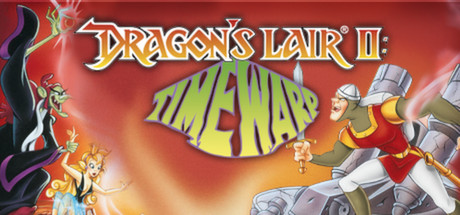
Dragon's Lair II: Time Warp is the Sequel to the original Dragon's Lair...and succeeds at that! Dragon's Lair II works just like the first one, where you have to make the right choice at the right time without messing up. What Dragon's Lair II does better than the first one, though, are the Stages. This time, there are only about 8 stages which are all connected. These are MASSIVE. Don Bluth had more time with the Stages and was able to be more creative, as now Dirk has to go to different timezones to collect treasures with the help of an speaking time machine. If that doesn't sound crazy enough, the Stages are even more crazy, with having to make a move seemingly every second, as there is a lot of stuff happening. Luckily, Don Bluth always highlighted most of the moves you were required to do, and many that weren't were obvious. A Stage alone could take 10 minutes to beat, as the setpieces are huge. Speaking of setpieces, these are: The Dragon's Lair (with Singe's skeleton being in the background, cool detail), the first encounter with Mordrock, Daphne's new kidnapper and the original owner of the Castle, Alice in Wonderland (which is somehow a time period and is very reminicent of Disney's Alice in Wonderland), Garden Eden (Adam and Eve are even in it, just not biblically accurate), Giant Beethoven (once again, how is this a time period?) Ancient Egypt and last but not least: the Final Stage with Mordrock. There was also a Pirate Stage planned but got canned. You can even see a Pirate flag when Dirk gives all the collected treasure to his kids (he has like 10 of them, truly a busy man Dirk must be) which is clearly a leftover. Yeah, really. When I said this game's stages were massive, I meant it! The Animation once again is done by Don Bluth and is a clear step-up from the original. It's more detailed and impressive, showing how just great of an Animator Don Bluth truly is. Even though the Gameplay stayed the same, there is a new mechanic: the treasure! Treasure is collected in each stage, which is required to progress to the final stage. This got dumped in the Home Computer ports of Dragon's Lair II (which are not worth checking out). Back to the treasure: There are about 11 treasure pieces to collect throughout the stages. These are: an Arrow, a Bow, a Key (another reference to the first Dragon's Lair as it is the Key Singe wears around his neck), an Egg, an Ace, an Hammer, a Butterfly, two golden Apples and an Hourglass. Whenever the player didn't collect all the treasure, he has to start over again and try to collect all the treasure once more. The Steam Port, however, will save the treasure you already collected and will only require you to collect the treasure you missed. It's an interesting mechanic that isn't immidately known, as the treasure is easy to miss on a first playthrough. Dragon's Lair II: Time Warp was really succesful at the time of it's release, being the Nr. 1 Arcade Game in November of 1991. The first Dragon's Lair released 1983. That was 8 Years after the first Dragon's Lair Game! Not surprising considering of the huge setpieces, Don Bluth's beautiful Animation and improved gameplay, which makes Dragon's Lair II: Time Warp worthy of an try if you enjoyed the first one. Don Bluth nailed it once again.
this game is a wonder we control the anime like if we control for real the character the concept is incredible and the graphism are wonderfull i would love to see more than the 3 games i love this game my favorites of the serie but i love too the two others the game creators of this game has created the first and last anime games we can control or i miseed games i recommand a lot this is a wonder if you like anime the only bad thing is when we finish such wonder we would love to have more but nobody suuceed to create more than this serie of three incredible anime games
:: LaserDisc - 1983 - Don Bluth ::
Too fast. you either follow the move guide or the screen. The original was at least paced so you could follow both.
Dragon's Lair 2 is a great experience. It's not like most games these days, but I still enjoyed playing it a lot when I used to play it as a kid. The version I played back then was a cheap port to the PC and even that version was like heaven when compared to this piece of trash. Pros: + It has high resolution video + DL2 is just a fun game to play / unique experience to be had on it's own + The featured animation of the cut pirate stage was a nice addition Cons: - The "director's cut" is a joke. Literally all they did was [i]cut[/i] the final boss from the game, making it anticlimactic and far less fun to play. - The game straight up doesn't work with keyboard controls. You [i]have[/i] to use a controller, because for some reason it only picks up every 10th key-stroke. - The game doesn't save properly (most of the time you can't restore a game anymore and it doesn't remember your settings). - The Settings can not be changed mid game. - The game crashed on me a couple of times. - The user interface sometimes works. - The game is way overpriced, even when it's on sale for 5€. - There are way too few achievements. - There is no way to turn off the movement-guide overlay, even when movement guiding is turned off. From a programming standpoint, making a game like this is as easy as it gets. And I have no idea how they even managed to screw this up so bad. If this is version 2.0.0, I don't want to know what 1.0 was like.
Like Space Ace and the first Dragon's Lair, Dragon's Lair 2 has the same quick-time event-style gameplay, so if you've enjoyed your time with the other two games, this one should be an easy buy as well. The same fantastic animation by Don Bluth is present in this game as well, and it's still just as much fun to watch everything, even the deaths. That said, there's a lot of things that improve the game compared to its predecessors as well. The flashing lights are always present to tell you which action to take, rather than only sometimes, so a lot of the frustration when playing without a move guide is gone. One could argue this frustration is replaced with having to find secret treasures throughout the game or else repeat the whole story again, but most of them are relatively easy to see, and the game is pretty generous with telling you where they are with the flashing lights. There is also a lot more generosity in the timing of the action prompts: mashing the buttons until an action is taken seems to actually work in this one compared to the stricter timing in the first Dragon's Lair. Finally, the new locations are incredibly diverse and interesting, ranging from standard time travel locations like Prehistoric Times and ancient Egypt to more out there locations like the Garden of Eden or during a piano performance by Beethoven. Like all other games in the Dragon's Lair Trilogy, however, this game is incredibly short if one knows what they're doing. Ultimately, it comes down to how much you like the gameplay and animation of these types of games. Personally, I'd recommend them due to my own enjoyment with them, even if I've never played them before. There really aren't many games like these, and I think the uniqueness and charm of the experience alone is worth the sale price.
Related
Related
Trends
Modeled estimate over time, reconstructed from Steam's monthly review histogram.
Audience
Audience
Estimated from the language of this game's reviews — a proxy for where players are, not official Steam demographics.
Games most often reviewed by the same players — an audience-affinity signal from our review sample, not full ownership data.
Related
| Culpa Innata | $33.1K | 118 | 75% | $9.99 |
| Welcome to the Adventurer Inn! | $33.1K | 118 | 63% | $9.99 |
| Paper Beast | $33.1K | 700 | 94% | $1.99 |
| Hitler Hates Anime | $33.1K | 658 | 93% | $1.99 |
| 120 Yen Stories | $33.1K | 85 | 98% | $19.99 |
| Aveyond 4: Shadow of the Mist | $33.1K | 93 | 90% | $14.99 |