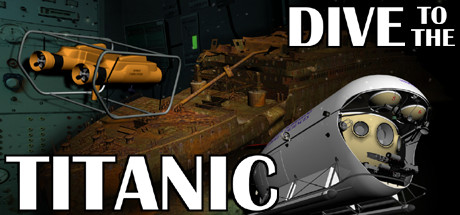
100 years after the tragic sinking of the Titanic, re-discover this epic maritime story and explore the wreck 100 years later.
Modeled estimate, not a reported figure. How we estimate →
Media

About
Genres
Stats
All-time low is the lowest price we've recorded for this game since we started tracking it.
Languages: English
Engagement
Hours played at review time, across 40 reviews with recorded playtime.
Reviews
Themes across 40 recent reviews and how positive each mention is. A keyword signal, not full sentiment analysis.
positive critical· bar length = how often the theme comes up
Reviews
Dive to the Titanic, developed by TML-Studios and published by Astragon Entertainment, is a deep-sea exploration simulator that attempts to transform one of history’s most haunting tragedies into an immersive, interactive experience. Released in 2010, the game invites players to pilot a submersible thousands of meters beneath the Atlantic Ocean to explore the wreck of the RMS Titanic. Rather than focusing on action or spectacle, it emphasizes realism, atmosphere, and the quiet, eerie majesty of deep-sea archaeology. The concept is immediately compelling—a digital expedition into one of the most famous and mysterious shipwrecks ever discovered—but the execution reveals both the ambition and the limitations of early simulation design. The premise places the player in control of a research mission charged with investigating the Titanic’s remains, cataloging artifacts, and documenting the wreck through photographs and data collection. Before each descent, you prepare your submarine by checking oxygen levels, power reserves, and camera equipment. Once submerged, the game slows to a deliberate, almost meditative pace as you descend into the dark ocean depths. The lighting fades gradually, the pressure increases, and the hum of the submarine’s engines is the only sound until the silhouette of the Titanic emerges from the darkness—a breathtaking and haunting sight that remains one of the game’s most memorable moments. The developers clearly intended for the experience to feel reverent rather than sensational, capturing the solemn weight of the Titanic’s resting place rather than turning it into a playground for exploration. The game’s most striking strength lies in its atmosphere. The deep-sea environment is dense and claustrophobic, with visibility limited to the faint cone of your searchlights. The Titanic herself is modeled with care: her broken hull, rusted decks, and eerie stillness create a sense of tragic beauty. The slow, methodical pace enhances the immersion for players willing to approach it as an expedition rather than a traditional game. The sound design complements this perfectly—soft mechanical hums, distant metallic creaks, and occasional sonar pings create an almost meditative tension. For brief moments, Dive to the Titanic achieves what few games manage: the illusion of real scientific exploration, of discovering something sacred and long forgotten at the bottom of the ocean. Unfortunately, while the concept and atmosphere are impressive, the gameplay struggles to maintain the same level of engagement. Movement controls are heavy and unresponsive, making navigation cumbersome. The submarine feels sluggish, and the camera system often works against you, leading to frustration when trying to maneuver through the wreck’s tight spaces. Objectives, though thematically appropriate, are repetitive—taking photos, collecting artifacts, and returning to base. The lack of meaningful interaction within the wreck undermines the potential sense of discovery; most of the ship’s interior feels empty, and many missions reduce to slow treks from one marker to another. What could have been a tense archaeological adventure instead becomes a test of patience. Technical limitations also hurt the experience. Even for its release era, the visuals were uneven: while the submarine and Titanic models show impressive effort, the water effects and lighting lack the nuance needed to convey true underwater realism. The game’s pacing compounds these issues, with long stretches of waiting or traveling broken only by small bursts of interaction. The absence of significant narrative elements or voiceovers means there’s little emotional context driving the player forward beyond personal curiosity. The simulation framework, while authentic in concept, sometimes feels more like a technical demo than a fully realized experience. Yet, despite these flaws, there is an undeniable fascination in what Dive to the Titanic attempts to do. For players interested in maritime history or deep-sea exploration, it offers something unique: the chance to sit in the pilot’s seat of a submersible and personally witness the decaying grandeur of a ship that has captured the world’s imagination for more than a century. The game’s slow, quiet pacing can feel therapeutic for those seeking a meditative experience rather than an adrenaline rush. There are moments—when your lights sweep across the Titanic’s grand staircase or when you drift silently past a piece of debris resting in the silt—that evoke genuine awe. It’s in those moments that the game transcends its mechanical shortcomings and reminds players why the Titanic remains such a powerful symbol of human ambition and fragility. Dive to the Titanic is, in many ways, a product of its time: ambitious, atmospheric, and imperfect. It aimed to deliver a respectful, realistic underwater experience long before technology could fully realize that vision. Its appeal lies not in dynamic gameplay or high-end visuals, but in the feeling of presence it creates—a contemplative journey through darkness and history. While its rough edges, sluggish controls, and repetitive objectives may deter casual players, those with patience and a fascination for the Titanic’s legacy may find something hauntingly beautiful beneath its surface. It’s a flawed but sincere attempt to turn exploration into an act of remembrance, inviting players to dive not just into the ocean, but into one of humanity’s most enduring stories of wonder and loss. Rating: 4/10
spel werkt niet ook al heb je QuickTime Player die het spel je aanbied
10/10 for realism, my submarine imploded whilst looking for the Titanic. Jokes aside, this game sucks, don't waste your money on it
Esta bastante curioso, es muy lento y relajante.
Sound: 6 Graphics: 5 Story: 10 Gameplay: 6 Commands: 5 Fun: 7 Time to load / lag: 9 Bugs / Problems: 8 Final score: 6
Lo recomiendo!. El juego es un poco antiguo pero la experiencia es muy buena. Es muy realista y de verdad que parece que estás dentro del Titanic.
Just giving anyone considering the game a heads up "WARNING" the game don't work so don't waste money on it. I'm only out a little over $0.99 I take the loss, and not even bothering with a refund I would rather call it a Christmas donation.
ik heb dive to the titanic gespeeld op windows xp super gaaf en nu op windows 11 nog steets super gaaf ik zou een remake maken met zee leven erbij om nog spanender te maken met haaien en kwallen erbij m ischien murenen mischien met de beelden van nu erbij om nog levender te maken sonde van al die negetieven reakties voor echte duik fans zou het een ultieme game zijn aanrader zeker wel
Lets get this to overwhelmingly negative.
just good
Related
Related
Trends
Modeled estimate over time, reconstructed from Steam's monthly review histogram.
Momentum
Pace estimated from the game's recent review growth (our daily snapshots) at its own sales-per-review ratio — a momentum signal, not booked sales.
Audience
Estimated from the language of this game's reviews — a proxy for where players are, not official Steam demographics.
Related
| Inquisitor | $41.2K | 697 | 69% | $2.49 |
| Theatre of War | $41.2K | 373 | 62% | $3.99 |
| Serum: Toxic Survival | $41.2K | 305 | 50% | $6.24 |
| MAHOUTEQ! | $41.2K | 1.3K | 100% | $1.99 |
| White Wings ホワイトウィングス | $41.3K | 147 | 44% | $19.99 |
| SKIBIDI: ESCAPE FROM TOILETS! | $41.3K | 443 | 69% | $4.99 |