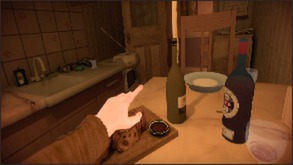
Dinner Date is an experimental game, pushing at the edges of what a game can be. You play as Julian Luxemburg, a 27 year old British man who has been set up on a date with a 20 year old Japanese woman named Meiko. As the evening wears on, it becomes clear that Meiko will not be arriving for that date, leaving Julian alone with his thoughts.
This is not a game with gameplay in the traditional sense. While the player can move Julian’s arms through a series of keyboard inputs and decide how much bread Julian eats or how much wine he drinks, none of these progress the gameplay in any way. The only progression through the game is the slow tick of the clock above the table and the meandering of Julian’s thoughts through possibilities, fears, and sorrow.
It’s not a happy game in any way. It’s an experiential game, meant to convey a specific narrative and sensation of being engrossed in that narrative, and a way to experience an event in a safe and empathetic way.
It’s in the assumptions this game makes about the universality of the experiences it depicts that I really struggled and why, perhaps, the game fell flat for me. Rather than empathising with Julian, I felt a softer version of what I felt when I played [url=https://steamcommunity.com/profiles/76561198031223198/recommended/520720/] Dear Esther. [/url] I felt unsafe, unclean, and grateful that Meiko never turned up to this unsettling evening.
In [url=https://www.npr.org/sections/alltechconsidered/2010/10/18/130646920/dinner-date] interviews [/url] he’s given about the game, Dinner Date’s creator, Jeroen Stout, described the game as an opportunity “to sympathize with someone who is slowly consumed by a sense of inadequacy” and a space to explore “things you can’t tell your friends.” This is fundamentally a game built around empathy and around having an unsafe experience in a safe space, and thus gaining a bit of empathy and a taste of the experience for oneself. Whether the game succeeds or fails at its goal is entirely contingent on well it builds the reality of the story and allows the player to inhabit this fundamentally unpleasant place. To be clear, with what little gameplay, graphics, and general interactivity Dinner Date has, it does a good job of drawing the player into the narrative. Throughout the game’s brief runtime, there is a decided sense of claustrophobia and anxiety as it becomes clear how much the player is trapped in this evening gone wrong. The glasses of wine and cigarettes only highlight the cycle of bad decisions that led to this point, and which will probably lead to more like it.
As well as the game does with crafting a setting, though, what it didn’t succeed in doing was making me feel sympathy for Julian. Julian’s monologue about his life has the dual function of both creating a sense of anxiety and self-loathing, and telling a story - however brief - of who he is and how he got here. He talks about how he got to this point, his fears and doubts, and what he wanted with the evening.
In doing so, this stopped being a game I could see myself in. Instead, I saw the mind of every man who has harassed me in the street, the ones who would not stop pestering me for my number, the ones who followed me home and made me feel unsafe. In listening to Julian’s monologue, I saw a bit more of the truths of the men who believed themselves to be entitled to my company, and I did not sympathise with them.
That Stout hopes Dinner Date captures some degree of universality and expects empathy worries me.
It’s hard to put my finger on what exactly makes me uncomfortable about Julian Luxembourg. It may be that he is 27, waiting for a 20 year old woman to come into his apartment so he can have sex with her. It may be how he softly rages when she doesn’t appear, mentally accusing her of sleeping around. It may be the way he repeats that he “deserves” this over the course of the evening, though whether that “this” is the date or the sex is unclear. It may be the way he continues to sit at the table for hours, staring at the door after it’s long become apparent she’s not coming. It may be that he doesn’t call her and instead prefers to linger in the fantasies of what-ifs rather than engaging with her as a person. It’s this long medley of thoughts and actions that sent my hackles up and made me feel uncomfortable to be in this man’s skin. If there is a universality to his thoughts about being stood up, it’s not one I identify with. It’s entirely possible that universality is a male one, but even then, I would hate to believe that the universal male experience is to mentally slut shame a significantly younger woman for not coming to a late evening at an older man’s apartment.
If the idea of the game is to make me feel empathy as a man spirals into self-loathing, it fails. I see the self-loathing, but the way it manifests is toxic. Self-loathing has a tendency towards toxicity, sure, but that toxicity isn’t inherently misogynistic. There are ways to tell this story that make it actually universal and actually generate some degree of empathy. The story told here is an explanation rather than an event.
I think, too, this game hits a bit differently, given that I played it the day before getting stood up on a date of my own. It’s in the comparison of my experience and thoughts and Julian’s that the ideas and goals of this game ring truly hollow.
My potential date was meant to meet me for coffee. It was supposed to be the first date I’d been on in years. I went across the city to meet her, fiddling with my nails, my hair, my clothes, my phone on the metro the whole way. She e-mailed me as I was arriving at the coffee shop, telling me she wasn’t going to be able to make it, and I was left there, standing outside the coffee shop, unsure of what to do with my now empty afternoon.
I got a cup of tea, sat down, and finished the book I’d been trying and failing to read on the metro.
As I sat and read and drank my tea, I thought through the things that had brought me to that point. I thought about my nervousness about the date, and about the woman I was planning to meet. My mind ran back through all the things I’d planned to talk about, all the jokes I’d tell, and all the things I’d imagined she’d say that I would laugh at and sympathise with in turn. I played through the scenarios I’d imagined, then set them all aside. I did not know why she’d cancelled on me. I wasn’t going to ask because her business was her own. All that mattered was that there was no date, and it was up to me to decide how to move on from that. I could linger, and in so doing, accomplish nothing but misery for everyone, or I could go on with my life, and she hers.
I drank my tea. I went home. I moved on.
This story of my own date is not necessarily a better version of the story Stout chose to tell. However, that it’s a different story speaks volumes about the story he is telling, and about the ideas he believes are inherent. I recognise that my experience as a woman may colour my views on dating and male toxicity. That this is a game meant for men and the male dating experience, and I will therefore never actually be able to find myself in it is an entirely valid possibility. If that is the case, it works, and I humbly accept that, as a non-male, I do not have a clear window on the male experience.
However, if this is a game offering universality and a generally understandable portrait of empathy, it’s worth considering why it doesn’t work from my female perspective. In being locked in Julian’s narrative, I think of my own narrative and though processes. I compare our paths, and to compensate for my own failings, I critique his. I find him wanting, perhaps as a solace to myself, and perhaps as a subjective truth, but I find his is not a head I feel safe in.
We can be sad. We can feel pain. It doesn’t have to be at the expense of others.