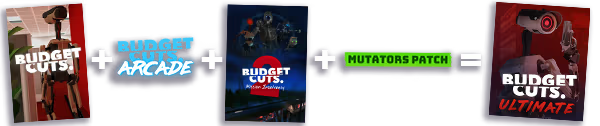
Enter a VR stealth game as the last human amidst robot managers programmed to 'optimize' the workforce. Escape the office alive by sneaking past enemies or unleash a fistful of knives, quivers of arrows, grenades, and coffee mugs onto their unsuspecting circuits!
Modeled estimate, not a reported figure. How we estimate →
Media

About


Stats
All-time low is the lowest price we've recorded for this game since we started tracking it.
Languages: English*, French, Italian, German, Spanish - Spain, Japanese, Russian*languages with full audio support
Engagement
Hours played at review time, across 41 reviews with recorded playtime.
Reviews
Themes across 41 recent reviews and how positive each mention is. A keyword signal, not full sentiment analysis.
positive critical· bar length = how often the theme comes up
Reviews
Однозначно рекомендую! Весело, с сюжетом, интересная и приятная глазу графика. Фишки тоже прикольные
Bomboclat (too puzzel-ey also movement is weird)
Не знал что Адам Смешер впервые появился здесь
Прикольная но хардкорная игра. Попробовать в любом случае стоит, так как трилогия стоит смешных 400 рублей.
Budget Cuts Ultimate is a virtual reality stealth adventure developed and published by Neat Corporation that combines the original Budget Cuts and its sequel into a single package designed to showcase the strengths of immersive VR gameplay. Built around stealth, environmental interaction, puzzle-solving, and creative movement systems, the game places players inside a strange corporate future where robotic workers dominate enormous office complexes and humanity has seemingly disappeared into the background. Rather than relying on fast-paced combat or spectacle-driven action, Budget Cuts Ultimate builds tension through exploration, observation, and careful decision-making, creating a VR experience that feels uniquely designed for the platform rather than adapted to it. The setting immediately establishes an unusual atmosphere. Players find themselves trapped within sprawling corporate facilities operated entirely by machines. Endless office spaces, production sectors, maintenance areas, and industrial environments create a world that feels sterile on the surface but increasingly unsettling beneath its polished appearance. Small environmental details gradually reveal larger mysteries surrounding the fate of human workers and the systems controlling these enormous robotic workplaces. Storytelling unfolds naturally through exploration rather than overwhelming players with lengthy exposition. The world communicates much of its narrative through atmosphere and discovery. As players move deeper into restricted facilities, hidden information and environmental clues slowly build understanding surrounding the strange corporate reality driving the game’s setting. This slower narrative approach fits the experience well because discovery becomes part of progression rather than existing separately from gameplay. Movement mechanics become one of Budget Cuts Ultimate’s defining strengths. Instead of traditional movement systems alone, the game introduces portal-based teleportation that fundamentally changes how players approach exploration and stealth. Players can project portals into distant locations to preview environments before committing to movement. This creates an important strategic layer where observation becomes just as valuable as action. The portal system accomplishes several goals simultaneously. It reinforces stealth mechanics by encouraging players to scout dangerous areas carefully. It supports puzzle-solving by expanding movement possibilities. Most importantly, it strengthens immersion while reducing motion discomfort often associated with virtual reality movement systems. The mechanic feels remarkably natural and remains engaging throughout the experience. Stealth forms the foundation supporting nearly every major gameplay system. Robotic security units patrol facilities constantly, forcing players to think carefully about movement and positioning. Charging directly into danger rarely ends well. Instead, success comes through patience, environmental awareness, and understanding enemy behavior patterns. Every hallway becomes a space to evaluate. Every encounter encourages planning before execution. The tension created by stealth systems works especially well inside virtual reality because physical presence strengthens immersion considerably. Leaning around corners, hiding behind objects, and carefully observing enemy patrol routes creates a level of engagement difficult to replicate outside VR. Players become more invested because danger feels immediate rather than distant. Combat exists alongside stealth but intentionally avoids becoming the central focus. Weapons and throwable tools provide defensive options when situations become dangerous, but direct confrontation often introduces additional risks. Combat interactions benefit heavily from virtual reality controls, requiring physical precision and deliberate movement rather than relying entirely on simple inputs. Environmental puzzles contribute additional variety throughout progression. Locked systems, security obstacles, navigation challenges, and interactive environments regularly interrupt straightforward exploration. Puzzle complexity generally prioritizes pacing and immersion over extreme difficulty, creating satisfying moments of problem-solving without disrupting momentum. One of the strongest accomplishments of Budget Cuts Ultimate lies in how naturally all its systems connect together. Exploration reinforces narrative discovery. Movement systems strengthen stealth gameplay. Puzzle mechanics support progression without feeling disconnected from the setting. Virtual reality interaction consistently feels meaningful rather than existing simply to justify VR hardware. Environmental design deserves particular recognition. Office spaces and industrial environments maintain strong visual identity while encouraging curiosity. Hidden pathways, overlooked rooms, and smaller discoveries reward players willing to move carefully and explore thoroughly. The corporate setting remains visually memorable because environments constantly reinforce themes surrounding automation and control. The visual presentation itself balances style and readability effectively. Virtual reality games depend heavily on environmental clarity, and Budget Cuts Ultimate handles this requirement well. Important objects remain easy to identify while robotic enemy designs communicate threats clearly without sacrificing personality. Audio design strengthens immersion significantly. Mechanical sounds, distant movement, machinery noise, and environmental effects contribute heavily toward building atmosphere. Sound frequently becomes an important gameplay tool as well, helping players identify nearby threats or understand environmental activity before directly encountering danger. The inclusion of both major entries inside a single package substantially improves value and overall experience quality. The original Budget Cuts establishes core systems effectively, while Budget Cuts 2 expands scale and introduces additional content that builds naturally upon established mechanics. Together, they create a fuller experience that showcases the evolution of the series. The game occasionally reveals smaller limitations during longer play sessions. Certain stealth scenarios begin feeling familiar over time, and players looking primarily for action-heavy virtual reality combat may occasionally find the slower pacing restrictive. Combat systems function well, but stealth consistently remains the stronger gameplay element. Despite these minor issues, Budget Cuts Ultimate succeeds because it fully understands the advantages virtual reality provides. Presence matters. Spatial awareness matters. Physical interaction matters. Neat Corporation builds nearly every mechanic around those strengths rather than forcing conventional gameplay ideas into VR spaces. Budget Cuts Ultimate delivers an immersive and creative stealth experience that remains one of the stronger examples of thoughtful virtual reality design. Through clever movement systems, atmospheric world-building, satisfying stealth mechanics, and meaningful interaction design, it creates an adventure that feels distinctly suited for VR rather than simply playable within it. Rating: 8/10
W game
One of the best single player VR games.
I enjoyed the games but as other reviews have pointed out: there are quite a few levels with bad design such as the factory or the one with the note under the chair. This is a port of a port and the lighting was redone for the Quest version so it looks very over-bright and non-atmospheric in a lot of areas compared to the originals. It offers a nice transition between the two games but that's about all I can think of. If I knew about the lighting situation I would've bought the originals but they're a bit pricier than here. I like the teleport mechanic but it wasn't all too unique at the time. Pick up and play if you don't mind some of the shortcomings over the originals and want something a little cheaper.
adam is scary
one of my fav vr games ever but id recommend getting both games separately the remaster kinda buns
Related
Related
Trends
Modeled estimate over time, reconstructed from Steam's monthly review histogram.
Momentum
Pace estimated from the game's recent review growth (our daily snapshots) at its own sales-per-review ratio — a momentum signal, not booked sales.
Audience
Estimated from the language of this game's reviews — a proxy for where players are, not official Steam demographics.
Related
| ALONE IN SPACE | $29.7K | 157 | 54% | $9.99 |
| My MILF Stepmom: Free Use💋 | $29.7K | 119 | 76% | $6.99 |
| Legends of Immortality | $29.7K | 87 | 49% | $8.99 |
| Home is Where One Starts... | $29.7K | 583 | 78% | $2.99 |
| My Exercise | $29.7K | 442 | 93% | $3.99 |
| Drunkn Bar Fight 2 VR | $29.7K | 64 | 50% | $12.99 |