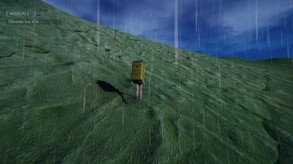
ANIME STANDING, developed and published by Konnichiwa Games, is a strange, self-aware, and purposefully absurd indie game that mixes parody, open-world exploration, and minimalistic gameplay in an experience that is as confusing as it is oddly compelling. Released as a clear homage—and perhaps a tongue-in-cheek satire—of big-budget titles like Death Stranding, it reimagines the “delivery simulation” formula through the lens of anime culture, low-budget humor, and surreal design choices. Rather than trying to compete with large-scale productions, the game thrives on its deliberate lack of polish and over-the-top absurdity, leaning fully into its meme-inspired concept to create something that feels more like a digital inside joke than a traditional video game.
At its core, ANIME STANDING is about walking, delivering, and existing within a bizarre, lonely world. Players take on the role of an unnamed delivery agent whose goal is to transport packages between outposts scattered across an open landscape. The tasks are straightforward—pick up an item, trek across strange terrain, drop it off—but the experience is less about the destination and more about the strangeness encountered along the way. The environments are sparse and often surreal, blending anime character designs with empty, dreamlike landscapes. The game’s simplicity makes it easy to grasp, but the underlying humor and randomness keep players intrigued just long enough to see what absurdity comes next.
Visually, the game embraces a mix of anime-inspired character models and intentionally crude environmental design. There’s a disorienting contrast between the bright, stylized characters and the desolate world they inhabit, giving the impression of an unfinished dreamscape. The textures are basic, the lighting flat, and yet the simplicity contributes to its charm—it feels deliberately unrefined, as if mocking the hyper-detailed realism of major releases. The camera work is functional at best, but the exaggerated animations and awkward transitions add a comedic edge. The aesthetic may not appeal to players looking for technical artistry, but it captures the strange sincerity of a developer committed to parodying rather than perfecting.
The soundtrack and sound design further reinforce the game’s absurd tone. Melancholic background music plays against the bizarre visuals, creating an odd emotional disconnect that makes the world feel both eerie and amusing. Character voices, when they appear, are often exaggerated or poorly mixed, as if to emphasize the game’s tongue-in-cheek tone. This clash of seriousness and silliness defines the experience—nothing quite fits, yet everything feels intentionally placed to provoke reaction rather than immersion.
In terms of gameplay mechanics, ANIME STANDING is minimalistic to the point of being meditative. There are no combat systems, skill trees, or complex interactions. You walk, deliver, and occasionally interact with environmental elements. The addition of optional downloadable content that allows players to leave messages for one another hints at an attempt to emulate community-driven systems from larger games, but it remains a small, novelty feature. The game’s charm lies not in challenge or progression but in its willingness to exist as something bizarrely self-aware. The open-world setting feels empty, but that emptiness becomes part of the humor—it’s an exaggerated imitation of games that take themselves too seriously.
The narrative, if one can call it that, is intentionally cryptic and fragmented. There are hints of a post-apocalyptic world and references to some greater purpose, but the story is mostly secondary to the atmosphere of absurdity. The writing oscillates between mock seriousness and anime melodrama, often delivering dialogue that feels both dramatic and nonsensical. Players are never quite sure whether the game is trying to make a point or simply making fun of the concept of having one. This ambiguity, while frustrating to some, gives the game a peculiar sense of personality—it’s as if it’s daring the player to take it seriously.
As an overall experience, ANIME STANDING is difficult to categorize. It’s part walking simulator, part visual parody, and part performance art. The gameplay loop is shallow, the technical execution rough, and yet it possesses a kind of unintentional brilliance through its bold disregard for convention. It’s not designed to impress but to amuse, to confuse, and to make the player question what they’re even playing. For some, it will be an unplayable joke that overstays its welcome within minutes; for others, it’s an oddly fascinating experiment in absurdist game design.
Ultimately, ANIME STANDING exists as a testament to how far creativity and humor can go when freed from expectation. It’s not a good game in any traditional sense—its mechanics are repetitive, its visuals unpolished, and its world largely empty—but it’s memorable precisely because of these flaws. It plays like a parody of modern gaming’s obsession with meaning and grandeur, stripping those elements down to their most ridiculous form. For players who enjoy experimental, meme-infused curiosities and can appreciate humor born from chaos, ANIME STANDING offers a brief but unforgettable detour into the bizarre corners of indie game development.
Rating: 8/10