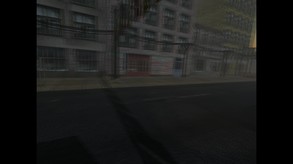
All Alone: VR, developed by 8bit and published by Bitlock Studio, is a compact virtual reality horror experience that immerses the player in a chilling and desolate environment. Released on Steam in 2017, it places you in the middle of a deserted town with no clear explanation of how you arrived there and no visible life anywhere around you. Your only tools for survival and discovery are a flashlight to pierce through the oppressive darkness and disembodied voices that echo through the empty streets, guiding—or perhaps deceiving—you as you search for a way to escape. The simplicity of this premise belies the tension that builds throughout the game, as the quiet atmosphere and lack of direct exposition create a pervasive sense of dread. The design relies not on elaborate jump scares but on slow, deliberate psychological unease, making every shadow and whisper feel significant.
The greatest strength of All Alone: VR lies in how effectively it uses its minimalism to create an immersive experience. The first thing players will notice is the oppressive silence punctuated by ambient noises: the hum of electrical wires, the crunch of gravel underfoot, the distant howl of wind through hollow streets. These elements come together to simulate true isolation. Unlike more action-oriented horror games, this one emphasizes atmosphere over conflict. The flashlight, your sole companion, becomes an extension of your fear—its narrow beam of light illuminates fragments of the world while leaving most of it swallowed in shadow. Every corner you turn feels uncertain, and the faint voices that seem to call from nowhere deepen the paranoia that perhaps you are not as alone as the title suggests. The slow pacing and darkened world encourage you to take your time, but the constant uncertainty ensures that comfort never fully returns.
In terms of structure, the game functions as a first-person exploration puzzle, with objectives centered on finding keys, activating hidden mechanisms, and navigating blocked pathways. There is no combat, no elaborate interface, and no narrative dialogue beyond what you infer from the environment and the haunting voices that beckon you. The gameplay loop revolves around exploration and discovery rather than action, and this focus works well within VR. The lack of explicit instructions adds to the unease, forcing players to rely on observation and intuition. While the world is not vast, it is detailed enough to evoke a believable sense of place—a forgotten town filled with derelict buildings, flickering streetlights, and the remnants of civilization long abandoned. The immersive qualities of VR amplify this sense of place, making it feel as if you are truly standing within its cold, empty streets.
Visually, All Alone: VR achieves a surprising amount with limited resources. The textures and models are not high-end, yet the lighting and use of fog create a convincing and oppressive mood. The color palette is dominated by greys, browns, and muted blues, emphasizing decay and hopelessness. The flashlight’s beam cuts through this darkness in a way that feels tactile, enhancing the immersion that VR can uniquely provide. Sound design plays an even greater role in maintaining tension. The ambient noises are subtle but precise, with every creak, whisper, and gust of air contributing to the uneasy atmosphere. The game uses stereo sound positioning to great effect, allowing the player to instinctively sense direction through auditory cues. When the mysterious voices whisper close to your ear or echo from afar, the sensation feels disturbingly real, fully exploiting the spatial audio capabilities of virtual reality.
Despite its effective mood-building, the game’s limitations are noticeable. The controls, while functional, lack the refinement found in more polished VR titles. Movement is achieved through traditional analog walking rather than teleportation, which can cause motion sickness for some players. Object interaction occasionally feels awkward, as picking up items or triggering mechanisms may not always respond smoothly. The simplicity of its puzzles can also work against it, as players who expect a deeper or more varied challenge may find the gameplay repetitive after the initial tension wears off. Once you understand the rhythm of exploration and how the game’s scares operate, the mystery begins to lose some of its intensity. Moreover, at under an hour in length, All Alone: VR is a brief experience that ends just as its atmosphere reaches its peak. For those looking for a longer, story-driven horror adventure, it may feel too fleeting.
However, the game’s brevity and focus also serve as part of its charm. All Alone: VR feels designed to be experienced in a single sitting—a concentrated dose of isolation and suspense rather than a prolonged narrative. Its minimal approach is reminiscent of short horror films or urban legends told through immersive means. In this sense, the title succeeds in its goal: to make the player feel vulnerable and uncertain in an unfamiliar, hostile environment. The lack of direct exposition or traditional storytelling leaves much to interpretation, which can make the experience linger in your mind after you’ve finished. It’s less about resolution and more about the journey through fear and solitude.
For an indie VR release, All Alone: VR delivers exactly what its name promises. It encapsulates the essence of loneliness and fear in a confined space, using the strengths of virtual reality to heighten every sensation. While it may not boast the complexity or technical sophistication of larger VR horror productions, its deliberate simplicity works to its advantage. It succeeds by understanding that the scariest thing in horror isn’t what you see, but what your imagination fills in when you can’t. For players seeking an affordable and atmospheric VR experience—a short but tense walk through a world that feels alive with unseen danger—All Alone: VR offers an experience that is as unsettling as it is intimate. Its flaws are easy to forgive when weighed against its ability to immerse you so completely in its haunting silence, leaving you to confront not just the darkness of the abandoned town, but the discomfort of being truly alone.
Rating: 7/10