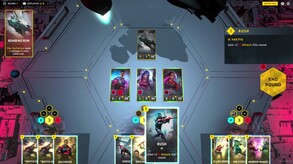
A roguelite deckbuilder crossed with a CCG, set in a dark cyberpunk world. You will lead a three-man squad against competing factions fighting among the ashes of a world-wide war. Each operator comes with a unique deck that can be customized and augmented.
Modeled estimate, not a reported figure. How we estimate →
Media

About
During the Last War, the thriving metropolis Zerzura was almost obliterated in a war between AGIs (Artificial General Intelligence). As Zerzura City is known to host the mausoleum of the last functional AGI, an Exclusion Zone has been established around the ruins of the city by the mega-corporations - ostensibly to safeguard the public against rampaging AGI-forged anomalies, but also to ensure the corporations have the first pick of precious salvage.
Assemble your crew of 3 from 9 steadfast operators, split into 3 core archetypes: Guardian, Assault, and Specialist. Choose to field a classic party with one of each archetype, or mix things up with unconventional compositions. Any combination is viable, provided you have the skill to guide them through the trials of Zerzura City. There is no true protagonist in this game: with the right cards and augmentations, any operator can have their turn to shine.
Each operator comes with their own deck containing at least 8 signature cards and at least 12 free slots. These resistance fighters are all armed to the teeth: each customisable deck must contain at least 20 cards; and any exposed weaknesses means certain death. To succeed, exploit the synergies between your decks and devise inspired new tactics to defeat your foes.
Engage in combat against multi-phase boss encounters inspired by MMO raid bosses, each with their own exhilarating mechanics and unique abilities. Take on the Siegebreaker, a colossal mech war machine; spill the blood of the Mithraean Bull, a terrible experiment gone awry; or defend a rooftop against a gunship blazing with weapons.
Make your way through 3 out of 6+ shattered districts before reaching the culmination of your journey in Wargentin District, the dark heart of the Zerzura Exclusion Zone.
Inspired by drafting formats in CCGs, draft mode starts you off with a veritable arsenal of data shards. Unseal your shards, draft the cards within to create your decks, and then take those decks into battle against an unforgiving gauntlet of randomized, escalating boss encounters. How far can you get before you succumb to the most dangerous enemies in Zerzura?
Earn Mnemosynth through your runs, and use these synthetic memories to permanently imprint cards into your collection through the Failsafe system. The added cards can be carried over to the next run, greatly enhancing your deck’s power.
Stats
All-time low is the lowest price we've recorded for this game since we started tracking it.
Languages: English, Japanese, Simplified Chinese, Traditional Chinese
Engagement
Hours played at review time, across 40 reviews with recorded playtime.
Reviews
Themes across 40 recent reviews and how positive each mention is. A keyword signal, not full sentiment analysis.
positive critical· bar length = how often the theme comes up
Reviews
This game has severe balance issues. With the right build, the starting offensive character can kill all the enemies in almost every encounter on turn 1 (With the only exceptions being one encounter with enemies that have a 3 damage cap and bosses that end your turn when a phase ends.) This is a game where you get extra rewards for clearing battles without taking health damage and the above build makes it happen every time. This is also a game where its really easy to get the same cards and equipment. For cards after each run your able to spend an account resource to make cards you had that run be available in all future runs (up to 5 cards) and there aren't too big a pool of cards anyways. For equipment, this game has equipment be divided into 4 different pack types with you choosing 1 of 2 equipment or some money when opening the pack. The build I mentioned only needs 1 specific equipment to work, so all you really need to do is save your money until you find a shop that sells the correct pack, then spam buy it until you get the required equipment. There is apparently also another character that can go infinite by themselves (I've only read someone on the steam discussions mention it, so not sure how its done or how much deckbuilding / equipment needed, but I can't be bothered to play more of this poorly balanced game to find out,)
非常华丽,科技感十足的高速卡牌游戏。动画效果贼拉快,贼拉风,让人感觉赏心悦目,耳目一新。 画面布局,规则,手感,各种方面都很独特。高清图加了很多特效,比如像素特效,半透明特效。 BOSS战的时候对面还是3D形式呈现的。爬塔的线路图可以往回走。特质非常非常多。
This game rocks. A top tier deckbuilder with Cyberpunk theme and really cool mechanics and cards from the first run - unlike some other games the really cool stuff is not hidden behind meta progression. Also, the art being good surprised me. The humans are far the worse aspect of the art, so thar blond chick they used in the store is a real bad representation - vehicles, weapons and tech in general are really cool. This is what kept me from buying before the promo and rest assured it's not half as bad as it looks. I'm not sure about the replayability. Frankly, I finished my first run and came here to write this review to (maybe) help people to pull the trigger during the 25% off promo happening - but I feel it's totally worth the full price too.
全実績取ったので感想。 3人1組のPTで全3ステージのクリアを目指すSlay the Spireライクのカードゲーム。味方三人それぞれがカードデッキを持ち、手札からカードを使用して戦います。複雑そうに見えますが、遊んでいる内に慣れていくと思います。 現時点で10人のキャラが存在し、その中から3人を選んでPTを組み、挑戦していくという流れになります。 シールドを張って味方を守るキャラ、ターン内で連続攻撃をしてどんどん敵を倒していくキャラ、味方モブを召喚したりして戦況を優位にしていくキャラなど、それぞれが特徴を持っており面白いです。 さらに、永続アップグレードして各キャラクターを強化する事も可能なので、どんどん強くなっていくPTを見るのも楽しいですね。初期状態とフル強化では天と地の差があり、強すぎるくらいになります。 1ステージ目、2ステージ目は複数のMAPが用意されており(2~3種類?)、それぞれ登場する敵、?マスのイベント、ボスが違います。マンネリ化を防ぐには十分な量かなと思います。 その反面、3ステージ目は変化が無く、ラスボスもあまりパターンが用意されていません。 日本語訳は良好です。支離滅裂な文章はありません。ボス戦時に「え?」と思うような会話があったりしますが、ゲームを遊ぶ分には問題ないでしょう。 気になった点としては ・キャラ固有カードが少ない 1キャラ4種類。全て初期デッキに入っている。道中で拾うなども無し。拾えるのは共有カードのみ。 ・MAPから戦闘画面に移行する際に、毎回2秒くらいのロードが入る。 戦闘が終了してMAPに戻る際にも同様のロードが毎回入る。自分は気にならなかったが、テンポが悪いと感じる人もいそう。 ・タイトル画面などでキャラの強化が出来ない。 キャラの永続強化をするには、3人選んで難易度を選択し、ゲームを開始した後にメニュー亜面を開く必要がある。そこで初めて強化する項目が出てくる。出撃する前に強化出来てもよさそうだけど…。 ・キャラクターへの深掘りが無い。 せっかく10人ものキャラクターがいるので、それぞれのバックボーンやストーリーが分かるような演出が欲しかったですね。フレーバーテキストも一切無いのは寂しい。 総合的に見て面白いゲームだと思います。取っつきにくそうに見えますが、最初はカードの内容も敵の攻撃もシンプルなので、だんだんと遊び方が分かるようになると思います。敵から「お前これどうすんねん?」と思うような攻撃が来ても、案外なんとかなったりします。 良作ですね。
Good game to pass the time; nothing particularly new here tho. The short games (and then reset) mean you learn the cards and characters fast. There are massive balance issues and clear "best" character and cards. You can effectively solo almost everything with the right character and a few imprinted cards, with two support characters i can't imagine how you can lose. For the most fun just select random and play with what you get. I'll probably return to it in a year and get another dozen or so hours of enjoyment.
I feel this game deserves a proper review because I am legitimately enjoying it. This game is closer to Library of Ruina than Slay The Spire, and for that alone it's worth a purchase. The play pattern is enjoyable, and you do have to make choices as a run goes on; three characters with a three card hand that doesn't discard before drawing back up each turn means that individual turns play quite differently. The developer is also very active on the forums. The only concern I have is variance between runs. The problem is that while the individual talent trees for each operator are a nice touch, as well as the ability to carry over cards between runs, investment into individual characters as well as having access to certain combinations encourages playing the same decks. Metaprogression isn't itself a bad thing, but the aim should be to unlock more and different things rather than strictly better versions of the same thing. Maybe have the Imprint system only work on new cards you picked up in the last run, and have the operator talents unlock over the course of a run instead? That being said, I have only done about five runs and each was fun despite being with more or less the same deck each time. I've heard people talk about infinites with certain characters but that's easily fixed in time by the developer, and nothing's forcing you to use a certain character. The only other suggestion I have for this game is that a lot of thought has gone into the setting, but there's no way to experience it. Maybe add a sentence of flavour text on some of the cards and items, nothing too detailed, just enough to Set The Scene. Monster Train is a good example here, every encounter, card and item had a line of text to go along with it and it added a lot to the experience with comparatively little effort. Looking forward to seeing how this develops!
A refreshing and welcome take on the formula. Three heroes, each with their own cards and at least one individual ability, add depth and variety to the known concept. I still didnt keep keep it, because i personally found it too simple, but thats just a personal preference, and i can easily recommend ZD to fans of Roguelike-CCG's.
Echoing some of the other reviews, this game isn't the deepest but is still worth a play if you enjoy "figuring out" rougelike deck builders before moving on. Decks are a minimum of 16 cards, of which 8 are each heroes' unique signature cards. The signature cards tend to be powerful and have good synergy with each other so your decks are basically always going to be pretty strong. The remaining cards are generic and can be freely swapped with any other hero's deck between battles. Deck power gain is usually done through obtaining the stronger generics to supplement your signature cards. Otherwise your power gain is through 'augments' which are basically StS relics equipped on a single hero. This game has meta-progression wherein you can buy permanent upgrades on your heroes and start each run with generics of your choice. I think it's well designed enough, most heroes are strong even without upgrades and it's satisfying to purchase the upgrades. The sci-fi world building had potential, but unfortunately there isn't enough unique dialogue from the heroes to really bring it to life. In fact, all dialogue is generic with no unique lines. The game looks and sounds good enough. Overall if you like the genre this game is good enough to be worth playing but probably not worth revisiting once you've figured it out.
Zero Division is a dark, methodical strategy experience developed by Robot Cat Limited and published by Astrolabe Games that merges roguelite structure with squad-based card combat in a bleak cyberpunk setting. Rather than focusing on a single hero or deck, the game builds its identity around commanding a small team of operators, each with their own cards, roles, and synergies, creating a layered tactical experience that rewards planning, adaptability, and long-term strategic thinking. From the outset, it is clear that Zero Division aims to appeal to players who enjoy careful decision-making and experimentation rather than fast or flashy action. The setting establishes a grim backdrop shaped by the aftermath of catastrophic conflicts between advanced artificial intelligences. Zerzura City, now sealed off as a dangerous exclusion zone, becomes both a battlefield and a resource-rich graveyard where remnants of failed technologies and hostile forces coexist. This dystopian atmosphere is not just window dressing; it informs the game’s tone and structure, reinforcing the idea that every expedition is risky and every choice has consequences. The narrative is conveyed in fragments through encounters, character descriptions, and environmental context, allowing the world to feel coherent without overwhelming the player with exposition. At the core of Zero Division is its squad-based deckbuilding system. Each run begins by assembling a team of three operators chosen from a diverse roster, broadly divided into roles such as Guardians, Assault units, and Specialists. Each operator comes with a unique set of cards that define their combat identity, while additional slots allow players to customize decks and create powerful synergies across the team. This multi-deck structure adds a layer of complexity rarely seen in the genre, as success depends not only on individual card strength but on how abilities interact across characters and turn order. Combat unfolds through turn-based card battles that emphasize positioning, timing, and resource management. Rather than playing cards from a single shared deck, players must think across multiple hands and cooldowns, coordinating actions to mitigate damage, control enemies, and exploit openings. Enemy encounters are varied and often demand adaptation, as different foes introduce mechanics that challenge overly rigid strategies. This keeps battles engaging over repeated runs, encouraging players to refine their approach instead of relying on a single dominant build. Boss encounters stand out as some of the game’s most memorable moments. These fights often feature multiple phases, shifting mechanics, and punishing abilities that test both deck construction and in-combat decision-making. Unlike standard encounters, bosses can invalidate careless strategies and force players to rethink card priorities and operator roles mid-fight. This design gives climactic battles a sense of scale and tension, reinforcing the feeling that each successful run is earned through understanding and preparation rather than luck alone. Progression is structured around a roguelite loop that balances short-term runs with long-term growth. Even failed expeditions contribute to permanent unlocks through meta-progression systems that expand the available card pool and strategic options. This approach softens the frustration of defeat while maintaining challenge, as each run offers new tools rather than raw statistical power. Over time, the expanding pool of cards encourages experimentation and replayability, allowing players to chase different playstyles and squad compositions across multiple attempts. Visually, Zero Division adopts a functional but atmospheric cyberpunk aesthetic. Character designs are stylized and distinct, making it easy to identify operator roles at a glance, while environments emphasize decay, industrial scale, and technological ruin. The interface prioritizes clarity, an essential choice given the complexity of managing multiple decks and enemy intents. While not lavishly animated, the presentation supports strategic readability and keeps the focus on gameplay decisions rather than spectacle. Audio design complements the tone with restrained, moody soundscapes and combat cues that enhance tension without overwhelming concentration. Music underscores the oppressive atmosphere of the setting, reinforcing the sense of operating in hostile territory where survival is never guaranteed. Sound effects provide clear feedback for card actions and enemy attacks, helping players track the flow of combat even during complex turns. Community reception has largely been positive, particularly among fans of deckbuilders and tactical roguelites. Players often praise the depth of its systems, the satisfaction of building synergistic squads, and the challenge posed by its encounters. Criticism tends to focus on balance inconsistencies, occasional interface roughness, or moments where certain combinations can trivialize difficulty. These issues, however, do little to undermine the strength of the core design and are often seen as areas for refinement rather than fundamental flaws. Taken as a whole, Zero Division is a thoughtful and ambitious entry in the roguelite deckbuilding space that distinguishes itself through squad-based mechanics and a cohesive dystopian setting. It demands patience and strategic curiosity, rewarding players who enjoy learning systems, experimenting with builds, and overcoming difficult encounters through planning rather than reflex. While it may not be the most accessible deckbuilder for newcomers, it offers a rich and engaging experience for those willing to invest the time, standing as a strong example of how familiar genre elements can be recombined into something fresh and compelling. Rating: 8/10
Wow! I love the card artwork! The women are gorgeous! This game is a must-play if you like sci-fi, roguelike deckbuilding. Each run is different. The game features 9 characters, with 12+ difficulty levels.
Related
Related
Trends
Modeled estimate over time, reconstructed from Steam's monthly review histogram.
Momentum
Pace estimated from the game's recent review growth (our daily snapshots) at its own sales-per-review ratio — a momentum signal, not booked sales.
Audience
Estimated from the language of this game's reviews — a proxy for where players are, not official Steam demographics.
Related
| Thunder Helix | $94.9K | 121 | 97% | $19.99 |
| Hammerwatch Anniversary Edition | $94.9K | 190 | 81% | $19.99 |
| Barbie Project Friendship™ | $94.9K | 74 | 73% | $39.99 |
| Phantasmagoria | $94.9K | 533 | 87% | $9.99 |
| Pastel☆Parade | $94.8K | 234 | 91% | $15.99 |
| Nexuiz | $94.8K | 338 | 54% | $9.99 |
Related
| 7 Days to Die | $425.3M | 403.5K | 87% | $44.99 |
| Mount & Blade II: Bannerlord | $309.8M | 293.9K | 88% | $49.99 |
| Don't Starve Together | $130.6M | 373.1K | 95% | $14.99 |
| Mount & Blade: Warband | $101.9M | 171.6K | 98% | $19.99 |
| Darkest Dungeon® | $83.5M | 160.7K | 92% | $24.99 |
| Slay the Spire | $80.1M | 216.5K | 97% | $24.99 |