Winter Polaris is a quiet, melancholy visual novel built around loneliness, immortality, human connection, and the question of what makes a finite life meaningful. Rather than treating its unusual science-fiction premise as an excuse for action or elaborate world-building, it keeps the focus firmly on its characters and their emotional journeys. Developed by stage-nana and published by Sekai Project, it follows the storytelling tradition of the creators behind Narcissu and Ame no Marginal, favoring reflective conversations and atmosphere over conventional gameplay. Its deliberately restrained presentation will not suit everyone, but readers who enjoy contemplative visual novels should find plenty to appreciate.
The narrative is divided into two distinct stories that initially seem largely unrelated. The first takes place in Tokyo after a mysterious global phenomenon begins causing people to disappear without explanation. Civilization gradually collapses, and the protagonist retreats into the mountains in an attempt to escape whatever is happening. After years of isolation, he returns to the remains of the city hoping to discover another survivor. Instead of finding ordinary human companionship, he encounters a strange girl who casually claims that she cannot die. This meeting transforms the story from straightforward post-apocalyptic fiction into something considerably more philosophical.
The ruined world is effective precisely because the narrative does not obsess over explaining every practical detail of society's collapse. Empty cities and vanished populations instead create an environment where the protagonist must confront the psychological consequences of surviving when almost everyone else is gone. The immortal girl provides an interesting contrast to this situation. Surviving indefinitely might initially sound desirable in a world dominated by death, yet the story gradually encourages consideration of whether endless existence is truly valuable when relationships, memories, and familiar surroundings inevitably disappear. Mortality becomes less of an enemy and more of an essential part of what gives individual experiences importance.
The second narrative, Sweeper Swimmer, moves away from devastated Tokyo and introduces Elena, a courier living on a rustic island. She travels by boat to transport cargo between neighboring islands, giving this section a noticeably different atmosphere. Following a powerful storm, Elena discovers an unconscious girl floating in the sea and rescues her. The stranger possesses a mysterious glass object made using craftsmanship and technology that Elena does not recognize. Questions surrounding the girl's identity and the object's origins provide the motivation for another journey.
This change of scenery works surprisingly well. The first story emphasizes emptiness and the unsettling silence left behind by a disappearing civilization, whereas Elena's adventure initially carries a stronger feeling of mystery and exploration. The contrast prevents the experience from becoming emotionally monotonous while allowing similar ideas to be examined from another perspective. Both narratives revolve around chance encounters between people whose circumstances separate them from normal society. Their apparent independence also gives the eventual thematic connections greater significance, rewarding readers who pay attention to recurring ideas rather than expecting immediate explanations.
As a visual novel, interaction is minimal. This is primarily an experience about reading dialogue, following the characters, enjoying the soundtrack, and absorbing the artwork rather than making strategic decisions or mastering gameplay mechanics. That simplicity can be either appealing or disappointing depending on expectations. Players looking for branching choices, puzzles, combat, or extensive interactive systems will find little of that here. The advantage is that nothing significantly interrupts the storytelling, allowing its slow and thoughtful pacing to establish the intended mood.
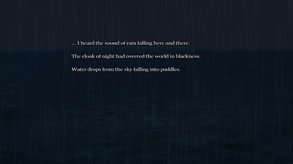
The presentation complements that approach with attractive 2D anime artwork and a subdued aesthetic. It is not among the most visually elaborate examples of the genre, and animation is limited, but the illustrations fit the introspective nature of the narrative. Japanese voice acting strengthens important character moments, while the music contributes substantially to the feeling of solitude and melancholy. The overall experience often feels closer to an illustrated audio drama than a traditional game, which is appropriate considering how heavily it depends on dialogue and narration.
Despite its gentle appearance, the subject matter can become quite dark. The narrative contains depictions and discussions involving violence, death, and suicide. These elements are connected to its examination of mortality rather than existing purely for shock value, but they give the story considerably more emotional weight than its colorful character artwork might suggest. The writing is particularly interested in mistakes, regret, loss, survival, and whether someone can find purpose after the world they understood has fundamentally changed.
Steam Deck compatibility is officially rated Playable rather than fully Verified. The game runs successfully on SteamOS, its interface text is considered legible, and the default graphics configuration performs well. However, some functions are not conveniently accessible through the standard controller configuration, potentially requiring the touchscreen or a community controller layout. Players may also encounter keyboard, mouse, or non-Steam-Deck button icons. Since this is predominantly a text-driven visual novel, these limitations are relatively manageable, and the handheld format is otherwise naturally suited to relaxed reading sessions.
Its biggest weakness is that the subdued pacing and limited interaction demand patience. Readers who are not immediately invested in the philosophical themes may feel that events develop too slowly, while the modest visual presentation leaves much of the experience dependent on the quality of the writing. For its intended audience, however, those same qualities create an intimate and unusually reflective experience. Instead of trying to impress through spectacle, it uses two mysterious journeys to explore the value of companionship, the burden of continuing onward, and the relationship between mortality and meaning. It is a thoughtful visual novel whose emotional ideas remain more memorable than its mechanics, making it particularly worthwhile for players who appreciate short-form, character-driven speculative fiction.
Rating: 8/10