Recruit your team, choose your path, and descend into hell. Four heroes must overcome the trials of the underworlds in tactical narrative encounters. A new systemic storybook experience blending mythology and surrealism. From the designers of King of Dragon Pass and Six Ages.
Modeled estimate, not a reported figure. How we estimate →
About
“A surreal journey into the afterlife. Can you survive the Thousand Hells?”
Four heroes risk their body and mind as they descend into the underworlds. Thousand Hells is a tactical narrative game where your choices determine your fate and change your party forever. Assemble a team that can handle the physical and mental trials of hell, or at least the demons, guardians, and gods in the one you’re visiting today.
In the underworlds, you and your team must fulfill your contract with the mysterious Ambassador, which changes with every mission. Planning helps, but no job ever goes according to plan...

Customize your character and build a party with unique skills and traits.
Dynamic Narrative Encounters: Choose the best option and use your party’s skills to advance with your body and mind intact.
Life or Death Choices: Multiple paths for every encounter. Take a risk for big payoffs or play it safe to keep your party healthy?
Highly Replayable: Create a new unique quest or retry failed missions. Your cast of helpers changes each time.
Experience Every Underworld: Whether you’re following in Orpheus’s footsteps to rescue a loved one or save the Eternal City from an insect plague, the underworld you visit and how you tackle its challenges will change the way the story plays out.
An anthology of mythic journeys imagined by 8 different writers, with hundreds of hand-painted illustrations.

Every heist needs a team but not all heroes get along! Before setting out you need to gather a party of skilled adventurers. Each hero has a profession and a unique set of skills. Make sure to choose a variety of skills and personalities so you’ll be ready no matter what comes crawling out...

The evil below has many weaknesses, your choices will affect your chances at surviving. Use the strengths of your party in over 280 unique dynamic narrative encounters. Skills will change depending on your team’s successes and failures. Avoid combat by sending your bard to calm the nerves of bandits. Hire a demonologist to communicate with a possessed book. Take the risk and reap the rewards, otherwise you’ll end up with a broken arm, or worse.

Thousand Hells is highly replayable, creating a new unique quest or letting you retry a failed mission. Your cast of helpers is different each time. One run takes about an hour, but automatic saving and a synopsis of the story so far lets you play when you only have a few minutes.

You reside in the Eternal City, a Byzantine-flavored fantasy world where untold demons lurk below your feet, with riches ready for the taking, if you dare. A client hires you for one last job, but you’ll need the right team to pull it off.
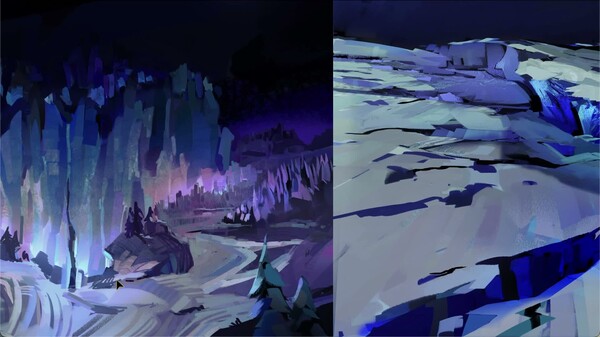
Thousand Hells takes place in a stand-alone fantasy world from the designers of King of Dragon Pass and the Six Ages series. This anthology narrative was pulled from the minds of 8 different writers such as Robin D. Laws and Aaron A. Reed and is supplemented by gorgeous hand-painted illustrations. Each hell is distinct, with its own palette and idiosyncratic threats to survive. No generative AI was used in the making of this game.
Genres
Stats
All-time low is the lowest price we've recorded for this game since we started tracking it.
Add-ons
Each DLC is estimated with the same model as a game, then summed — a modeled figure, not reported DLC sales.
Engagement
Reviews
Themes across 74 recent reviews and how positive each mention is. A keyword signal, not full sentiment analysis.
Reviews
I will try to refund this after my review and I feel sad about it. I liked the other games of this studio and was thrilled when they announced this, as it sounded like a fresh, very interesting premise. I love myself a narrative game - replayability, heists, gorgeous artwork - what's not to love? I bought the game on release day, played it and let it sit for a few hours only to get back with a "if that was 2 hours or less, I am refunding". Because I did fundamentally not enjoy my experience. My first few runs ended quickly and I assumed that this was a learning curve to beat - a bit roguelikey, once I understand how the game works, it'll work out. Then I got a run that started off great and I actually got to the hell and try the bank heist. At that point I had already begun to click quicker and quicker because the character interactions felt empty. I got to a relevant encounter in top shape and 5 minutes later the run was over. Without a chance to turn it around, because I had back luck guessing what the option tiles mean. Or bad luck rolling the dice? Or both? Or maybe just general bad luck? Because the game transparency is so nonexistent I can't tell you. There is also nothing I could've done differently to change this. I picked the option I thought was best and it failed miserably. I learned nothing. I gained nothing. My loss was not meaningful, because it did fundamentally not feel deserved. Or meaningful, because I can't get attached to the characters. Which is a shame. So the feeling I ended with is th is: I just lost an hour of time on this run because in theory I COULD start again, but I don't see why I should. I can't come better prepared - I had good story tiles and equip/connections left over the last time. I can't pick a better team - The character I chose felt very well suited the last time. I can't learn more about the mechanics in a non-frustrating way because so much is pure chance and NOTHING is shown transparently. I wanted to love this. The art is still gorgeous. Byzantine-flavored? I would LOVE to see that in a game in a way that I can feel it. But the core gameplay loop currently is so fundamentally not fun to me it's heartbreaking.
Media

Related
Related
Price dynamics, follower growth, revenue and sales trajectories with interactive tooltips
This and every other Pro feature is free until October 20, 2026. A free account is all it takes.
Languages: English
Hours played at review time, across 74 reviews with recorded playtime.
positive critical· bar length = how often the theme comes up
After finishing my 1st run, I think that Thousand Hells: The Underworld Heists has potential to be a strong candidate for a narrative game of the year for me. The challenges that you encounter during the journeys are tense and exciting. In my opinion the difficulty is just right, you sometimes encounter situations where you feel that none of your options really fit the challenge at hand but then it feels so rewarding when you overcome the odds. There is a lot of replay value and I will for sure be chasing as many achievements as I can on this one. :)
Huge fan of King of Dragon Pass and Six Ages. Was very, very excited about the premise of Thousand Hells. Unfortunately, the game is just way too random, with everything. You get a random story, with a random protagonist. You also get random party members with random traits. The challenges are fought using the random traits; I've had a hard time figuring out which traits help. Then, the challenge is determined by random dice rolls. After losing three quests in a row, from constant bad rolls and not being sure what the random traits help with, I've given up. There isn't enough player agency in Thousand Hells for me to enjoy it. I'll still buy future A Sharp products. This one is just a miss for me.
I robbed the demon bank but my ritual to spiritually launder the money failed so I was dragged into hell, Payday 2 this is not
I don't thing the game is where I would like it to be in order to recommend it. For context, I've played two full runs where I got to a pretty natural end (the [spoiler]Profane Tragedy in the Midnight North[/spoiler] and the [spoiler]Love Lost in the Great Below[/spoiler], in case you're curious.) The good parts are easy to praise. The creativity on display in both the writing and art of the hells is terrific. Individual scenes are captivating and, when strung together into a whole story, the impressions they made lingered in my thoughts well after I'd closed the game. These places feel like they have their own rules and intentions which drew me in in the same way some of my favorite text-based games have. Additionally, I found the "fail forward" nature of many of the encounters worked really well and kept me from feeling like I was hopelessly doomed just for a string of setbacks. Yes I came out of those worse for wear, but never unsure of how to proceed or what I'd be doing next. Pulling tiles to generate options in an encounter also feels really easy to interface with. While I was sometimes stumped by which one to use, I never struggled to use the system itself (unlike some of A Sharp's other titles). It's an elegant, if sometimes obtusely worded, way to handle challenges and I really see the appeal in it. Unfortunately, that's where my praises end. For all of the talent on display and the desire I had to engage with it, the game has some shortcomings that keep me from recommending it to others. Both of my runs felt kind of abrupt, which feels weird to say for a 2 hour and 1.5 hour session of play respectively. In the run where I lost, an encounter with the demonic antagonistic of our story removed one of my characters from play and then I lost the climactic encounter of the run in just three challenges. Immediately after, my character crumpled over and I was denied the bitter march home I expected to face my failures. In the run where I succeeded, all the characters got a moment collecting their earnings in the Eternal City and then the run just ended. It was a perfectly adequate ending, but it still felt sudden. When I was playing through these runs, I enjoyed the story in the middle and the settings of the hells but that enjoyment fell off at the end. And maybe that's the intent here... but I can't help but feel like I was told I was done and the book slammed closed. What's more, some of the things I'd look for from a rougelike with such a narrative focus just aren't present. There isn't a feature to let you view previous runs, or even a sort of epitaph style summary of what occurred. I've been told they're working on implementing one, but I'm astonished it wasn't something they'd have at launch on a game like this. Additionally, hellfarers seem to be randomly generated each run and you aren't able to return to any of your previous characters in future runs. I'd expected to see some hellfarers I'd taken back as options for delving in the future, and, while I admit two runs might not be enough to see that sort of thing, I'm not under the impression that's how the game currently works. These issues compound the fact that the challenges can be obtuse. I can only imagine that this is by design, and I like the game for being vague on some challenges, but I feel like a calamitous loss stings that much worse (and a hard-fought win feels that much lesser) when they don't really linger in the game. The runs end abruptly and, while the journey there was wonderful, I end up with very little record they happened and the sense that I missed a beat in the story. I'm going to return to the Thousand Hells. I enjoy a fair bit of what this game has to offer and I'm excited to see what I haven't encountered, but I'm walking in expecting it to leave me with a bittersweet taste at the end. If this game sounds right for you even knowing that, then I hope you enjoy your time with it. I look forward to recommending this game to my friends when it's further along. Until then, I wish the A Sharp team the best of luck.
The resolution system felt way too obtuse to be fun. Each of your four party members has a collection of traits, represented as tiles that you draw from a bag, which you apply to the challenge at hand and will give you a bonus or penalty to the dice roll - but the traits are vaguely worded, and there’s no feedback as to what effect they had even after you use them. In order to pass a skill check you have to: * Be lucky enough to draw a relevant trait tile * Figure out if the game thinks the very vaguely-worded trait is relevant to the challenge * Succeed at the die roll, factoring in the lasting penalties you’ve accumulated from previous failures (which are handed out like candy) The tile-drawing mechanic effectively means you have to get lucky in an extra layer of RNG just to be //allowed// to use a character’s skills; my shaman was a nature specialist, and failed three challenges in a row in the jungle because I never pulled “so-and-so is a nature specialist” tile. And every challenge requires multiple successes.
A somewhat disappointing game. The idea is good, and the setting is unique enough - those are not the parts this game struggles with. Backgrounds look nice, even though plenty of those get reused. The heists are decently well-written, even though I haven't tried all of them yet. However, this offers very little in terms of gameplay, and everything you do is very affected by RNG. While yes, you can fail forward through most of the challenges, it simply feels bad to pick a perfect team for a route just to get shafted by the draw. One second characters brag about being great sailors and demonologists, next, they're failing simplest challenges, drawing "X is an alcoholic" or neutral cards. Next, it's not clear how a challenge is affected by specific cards, and insight tokens are very rare. I understand that no writer can predict how every single player could interpret the card<->challenge suitability, but the current system isn't fun as well. I wouldn't mind buffing insights to a point where you can reliably use at least one per encounter. Like, what do you mean "X noticed an opening" is a better card for climbing a tree than "Y is strong"? The risk/reward for each encounter feels very uneven. You can go through a heist perfectly, mess up one or two encounters/challenges and straight up invalidate an entire run, a short story worth of reading, and to get back to that point you gotta not only trudge through the same exact challenges, but also deal with the RNG's ♥♥♥♥♥♥♥♥. On the other hand, some of the encounters feel pointless, adding little flavour other than "oh hey, the characters are supposed to have a backstory, let's meet a rival team and awkwardly shove it in".
If you love visual novels with deep lore, go ahead and give this a spin. A "tactical narrative RPG", however, it is not. I want to love this game, but it's missing the core mechanic that any game needs to generate stories: trade-offs that feel meaningful. Thousand Hells feels eerily like a knock-off, as if someone new to game design was trying to make a mobile version of A Sharp's most beloved titles without understanding what made them successful. A Sharp is somewhat notorious for low-transparency mechanics, which works well in KODP because your community, neighbors, gods, and even the fields and herds you farm will consistently communicate feedback about how your actions have impacted them. As in real life, these ripple effects are ambiguous or suspensefully delayed, which makes the world feel alive. You must constantly make difficult compromises based on limited information, and find creative ways to to navigate conflicting priorities. In contrast, the decisions available to you in TH are very simplistic, like a children's book. 80% of the choices are 1) go left/right, or 2) attack/negotiate/flee. In general, your randomly generated team members have no strong opinions about what you should do, no particular personalities or goals, and no dedicated storylines. They say nothing and appear to feel nothing about risking their lives repeatedly, remaining mute even if they become heavily injured or demoralized as a result of your choices (except for a possible game over scene that can trigger if the whole team hits rock bottom). Instead of health and morale bars that decrease in proportion to the severity of their injuries, NPCs die instantly after 3 strikes. This leads to unintentionally comical situations where Joe the poet, who almost drowned before getting mauled by a lion, is crossing the treacherous desert just fine while Jane the warrior has abruptly keeled over and died after suffering her third scratch from some brambles. The rich lore could make up for the hollow NPCs on your team, if only there were any meaningful resource management. Incredibly, many of your supposedly valuable resources are designed to _deprive you_ of playing your adventure, rather than making it more absorbing. You have 4 resource types: special items, personal connections, insight, and supplies. Half of these (items and connections) are functionally the same resource, which I will call "auto-skip". You can spend one of your auto-skips to instantly proceed past any encounter, but this success doesn't feel earned, and actually causes you to miss out on the narrative content entirely. You click the option: "We don't need to navigate alone through this underground city full of spies and intrigue because an old friend who lives there can show us the way," and bam this whole chapter is over, you move on to the next encounter as if nothing happened in between, and you never see or speak of this "old friend" again. It's revealing that almost any challenge can be avoided if you spend an auto-skip. This betrays some awareness by the devs that the average playthrough will be plagued by a substantial number of situations in which it is impossible for the player to prevail, no matter how skilled they are. Instead of actually addressing this serious design flaw by enriching the narrative (e.g. by introducing a greater variety of ways to approach problems or recover from failure, or roguelike meta-progression to spice up future runs), the devs encourage players to not even bother to attempt to play through large chunks of content in the first place. Aside from making the plot feel contrived and hand-wavy, auto-skip causes narrative dissonance because you need to use this deus ex machina for the challenges that your team's particular skillset is least likely to survive; meaning that the hardest challenges that you are least prepared for end up being instant successes, while failure follows from less intimidating challenges that you chose not to skip because you had a good chance of succeeding. Similarly, you can only send in 1 team member at a time to solve a problem, and even when their skills are a good fit, failure is common; so that your team members rarely have to risk doing any tasks for which they are poorly suited, but fail frequently at precisely those tasks that are supposed to be their area of expertise. The other 2 resources are insight and supplies. Having supplies to use for recovering from injuries, bribing people etc. is a great idea, but how many you have left is not shown in the UI at all, a really strange design choice that prevents you from spending or saving them strategically. Insight is a super cool resource, and the only really original mechanic the game contributes to this genre; you can spend it to reveal the success chances of some of your options. In practice, though, it mostly serves to reveal how vague and arbitrary the underlying game rules are. It appears that storylines created by different authors will have very different interpretations of which skills are useful in which context. The lack of a coherent underlying game logic makes it hard to learn from your failures. Much like auto-skip, you can use Insight to meta-game your way out of high-stakes situations, but not to understand deeper patterns. Above all else, a single set of trade-offs has a massive, almost pre-determining impact on whether you succeed or fail in your quest: the skillset of your team, decided during player character creation and recruitment of 3 RNG companions. Yet you are forced to make these choices before you start your quest, knowing almost nothing about what awaits you, and you can't adapt them later in response to new information. An act of skillful resource management or immersive roleplaying this is not. TH falls into the common RPG trap of including dozens of character traits that are too numerous to balance properly. There are a handful of extremely OP traits crucial for almost any mission (e.g. Perception and Scouting), and then a long list of meh traits that SOUND dope but aren’t relevant 80% of the time (Healer, Royal Blood, Master of Disguise, Lockpicking, etc. etc.). There's a lot of overlap between redundant traits (e.g. Warrior and Combat Training), and super useful traits aren't more costly or rarely occurring than less useful ones, so your teams start to feel super samey across runs. In addition to skills each team member also has a weakness. In an immersive narrative game, these weaknesses would play a prominent role in the challenges you face as a team, and the failures you suffer. Instead, most scenarios that could trigger weaknesses are telegraphed ahead of time (oh gee, do I, who have a mortal fear of spiders, want to 1) turn left down the tunnel full of SPIDERWEBS or 2) turn right down the tunnel with squeaking noises?) and again, you can just auto-skip the riskiest events. In that sense weaknesses can be easily avoided, and yet in another sense they're also everywhere. Weaknesses won't just create obstacles in challenges that contain relevant narrative content but in literally every challenge, which is just confusing — why is my fear of spiders making it harder for me to sail a boat? After 5 playthroughs I only experienced a single one in which a team member’s weakness wasn't just impractical throughout, like all weaknesses are, but provided a major plot twist in its own right. Honestly aside from the occasional mild annoyance it causes, I would barely have noticed if this mechanic was missing entirely. During playtesting, that should've been a clear sign that its implementation needs to be revisited. At the end of the day, I'll happily return to the game to explore the rich lore, but I can't really think of another reason to recommend it. I hope the studio continues to experiment with new formats, while staying true to the secret sauce that has made the Glorantha series so special.
Not a fan, hard do not recommend, especially at this price point. I bought this because I adored Six Ages and King of Dragon Pass, and this comes nowhere close to matching the charm of either. I regret giving these guys the benefit of the doubt and buying thousand hells on day one. This is procedurally generated slop that is repeatable in the sense that Charlie Brown trying to kick a ball is repeatable. The artwork and writing were good enough that I stayed engaged for a total of three hours before realizing this absolutely sucks to play. There's no real overarching storyline. You generate a random combination of plot and setting and play until you win or die, and that's it. The developers made zero investment in creating actual characters. Instead you get procedurally generated slop assembled from an extremely small set of names, characteristics, and professions. lol. Really seems like they put the B-team on character creation while they went hog wild on the artwork and scenarios. The gameplay, if you can even call it that, after you've chosen your slop team is even more disappointing. In each scenario you select a lead slop member, then draw from three bags: one for the lead slop, one for the rest of the slop, and one full of random things like items or talking skinbooks. Your "choices" are either gussied-up character attributes or generic picks like a stroke of luck. You run through a set of sub-scenarios over a few rounds, needing four wins to win, and you lose after three losses. Most losses aren't run-ending, but it only takes a few to make a run no longer worth it because of all the debuffs (the ratio between debuffs-buffs-debuff removal is like 6-4-2, ridiculous). And that's when you find out the whole game boils down to "we're not going to tell you what your choice does in a sub-scenario, good luck nerd!" Example: I have one choice that's basically "this guy is an expert at boating" and another choice for the same character “this guy is a sailor.” A boat rope breaks and needs fixing. Apparently sailor works but being an expert at boating gets you knocked into Poseidon's butthole. How do you find that out? By getting knocked into Poseidon's butthole. You get no other information to decide. Does "combat trained" mean strong? Sometimes! Other times you were supposed to use warrior so eat it nerd. I would much rather square up against an RNG than a "haha wrong again dumbass" generator. I have basically zero incentive to replay a location or story when 50%+ of the choices will be the same and you can't invest in real characters or anything. “Consulting” mostly randomly generated characters that you won with is incredibly lame. Once someone drops actual definitions for choices onto a wiki, this game will lose 95% of its not very well thought out tension. Six ages and dragon pass were neat because you made an informed choice for a benefit now and it might come back to bite you in the face later but you can capitalize on that benefit in the meantime. This just makes everything a big unfun question mark.
To those who are a fan of text-heavy narrative games with some bomb-ass artwork and artwork, I would like to cordially invite you to go to hell. Forming a team of ne'er-do-wells, scoundrels, and the occasional poet, Thousand Hells invites you to descend into the depths of hell in search of riches, glory, and rarely, a good deed. Every heist is different and features a new line-up of folks. The job is usually going to go sideways. Sometimes folks die. Other folks get greedy. You? You ought to just focus on getting paid. Much of the games worth is borne out through the games ten different narrative scenarios and the four featured hells that tempt you into their depths (shout out to the frigid Midnight North). Though sometimes you can begin to see the edges of the game's script every once in a while, this setup still manages to allow for a truly admirable amount of replayability. There are some subtle variations in many of the tales that reward a bit of exploration; even if you think you know what comes next, the game can still find various sneaky ways to deceive you or keep you guessing. It also bear's mentioning that some of the most juiciest action occurs when you're dancing on a razor's edge between a fine success and an unmitigated failure; so don't be afraid to get spicy with your decision making! A loss can be just as entertaining as a success. So hey! That's about it. If you like word heavy, story-based games or are a fan of mythological flavored tales, go ahead and give this a shot.
Selling now
See how fast this game is selling right now — estimated copies and revenue per day from recent review growth.
Active players
Estimated daily and monthly active players (DAU/MAU) modeled from peak concurrency.
Players by region
Where this game's players are, estimated from review languages.
Players also reviewed
The games this title's players most often review too — audience affinity.
Related
| Game | Estimated lifetime revenue | Reviews | Review score | Price |
|---|---|---|---|---|
| — | 0 | — | — | |
| $5.6K | 20 | 100% | $9.99 | |
| $725 | 10 | 70% | $3.39 | |
| — | 109 | 43% | — | |
| $384.5K | 3.5K | 74% | $4.99 | |
| $267K | 460 | 81% | $19.99 |
Related
| Game | Estimated lifetime revenue | Reviews | Review score | Price |
|---|---|---|---|---|
| $73.9K | 189 | 90% | $14.99 | |
| $73.9K | 601 | 93% | $6.99 | |
| $73.9K | 155 | 83% | $9.99 | |
| $73.9K | 323 | 85% | $6.29 | |
| $73.9K | 127 | 69% | $14.99 | |
| $74K | 867 | 82% | $3.99 |