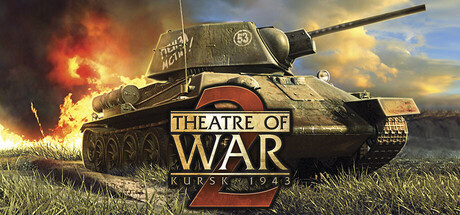
Theatre of War 2: Kursk 1943 is a dense, uncompromising tactical war game that recreates the largest armored clash in history with an almost academic commitment to realism. Developed and published by Fulqrum Publishing, the title focuses on the Battle of Kursk and its surrounding operations, presenting the Eastern Front not as a backdrop for spectacle but as a brutal, methodical contest of positioning, attrition, and command discipline. It is a game that demands respect for its systems and patience from its players, rewarding careful planning far more than reflexes or aggression.
The game’s structure revolves around historically inspired campaigns that allow players to command either Soviet or German forces during the summer of 1943. These campaigns are framed around real operational goals tied to Operation Citadel and the Soviet defensive counteroffensive, giving each mission a clear historical context. Rather than telling a cinematic story, the game communicates its narrative through objectives, terrain, and force composition, encouraging players to understand the logic behind each engagement. The result is an experience that feels less like a dramatized retelling and more like an interactive battlefield study.
Gameplay is entirely focused on tactical command. There is no base building, no production queues, and no abstract economy to manage. Each mission provides a finite set of units, often reflecting real orders of battle, and success depends on how well those units are used. Infantry, tanks, artillery, and support weapons must be coordinated carefully, with line of sight, range, armor penetration, and suppression all playing decisive roles. Open terrain, minefields, defensive belts, and layered fortifications define the flow of combat, particularly on the Soviet side, where defensive depth and preparation are central themes.
Armor warfare is the defining feature of Kursk 1943, and the game places enormous emphasis on realism in tank combat. Vehicles are modeled with individual armor zones, realistic gun performance, and crew behavior that affects effectiveness under fire. A well-positioned anti-tank gun or a properly angled tank can hold off superior numbers, while careless advances across open ground are punished brutally. Tank duels often unfold at long range, with visibility, terrain contours, and timing determining outcomes more than sheer firepower. This creates tense engagements where patience and positioning matter more than rapid movement.
Infantry play an equally critical role, particularly in spotting, holding ground, and supporting armor. Soldiers take cover, become suppressed, and can break if subjected to overwhelming fire. Heavy weapons teams, such as machine guns and anti-tank rifles, are essential for controlling key approaches, while engineers and artillery observers add depth to defensive and offensive operations. The game allows for the construction and use of fortifications, reinforcing the sense that battles are shaped long before the first shot is fired.
One of the game’s most compelling aspects is unit persistence and progression. Soldiers and crews can gain experience over the course of campaigns, becoming more reliable and effective. This progression system adds emotional weight to combat decisions, as preserving veteran units becomes a strategic priority. Losing an experienced tank crew or infantry squad can significantly affect future missions, encouraging cautious play and reinforcing the sense of command responsibility rather than disposable units.
Presentation is functional and restrained, prioritizing clarity over spectacle. Unit models, vehicles, and terrain are detailed enough to convey tactical information, even if they lack modern graphical polish. Explosions and sound effects are grounded and subdued, reinforcing the atmosphere of large-scale mechanized warfare without turning combat into a cinematic display. The interface, while comprehensive, is dense and occasionally cumbersome, reflecting an older design philosophy that assumes players are willing to wrestle with complexity in exchange for control.
Artificial intelligence provides a competent but uneven challenge. Enemy forces often make sensible use of terrain and defensive positions, but friendly unit behavior can sometimes require close supervision to avoid inefficiencies or misinterpretation of orders. This reinforces the game’s micromanagement-heavy nature, where success often comes from anticipating problems rather than reacting to them. The pace is deliberate, with battles unfolding slowly and methodically, mirroring the grinding nature of Eastern Front warfare.
Ultimately, Theatre of War 2: Kursk 1943 is a game with a very specific purpose and audience. It is not designed for quick matches or casual play, nor does it attempt to streamline the realities of WWII combat for broader appeal. Instead, it offers a demanding, historically grounded tactical experience that rewards careful thought, patience, and respect for combined arms doctrine. For players who enjoy deep military simulations and want to engage with one of history’s most significant battles on its own terms, it stands as a challenging and intellectually rewarding portrayal of warfare at its most relentless.
Rating: 6/10