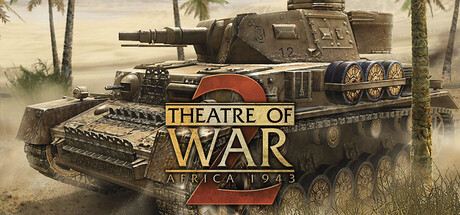
Theatre of War 2: Africa 1943 is a demanding, realism-driven tactical strategy experience that places players squarely in the unforgiving conditions of the North African campaign during World War II. Developed by 1C and published on Steam by Fulqrum Publishing, the game builds on the foundation of the original Theatre of War by refining its mechanics and focusing them into a more cohesive, scenario-based depiction of mid-war desert combat. It is unapologetically methodical, favoring historical authenticity and careful command over spectacle or accessibility, and it expects players to think and act like battlefield commanders rather than traditional RTS managers.
The setting is one of the game’s greatest strengths. The North African theatre brings with it wide open spaces, limited natural cover, and extreme visibility, all of which significantly influence how engagements unfold. Battles often hinge on who controls key ridgelines, choke points, and approaches across exposed terrain. The absence of forests and urban density means mistakes are punished quickly, as tanks and infantry caught in the open can be destroyed before they have time to react. This environmental pressure creates a constant tension, forcing players to plan advances cautiously, coordinate combined arms, and respect the destructive power of long-range fire.
Gameplay revolves around commanding a finite set of historically accurate forces in real time, with the option to pause and issue orders. There is no base building, no resource economy, and no reinforcements conjured out of thin air. Each mission provides a specific order of battle, and success depends entirely on how well those units are used. Infantry squads must be positioned intelligently, vehicles must be angled and supported to avoid catastrophic losses, and artillery and air support must be deployed at precisely the right moment. The game’s mechanics emphasize line of sight, weapon penetration, morale, and suppression, making every engagement feel grounded and consequential.
Infantry play a far more nuanced role than in many WWII strategy games. Soldiers seek cover, go prone under fire, and can become pinned or routed if overwhelmed. Heavy weapons teams, such as machine guns and anti-tank crews, are critical for establishing control over open ground, while engineers and support units can shape the battlefield through the construction of fortifications like sandbags, trenches, and roadblocks. These preparations are not cosmetic; they meaningfully affect survivability and tactical options, especially in defensive scenarios where holding territory against superior numbers is the goal.
Armor combat is equally deliberate. Tanks feel powerful but fragile, particularly when unsupported by infantry. Flanking, armor angling, and engagement distance all matter, and reckless advances often end with vehicles burning in the desert. The game does an effective job of conveying the vulnerability of armored warfare in this theater, where visibility is high and concealment is scarce. Artillery and air strikes add another layer of complexity, capable of breaking stalemates or annihilating clustered units, but their limited availability means they must be used with restraint and precision.
The campaign structure presents a series of historically inspired missions fought from the perspectives of different factions, including German, British, and American forces. Objectives vary between offensive breakthroughs, defensive holds, and tactical withdrawals, keeping the experience from becoming purely repetitive. While there is no overarching dynamic campaign map, the individual scenarios are dense and often challenging, requiring multiple attempts and careful analysis to master. Progression comes less from narrative development and more from the player’s growing understanding of the game’s systems and the historical tactics they represent.
Presentation is functional and utilitarian, in line with the game’s simulation focus. Unit models, vehicles, and terrain are detailed enough to convey identity and purpose, even if they lack the polish of more modern strategy titles. Explosions, weapon fire, and ambient battlefield sounds reinforce immersion without turning combat into a cinematic spectacle. The interface, while improved over earlier entries, remains complex and occasionally cumbersome, reflecting a design philosophy that prioritizes control depth over ease of use. Learning to issue precise orders efficiently is part of the challenge, and the game offers little hand-holding for newcomers.
Artificial intelligence shows moments of competence, particularly in defensive positioning and use of cover, but it can also behave inconsistently, sometimes failing to respond optimally to changing battlefield conditions. This can lead to frustration, especially when units misinterpret orders or pathfinding breaks down in tight situations. However, these shortcomings are often balanced by the sheer tactical depth of the scenarios, which reward players who anticipate problems and plan conservatively rather than relying on reactive micromanagement.
Ultimately, Theatre of War 2: Africa 1943 is a game with a very clear identity and audience. It is not designed to provide quick gratification or cinematic thrills, but to simulate the pressures and constraints of real battlefield command. Its emphasis on realism, limited resources, and historically grounded tactics makes it especially appealing to players with a strong interest in WWII military history and deep tactical gameplay. For those willing to invest the time to learn its systems and accept its rough edges, it offers a challenging and intellectually rewarding portrayal of one of the war’s most demanding campaigns.
Rating: 6/10