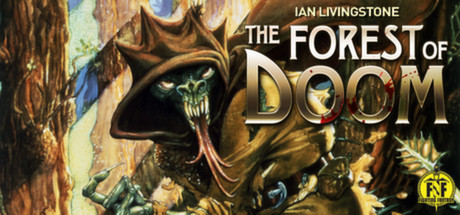
The Forest of Doom, developed and published by Tin Man Games, is a digital adaptation of Ian Livingstone’s classic Fighting Fantasy gamebook that successfully translates the charm of 1980s interactive storytelling into a modern format. Set within the mysterious and dangerous expanse of Darkwood Forest, the game casts you as a lone adventurer tasked with retrieving the two halves of a legendary hammer forged by dwarves. This artifact is vital to the defense of Stonebridge, a city on the verge of ruin. What follows is a perilous journey through an ever-changing wilderness where monsters, traps, and unexpected encounters lurk behind every page, and every decision you make could be your last. It is a work that relies on atmosphere, choice, and luck to sustain tension, evoking the feel of reading a well-loved adventure book while giving it the convenience and accessibility of digital play.
Tin Man Games has built its reputation on bringing classic gamebooks to contemporary platforms, and The Forest of Doom stands as one of its most faithful recreations. The core mechanics remain true to the original format: your character’s fate is determined by rolls of virtual dice that govern your skill, stamina, and luck. Each encounter plays out like a miniature battle of probability, where the outcome of a dice roll determines whether you triumph or fall to the dangers of the forest. Every page of the book is rendered in an interactive interface, allowing you to click through decisions rather than flip physical pages. The developers have added features that modernize the experience without altering its essence—automatic stat tracking, a clean digital adventure sheet, auto-mapping, and the ability to create bookmarks that let you retry pivotal choices. These small conveniences make what was once a demanding, bookkeeping-heavy process into something smooth and intuitive, ensuring the experience appeals not only to nostalgic fans but also to newcomers unfamiliar with tabletop-style mechanics.
The writing remains the backbone of the experience. Livingstone’s prose has a simple but effective rhythm, using short descriptive passages to immerse you in the forest’s oppressive atmosphere. Every step feels fraught with risk: a fork in the road might lead to treasure or to death, and even seemingly innocuous encounters can turn violent without warning. The tone is old-fashioned but sincere, drawing on archetypal fantasy elements—goblins, trolls, dark sorcery, and heroic courage—to create a setting that feels both timeless and familiar. There’s a sense of discovery in every new paragraph, heightened by the uncertainty of where your decisions will lead. Yet this adherence to the original text also exposes the limits of the genre’s age. Choices can sometimes feel arbitrary, and the game often punishes players for small missteps that couldn’t reasonably have been predicted. Success frequently depends on trial and error, or on remembering the correct sequence of paths after previous failures. For players raised on modern narrative design, where fairness and context-sensitive decision-making are expected, this can feel frustratingly unforgiving.
The interface is where Tin Man Games adds its most meaningful contributions. The presentation is polished, featuring parchment-like textures, ornate borders, and crisp typography that make the reading experience pleasant. The illustrations, adapted from the original book’s artwork, have been remastered in color while retaining the rugged line art style that defined 1980s fantasy. These images help to punctuate the text with moments of visual drama—a monster lunging from the trees, a cursed idol gleaming in the moonlight, a winding path that disappears into the mist. The auto-map is particularly useful, giving players a bird’s-eye view of their journey and preventing the confusion that once came from flipping back and forth through hundreds of numbered pages. Ambient sound effects and a moody soundtrack accompany your reading, reinforcing the eerie atmosphere of Darkwood Forest. The music loops after a while, but it remains subtle enough not to distract from the text. The overall effect is one of immersion through restraint; it never overwhelms the imagination but instead leaves space for players to visualize the danger for themselves.
The gameplay structure encourages multiple playthroughs. Because so much of The Forest of Doom relies on dice rolls and branching paths, no two runs are ever quite the same. Even when following familiar routes, random events or combat outcomes can shift the story’s rhythm. The game’s design rewards exploration, but also punishes overconfidence—stray too far from the main trail and you might encounter something deadly or expend valuable resources for little gain. This tension between curiosity and caution gives the game a sense of pacing that’s both methodical and suspenseful. For completionists, there are achievements tied to discovering hidden encounters and reaching alternate endings, as well as an unlockable art gallery that celebrates the game’s heritage. However, replaying the adventure multiple times can expose the narrowness of its structure. Despite the illusion of freedom, most paths ultimately converge toward the same handful of outcomes, and once you’ve mastered the optimal route, there is little incentive to continue beyond nostalgia or curiosity.
One of the most notable aspects of this adaptation is how it balances accessibility and authenticity. Players can choose between a “free read” mode that allows exploration without consequence and a “classic mode” that replicates the harshness of the original, complete with permadeath and limited resources. The latter captures the tension that made Fighting Fantasy books so memorable, while the former opens the experience to readers who want to enjoy the story without frustration. This flexibility highlights Tin Man Games’ respect for both the original material and its audience. They understand that not every player wants the same level of challenge, and by including multiple difficulty settings, they preserve the book’s historical integrity while making it more inclusive. Still, even in its friendlier modes, the random nature of dice rolls ensures that luck remains a defining element. Victory can sometimes feel as dependent on fortune as on smart choices, which adds excitement but can also lead to occasional exasperation when a bad roll undoes an otherwise careful run.
In its essence, The Forest of Doom is less a modern video game and more a celebration of a particular era of interactive fiction—a time when imagination and risk carried the weight of gameplay. It invites players to slow down, to savor the words and the atmosphere rather than chase instant gratification. The result is a short but richly textured experience that blends nostalgia with craftsmanship. It may not appeal to those seeking complex systems or cinematic storytelling, but for readers who appreciate the intersection of literature and game design, it offers a journey worth taking. Tin Man Games’ adaptation stands as both a loving homage to a genre-defining work and a reminder that simple, text-driven adventures can still evoke wonder in an age of graphical excess. For longtime fans of Fighting Fantasy or curious newcomers, The Forest of Doom remains a worthy trek into the heart of interactive storytelling’s early wilderness—a forest filled with danger, mystery, and the enduring spirit of adventure.
Rating: 8/10