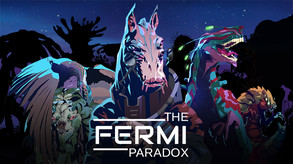
The Fermi Paradox is a choice-driven sci-fi narrative strategy game in which your decisions in one corner of the galaxy can upend entire civilizations in another. Guide species through millennia and help them explore the vastness of space, make contact and, perhaps, create harmony.
Modeled estimate, not a reported figure. How we estimate →
About
The Fermi Paradox is a choice-driven narrative strategy game in which you’ll guide alien civilizations that can thrive or simply survive through the ages, picking up radio signals from distant stars and finally making contact with one another by exploring the furthest corners of the galaxy.
Galactic God game: Play as galactic gardener rather than a single faction, guiding up to 10 civilizations simultaneously
Choice-driven gameplay: Every event presents three choices that change the course of history – every decision matters, and consequences ripple across millennia
Many unique alien species: From nightmarish deep sea creatures to graceful sapient plant-beings, there are even strange hairless mammals called Humans
400 different civilization-development events: Each event tells its own story and provides new choices that impact the story of that civilization – be it apocalyptic floods, sexual revolutions or conscious interstellar warships
Distinctive societies within starships and colonies: Life on a generation ship or on an unknown planet poses different challenges and special narrative events
Original electronic ambient soundtrack: Music playfully follows the evolutionary steps of developing civilizations and their spiritual, technological, and energetic trajectories.
Play again and again: Each play-through tells a different story and has its own ending. Will the people of that galaxy unite? Will they wipe out one another in a galactic war? Or will they perish, still alone, never really knowing that other alien life forms existed?
Twitch Integration: Let your Twitch audience vote on story choices in the game.
Become the galactic gardener!
Guide the fate of different planets, species and civilizations. Balance technological progress, military aggression and resource waste so that alien societies survive long enough to make contact with other species.
Choices matter
Alien societies grow and develop on their own – but you can alter the path of their development during crucial moments of social upheaval. How will society change when animals are domesticated, world wars break out or if civilizations begin cloning their own people?

Foster multiple alien civilizations
Develop societies from the Stone Age to technological singularity and beyond. How will they treat their own, and what will their beliefs be? What message will their first radio waves sent out into the cosmos contain? What are their intentions when travelling thousands of years by interstellar spaceships to another star?
Write the galaxy’s story
Each play-through will become a unique interstellar saga. From the first decision of which lifeforms will evolve into sapient species, there will be numerous choices determining the history and values of that civilization – from their views on sexuality and religion to their treatment of weaker members of society.
Overcome the long distances of space
Multiple generations will live out their days on starships seeking other habitable planets, while radio signals may echo unnoticed for millennia before they reach anyone that might listen. Of course, the society that sent out a signal may have already perished, and the starship answering their call might arrive only to find alien ruins. Elsewhere, distant colonies may develop into civilizations light-years ahead of the inhabitants of their home planet.
Keep the Balance
Each technological age brings its own challenges, from nuclear war to climate catastrophe, to murderous artificial intelligence. Experience the fragility of the universe, the dangers of military power and how peace might be wrought amongst countless intersecting cultures across the galaxy.

Who are Anomaly Games?
We are a team of indie game developers in Berlin, based at the Saftladen Game Collective. We work to make thought-provoking, inspiring and progressive games, and hope to offer a new take on the space sim genre. The Fermi Paradox is our first game together, but we’ve already made our fair share of video games. Our team members have worked on titles such as Spec Ops: The Line, Kane & Lynch 2, The Captain is Dead, Dreadnought and Sea of Solitude.
Content Warning: This is a game about the rise and fall of civilizations. This includes themes of war; oppression; and atrocities.
Genres
Stats
All-time low is the lowest price we've recorded for this game since we started tracking it.
Languages: English**languages with full audio support
Engagement
Hours played at review time, across 41 reviews with recorded playtime.
Reviews
Themes across 41 recent reviews and how positive each mention is. A keyword signal, not full sentiment analysis.
positive critical· bar length = how often the theme comes up
Reviews
Fermi Paradox is a casual game where you essentially play a god seeding races across habitable worlds, trying to ensure your races thrive and eventually make contact with one another, using your influence to avert wars or even make them worse so you may stop an extinction event later. The races are interesting and I like a lot of the story events for the different races, it allows you to make interesting universes depending on the choices you make, with some being a universe of war while others work to peacefully establish connections with one another. However, I do believe it is worth pointing out that while I do enjoy this game, updates take a VERY long time (As the update to version 0.71 to 0.72 took just under a year), so take that into mind before purchasing the game.
This is a good game that can be highly addictive (the whole "one more turn" mechanic). Civilizations can grow in many surprising ways (and wipe themselves out in equally surprising ways). The hardest mechanic to master is gaining points and when to spend them. Gaining 1 per turn is easy. However, if you want to gain 2 per turn, you've got to screw over a civ to do it. Or let them go extinct for a big point gain. This can make the end goal of getting 3 civs to the FTL stage of Tech really hard. Something to strive for. My only criticism of the game is that Machine revolutions happen way too often, and the game is extremely biased towards them. Having a machine revolution is a bad thing, from which there is no recovery. I feel the game would have been better served if your civs had a chance to actually stop the revolt, or if you could continue to control the development of the machine society. The game ends if there are nothing but machine civs left. You can reduce their population and let them "die off", but then they launch a ship with under 100 machines towards a random star to "survive". If they get to another organic civ, they wipe it out even if the civ has superior tech and billions of people. Absolutely stupid in my opinion. Apparently this is still in early access, so if the Dev's read this, I strongly encourage you to change this mechanic. It is not fun, just frustrating. Other than the above problem, the rest of the game is brilliant, and a lot of fun.
its fun sometimes but really only if you can take your ideal story getting ♥♥♥♥♥♥ up most of the time i cant so i just keep ragequitting it would be a lot more fun if things happend to but everything good in the game costs at least 60 points so all the storys are boring and suck
# The Fermi Paradox Review — A Small Sci-Fi Game With Big Questions The Fermi Paradox is a game built around one of the most interesting questions in science fiction: if the universe is so huge, where is everybody? Instead of turning that idea into a traditional space strategy game, The Fermi Paradox takes a more thoughtful approach. You are not just building ships, conquering planets, or managing resources. You are guiding different civilizations across time, making choices that can help them survive, evolve, destroy themselves, or eventually reach out into the stars. That is what makes the game stand out. The strongest part of The Fermi Paradox is the writing and concept. Each civilization feels like a small story inside a much larger cosmic timeline. You are constantly making decisions that seem simple at first, but those choices can ripple forward in big ways. A culture’s values, technology, conflicts, fears, and hopes all start to shape whether they survive long enough to make contact with others. I like that the game does not treat space as just a backdrop. The galaxy feels mysterious, distant, and fragile. Every civilization is trying to make it through its own problems before it ever gets the chance to answer the bigger question of whether it is alone. That gives the game a different kind of tension than most strategy games. It is less about winning quickly and more about seeing what kind of future your choices create. The art style also gives the game a strong identity. It has a colorful illustrated look that fits the strange alien cultures and big sci-fi ideas well. It feels more like an interactive science fiction anthology than a typical management game, and that works in its favor. The Fermi Paradox is not going to be for everyone. If you want constant action, deep tactical systems, or fast rewards, this may feel slow. A lot of the experience comes from reading, thinking, and watching long-term consequences unfold. Some players may also want more direct control than the game offers. But for the right kind of player, that slower pace is the appeal. This is a game for people who like choice-driven stories, alien civilizations, speculative sci-fi, and games that make you think about the bigger picture. It is not just asking whether a species can survive. It is asking what survival costs, what progress looks like, and whether contact with others is a blessing or a disaster waiting to happen. For stream or video content, The Fermi Paradox works best as a thoughtful discovery game. It gives you room to talk through choices, react to consequences, and let viewers debate what direction a civilization should take. It is not flashy in the usual way, but the decisions can create strong discussion. My verdict is Hidden Gem. The Fermi Paradox is a smart, unusual sci-fi game that turns big cosmic questions into an engaging choice-driven experience. It may be slower and more text-heavy than some players expect, but its concept, writing, and long-term decision-making make it worth checking out. It is thoughtful, strange, and much bigger than it first appears. Final Verdict: Hidden Gem
Sci-Fi is an amazing genre
Development takes forever and the game is buggy at startup. Ultrawide is not supported and trying to hexedit the unity.dll just leads to "ghost resolutions" added. Cannot recommend the game in its currents state, will check back after release, which is aimed within the next 12 months.
A fun little roguelike game. Games are quick, and the stories are fun. Though lord, it's heartbreaking watching your favorite species dodge extinction three times only to be done in by a machine revolution.
I bought it long ago and it sat in my library for a long time collecting dust before I gave it a spin. I am a big lover of table top rpg's and narrative sci fi and fantasy, so this was up my alley. Loved the game! I played through blind and had three set backs getting the ambivalent ending, getting technologically regressed or the colony dying, before finally getting the positive wormhole ending. Felt great after the long grind and multiple times of the whole galaxy getting technologically regressed from superliminal to lightspeed or even nuclear ages. The Pollux colony of humans who fled earth, set out their own colonists who in turn toured the galaxy and met all the species. Four legged herbivore personality mergers, robotic all consuming drones, angry fertility apes, utopian fire cats, and then other humans! When there was a galactic technological regression from wormhole collapse caused by the four legged reptile kind these utopian pacifist scientists were in deep space, immune from its effects. A separate human colony sent by Earth in the Epsilon Indi system which was a pleasure colony was finally met with these travelers they had a societal union, sharing culture and technology, and jumped to the superliminal age. These Neo-Gentleformer Charities in turn sent out colonists who shared technology with multiple other species, creating peace and bringing stability for the completion of the great wormhole project. And they lived happily ever until the heat death of the universe, to live on in the multi-verse.
!
Дуже цікава гра, якраз для поціновувачів космічної sci-fi та мрійників які люблять дивитись на зоряне небо і питати: "Там, біля тих зірок, хтось дивиться так само на зоряне небо?". Хотілось би більше анімацій, і більш реалістичних артів іншопланетян та їх життя. Додайте українську мову, будь ласка. Please add Ukrainian language.
Related
Related
Trends
Concurrent players on Steam, sampled daily since tracking started.
Momentum
Pace estimated from the game's recent review growth (our daily snapshots) at its own sales-per-review ratio — a momentum signal, not booked sales.
Audience
Estimated from the language of this game's reviews — a proxy for where players are, not official Steam demographics.
Related
| SimCasino | $499.3K | 757 | 74% | $24.99 |
| Alien Breed: Impact | $499.4K | 1.9K | 74% | $9.99 |
| Spark in the Dark | $499K | 1.1K | 88% | $16.99 |
| CastleStorm | $499K | 1.6K | 89% | $9.99 |
| Firmament | $498.6K | 1.6K | 72% | $20.99 |
| Ghost of Dragon | $499.9K | 804 | 41% | $19.99 |