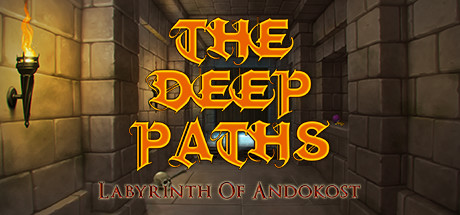
The Deep Paths: Labyrinth Of Andokost is a first-person, dungeon crawling RPG.
Modeled estimate, not a reported figure. How we estimate →
Media
About


Genres
Stats
All-time low is the lowest price we've recorded for this game since we started tracking it.
Languages: English**languages with full audio support
Engagement
Hours played at review time, across 40 reviews with recorded playtime.
Reviews
Themes across 40 recent reviews and how positive each mention is. A keyword signal, not full sentiment analysis.
positive critical· bar length = how often the theme comes up
Reviews
賛否両論のダンジョンクロウルゲー。 レジェンドオブグリムロック的な内容を期待するとどうしても評価が低くなってしまうが、全く違うゲームとしてとらえれば値段相応。いろんなところが洗練されていないが、慣れてしまえばダンジョン探索がちゃんと楽しめる。戦闘不能になっても短時間で復帰するし、空腹の概念が無いなど、難易度低めなので気軽にプレイできる。 たまにはダンジョンクロウルでも、と思った人におすすめ。短めのゲームです。
Really bad version of games like Dungeon master of old. Movement isn't fluid so no in and out and attacking, combat is clunky, just very bland. Play Grimrock instead, far superior
Also mir gefällt es. Klar, es gibt auch bessere Dungeon Crawler mit einem diffizileren Kampfsystem, aber es erfüllt seinen Zweck. Die Grafik finde ich sehr gut und auch die Rätsel treffen meinen Geschmack. Einige Kritiker bemängeln, dass das Magiesystem nicht der Hit ist. Stimmt schon, es ist ein wenig steif, einfach nur einen Stab zu finden und damit rumzuballern ist nicht wirklich das, was ich mir beim Anlegen meiner beiden Magier erhofft habe, aber man kann damit leben. Fazit: für 4,99 kann man schon nicht meckern und aktuell im Angebot für 99 Cent empfinde ich das Spiel schon als geschenkt.
Crashes after character creation. When trying to load a save from a few months ago does not load. Fun game for the three hours i played but way too buggy and unstable to recommend. Great intro music harking back to the early days of dungeon hack and slash rpgs of the 1990's. Here is to better luck on any future games by Mr Steve Jarman.
супер!
don't buy the game isn't working.
The puzzles are basically the same as in any dungeon crawler, trapdoors, buttons, timed levers etc. BUT... regaining health out of combat is so slow. 5 minutes for a full party. it also lacks to explain some game mechanics like 'why can't I press this button?'. some dialog pops up every now and then where party members discuss new mobs or dangerous parts of the dungeon, why not share their thoughts about unusable buttons? combat. wow. a rat almost killed me. ONE rat. and I was already on level 4.
It's a budget Legend of Grimrock. Replay value is a bit limited because of the simple character creation process.
A pile of junk, just refunded it. Antivirus doesn't like it but even after adding an exception the game keeps crashing. The 10mins I actually spent playing it showed me how poor this "game" is.
The Deep Paths: Labyrinth Of Andokost is a deliberately old-school first-person role-playing game that wears its inspirations proudly, aiming to recreate the feel and structure of classic dungeon crawlers from the late 1980s and early 1990s. Developed and published by Steve Jarman, the game is clearly designed for players who appreciate methodical exploration, grid-based movement, and a slower, more tactical pace that prioritizes planning and survival over spectacle. Rather than modernizing the genre with streamlined systems or cinematic presentation, it embraces retro conventions almost entirely, making it a niche but sincere tribute to its roots. The game places players in the role of a four-character adventuring party tasked with descending into the sprawling Labyrinth of Andokost, an underground maze tied to the fate of the city above. Movement is strictly tile-based, with players advancing one square at a time and turning in fixed increments, reinforcing a deliberate rhythm that demands attention to positioning and orientation. This approach emphasizes careful navigation and spatial awareness, encouraging players to mentally map corridors, intersections, and dead ends as they progress. Exploration is not about speed but about caution, observation, and learning the labyrinth’s layout through repetition and note-taking. Combat follows a turn-based structure that blends smoothly into exploration, triggering encounters when enemies are met within the dungeon. Battles focus on party composition, positioning, and the effective use of abilities rather than flashy animations or complex systems. Each character archetype fulfills a clear role, with melee fighters absorbing damage, rogues contributing precision attacks, and spellcasters providing offensive magic or support. While the mechanics are relatively simple compared to modern RPGs, they demand thoughtful decision-making, especially when resources such as health and spells become scarce deeper into the dungeon. Character progression is straightforward and functional. As party members gain experience, they grow stronger, unlocking improvements that make later encounters more manageable. Equipment upgrades provide incremental power boosts, and finding better gear becomes an important motivator for exploration. The game does not overwhelm players with build complexity or branching skill trees, instead favoring clarity and familiarity. This simplicity reinforces the retro design philosophy, but it can also feel limiting for players accustomed to deeper customization and mechanical experimentation. Dungeon design is expansive and intentionally maze-like, often prioritizing size and complexity over visual variety. Corridors, rooms, and secret passages form a dense network that can feel oppressive and disorienting, especially without modern conveniences like fully automated mapping. While in-game maps can be found and used, much of the burden of navigation still rests on the player. For genre veterans, this adds to the sense of immersion and accomplishment, but for others it may feel tedious or archaic, particularly during long play sessions where backtracking becomes frequent. Visually, The Deep Paths: Labyrinth Of Andokost adopts a functional 3D presentation that echoes early dungeon crawlers. Textures are simple, environments are sparse, and animations are minimal, but everything is readable and serves its purpose. The atmosphere relies more on imagination and tension than on visual flair, with dim corridors and repetitive stonework reinforcing the sense of being trapped underground. Sound design follows a similar philosophy, using restrained audio cues and understated music to support the dungeon’s mood without drawing attention away from gameplay. Narrative elements exist primarily as background context rather than a driving force. Lore is discovered through exploration, dialogue snippets, and environmental hints, giving players just enough information to understand the stakes without interrupting the dungeon crawl with lengthy exposition. The story functions as a framework for exploration rather than a focal point, aligning with the game’s emphasis on gameplay systems and player-driven discovery. The game’s reception reflects its narrow focus. Players who enjoy classic dungeon crawlers often appreciate its commitment to traditional mechanics, its low price point, and the satisfaction of overcoming challenges through patience and strategy. Others find its lack of polish, limited mechanical depth, and dated interface frustrating, especially when compared to more refined modern tributes to the genre. The interface can feel clunky, inventory management lacks convenience, and some systems feel underdeveloped, which can detract from immersion over time. Ultimately, The Deep Paths: Labyrinth Of Andokost is a game that knows exactly who it is for. It does not attempt to appeal to a broad audience or reinvent its genre, instead offering a faithful, uncompromising dungeon-crawling experience rooted in nostalgia and deliberate pacing. For players who miss grid-based exploration, manual mapping, and straightforward party-based combat, it provides a lengthy and atmospheric descent into a classic-style labyrinth. For those seeking modern comforts, deep customization, or narrative-driven RPG design, it may feel too rigid and dated. As a passion project and homage to a bygone era, however, it stands as a sincere and focused example of retro dungeon crawling done with clear intent. Rating: 5/10
Related
Related
Trends
Concurrent players on Steam, sampled daily since tracking started.
Momentum
Pace estimated from the game's recent review growth (our daily snapshots) at its own sales-per-review ratio — a momentum signal, not booked sales.
Audience
Estimated from the language of this game's reviews — a proxy for where players are, not official Steam demographics.
Related
| Black Myth: Wukong | $794.9M | 1.2M | 97% | $59.99 |
| ELDEN RING | $680.4M | 1.1M | 93% | $59.99 |
| DARK SOULS™ III | $467M | 437.9K | 94% | $59.99 |
| 7 Days to Die | $425.3M | 403.5K | 87% | $44.99 |
| Hogwarts Legacy | $323.6M | 369.9K | 90% | $59.99 |
| Mount & Blade II: Bannerlord | $309.8M | 293.9K | 88% | $49.99 |
Related
| 10 Years After | $19.5K | 129 | 11% | $5.99 |
| Oik 2 | $19.5K | 1.4K | 93% | $0.72 |
| Super Retro Fighter | $19.5K | 87 | 78% | $11.99 |
| Arrow Heads | $19.5K | 58 | 71% | $14.99 |
| My Magical Demon Lover | $19.5K | 58 | 72% | $9.99 |
| Deadly 30 | $19.5K | 1.2K | 80% | $0.79 |