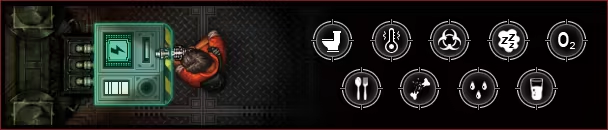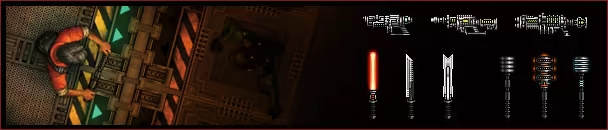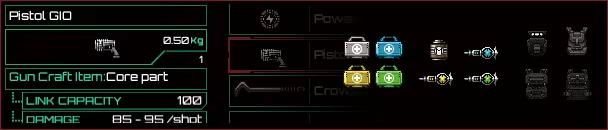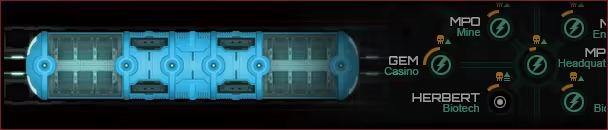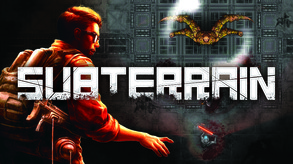
Uncompromising Sci-Fi survival on Mars! Manage the entire colony single-handed! Craft, Research, Explore and Fight against evolving mutants. Vast open world and randomly generated levels to explore! Can you survive long enough to escape the horror?
Modeled estimate, not a reported figure. How we estimate →
About


Genres
Stats
All-time low is the lowest price we've recorded for this game since we started tracking it.
Languages: English, Russian, Traditional Chinese, French, Italian, Spanish - Spain, Greek, Simplified Chinese, German, Japanese, Hungarian, Turkish
Engagement
Hours played at review time, across 40 reviews with recorded playtime.
Reviews
Themes across 40 recent reviews and how positive each mention is. A keyword signal, not full sentiment analysis.
positive critical· bar length = how often the theme comes up
Reviews
如果没有那些科学家就没有这么多事情 你叫韦斯特,精确地说是韦斯特博士。你被一个大老板邀请到火星的基地上去做实验,你玩脱了(事实上是别人拿你的研究成果玩脱了)。所有人不是逃走了就是变成了怪物,而你却因为被抓起来而幸运地逃过一劫,好吧现在怎么办?这个破地方就你还活着,没人想死对吧,那么故事也就从此开始了。 我究竟能不能逃离这里 在你准备离开之前,你发现这个地方所有的科技啊,电力系统啊,反应堆都被某个人故意调成了最低。这就直接引出了你要去到处找芯片的理由(没有芯片你就没有科技)。而且你还得睡觉喝水吃东西,这些我都能,但我觉得需要排泄感觉好奇怪,明明憋不住了却没有什么副反应(或者说是作用太小我看不见?) 回到正题,地图都是随机的,而且说实话,东西都很小,有些时候容易遗漏东西,这就有问题了,当你遗漏重要的东西时,你会很难再去发现或者找到它,因为它太小了。 当你小心翼翼并且做完了一切的工作,当你发射飞船时,接下来的故事会让你心碎,我已经被打击过了,所以希望你们也能在游戏中体验一下孤注一掷后换来这种东西的痛苦。 这场旅行究竟值不值 游戏给人的感觉还是挺好的,气氛挺压抑的,而且随机的地图和有限的补给(这里指你的温度、电池、氧气)让你不得不快速做出选择,在这里多走一步是危险也是机会。 游戏特点: 超棒地图探索与黑色区域消除体验 转转转,让你的地图看起来没有遗漏 按住你的shift不要松开 跑,坐下,跑,坐下,喔你冲进怪物圈子里了 不要玩手雷 每个东西都做两个 药品需要更多的血球来支持 在高品质画面下,你找东西会更加困难 没什么用的闪光弹 所有怪物都吃了火星玛丽所以你也应该来一剂来防止开门杀 我觉得我的近战可以砍死一片怪物 并没有用,你的近战一次只能对一个怪物进行攻击 别进怪物堆里,你会动不了的 你总是会忘记点东西并永远找不回来 不要指望一次就能通关 忘了手枪和霰弹枪吧,冲锋枪最好了 闪光弹的作用就是不会炸自己 你以为那些上锁的门里会有重要的东西吗?除非这个房间很特殊并可以找到对应的木马钥匙卡或者需要专属钥匙卡,不然里面只不过会有一些食物或者药品而已。 不要以为高级的钥匙卡就很稀有 很多故事但很难收集全 设备研究停不下来,生物研究闲得蛋疼 捡更多的垃圾,特别是半导体 超级感人的冲锋枪精准度,它总是完美地避开怪物
I really wanted to like this game, but it is just tedious and anti-exploration. You have 1 save slot and one auto-save slot. I had to restart my 2-hour playtime because it is not mentioned that the contamination slowly kills you, and the fast travel costs time, so I was constantly trying to find the next anti-pill and the next health pack until I ran out of health. So, new game: less exploration and go for the stuff directly so I can advance. It is not fun.
I really had a blast with this game especially considering that you can pick it up very cheap on sale. After a quick tutorial level you learn that you need do several things pretty much all at once. 1) Don't die, Eat, Sleep, Drink, Piss, ♥♥♥♥, and Keep your infection rates down. Keep the global infection rates down, keep the individual sector infection rates down. Don't run out of power (ammo and flashlight), oxygen or let yourself freeze to death. 2) Manage the reactor cores, if the reactor goes down, its over and yes there will be invasions. 3) Find upgrades for your base, which includes 4 sectors and the reactor cores and more. 4) Loot everything with your tiny backpack so you can keep upgrading your equipment, which includes armor, guns, grenades, drugs, and medicine... and more. 5) Manage your time effectively so you don't fall behind on anything from numbers 1 through 4. The main thing you'll need are the data chips for the 4 sectors, problem is you don't know where they are... and neither does the game (for most of them) because its randomized... If this sounds like a lot, its because it is, and the game does not do a very good job teaching you any strategy for how to handle all of this or even really where to start other than to just find those data chips... somewhere out there, but once you start to understand the flow of the game its gameplay loop is really fun, go out, survive, kill, loot, comeback research, repair, sleep... and slowly over time you'll go from barely hanging on to winning back the planet. Making tangible progress felt amazing, and kept me coming back, I would get excited about finding a new upgrade chip or maxing out my SMG research or making all new cores for the reactor or finally being able to grow tomatoes. I'm gonna give everyone a hint here... it's much better if you kind of spread the love around, but not too much. Stick close to home and do just 1-2 levels of an area, then retreat, repeat that only at the closest 4 locations until you have all your level 2 chips... by now you should know enough about the game to get your feet under you, and what you need to do to push ahead. On the down side the game is so overwhelming at times that almost anything you've missed or screwed up can feel like a mistake or bad design or a bug... if you miss a critical keycard or quest item, that can be real trouble. It can be crippling if you've dropped it somewhere you shouldn't have (don't drop stuff anywhere but your base). Subterrain can get pretty darn repetitive as you have a lot of areas to explore... like nearly 80 floors of rooms and doors and corridors. I will admit the game almost wore me out but I wanted to see the end, and I'm glad I did. There's multiple endings and I think overall the story was actually pretty good. To sum it all up I had a fantastic time with Subterrain and I think it could really appeal to a lot of people who like survival shooters, or crafting, upgrading, planning and time management. Especially for the low price point... its an amazing value, if you manage to figure out those first few steps. For the most sadistic there's also higher difficulties and permadeath modes to play through.
Score: 3/5 An interesting set-up/setting for survival-horror ruined by very poor balance/execution/polish in too many areas, especially regarding tedious inventory management and survival mechanics, and the distinct lack of post-launch support from the dev(s) who went on to make a sequel. [b]The Good[/b] 1. Writing and Setting 2. Atmosphere. Heavy, dreadful survival-horror. 3. Audio/SFX, Music/Soundtrack. a. Good variation on footsteps depending on the material you are walking/running on. Audible enemy reactions to being hit. b. Beeps from powered equipment to keep track of remaining charge. 4. Solid UI/UX. A lot of readouts/information from your equipment about your state, the state of the environment, location, time and date, etc. Pop-ups on many items/pieces of gear. Good “scan nearby area” feature to see what parts of the environment are interactable. 5. Responsive controls. 6. Saves, load times between levels, and when opening menus are all very quick. Also, smooth menu navigation (there’s a lot of it). 7. Stamina values are solid, including penalties, action costs and temporary action cost reductions, and regeneration rates. [b]The Bad[/b] 1. Combat balance is rough. a. Ranged weapons overheat too easily and use too much energy. Durability is a bit too low for some weapons (melee and ranged) and moderately too low for others (especially a handful of melee options). The repair station counteracts a good bit of tedium around durability though. Melee weapon damage is mildly-to-moderately too low, and ranged weapon damage is moderately too low. b. Enemy attacks’ contamination damage/rate is too consistent. c. Although some enemy combat behaviors / attack patterns are good, requiring moderate timing and thoughtful strategy to overcome, most enemies have very limited move-sets, including creatures that should mainly using melee attacks having no melee attack. d. Very little enemy variety. Although some enemies have different types of a similar/related units in their group that will make them fun to fight, the group will almost never have enough variation. 2. Survival mechanics are also imbalanced and tedious. a. Safe food is too difficult to secure. b. Contamination rates are absurd for farmed foods and tap water, and farmed foods have ridiculously low hunger/thirst reduction values. 3. Inventory management. a. The bags do not have nearly enough max slots, and the max amount of slots each item can take up is 1, with many items being stackable. But because many key items do not stack and are extremely small, slot management makes inventory management unpleasant overall. Even after quadrupling max slots for each bag/backpack through modding, it was still very tedious. Additionally, the train’s storage is laughably restrictive. b. Weight values (kg) are often too low, and rarely too high, but that favors the player and reduces some of the tedium from other mechanics, including slots, so it gets a pass from me. c. No sorting feature. d. Good controls for breaking item stacks into smaller stacks or removing single units. 4. Crafting costs and disassembling results are too harsh for many key consumables and pieces of gear. 5. Minor technical issues. Enemy AI/behavior will somewhat frequently glitch (or was poorly coded), and will not react to being hit with ranged weaponry, just standing still until you kill it. This only occurred rarely with melee weaponry though. Because the grab object button is shared with a key combat action, I often activated the battery-draining combat action when I didn’t mean to. 6. Although it has a small bit of official mod support, which is appreciated, modding was difficult. There is only a single, out-of-date mod on the Nexus. Acquiring the files/software to mod the files myself it was moderately rough/unintuitive, and many parts of the official modding files/software either don’t work when edited or work in bizarre ways that will not give you an intended/intuitive result.
Loved the opening hours but eventually hit a wall where progression stopped being fun and became more tedious. There is an absolute gem of a game here hidden under a few poor design decisions. I recommend heeding the warning of the negative reviews that detail this. Yet, still I recommend giving it a try. The atmosphere and overall gameplay loop for those first few hours is just so darn appealing it's worth seeing if the entire game is for you.
Задумка очень классная, но зачем так душить игрока в самом начале накидывая сразу все механики игры залпом? И реактор им почини, ресурсов добудь, баллонов насобирай и наполни, предметы создай, ключ карты найди итд, и приправлено все это ну очень мелким интерфейсом хоть с лупой сиди читай простыни текста. Надо постепенно механики игры раскрывать, а не в самом начале за раз все вываливать. За час игры голова вскипела. Не удивительно что только 60% процентов игроков прошли обучающий уровень. И самое главное, ГГ хочет в туалет по большому, идем делаем свое дело, через две минуты он хочет по маленькому! А совместить два дела никак за раз нельзя было?! И делать это надо в строго отведенных местах!!! А не где попало, ведь Вексу плевать что там темнота, инфекция, монстры и каждая минута дорога, главное добежать до сортира во тьме. Ох уж эти тупые игровые условности=)))
I can't manage to finish this game, the atmosphere just keeps dragging on you and there's no levity anywhere. It just moves me into disinterest every time I set up shop at the main hub.
Subterrain, developed and published by Pixellore Inc, is a demanding top-down survival horror game that blends intricate resource management with a persistent sense of environmental collapse. Set in an underground Martian colony that has fallen into chaos after a mysterious outbreak, it places players in the role of Dr. West, one of the few remaining survivors. Rather than focusing on action or spectacle, the game builds its identity around pressure—constant, layered pressure that forces players to think carefully about every decision they make. What immediately sets Subterrain apart is the complexity of its survival systems. Instead of a handful of basic needs, the game introduces a network of interconnected mechanics that must be managed simultaneously. Hunger, thirst, fatigue, oxygen levels, body temperature, and health conditions all require attention, and neglecting any one of them can quickly lead to failure. These systems are not isolated; they interact in ways that create cascading consequences. Venturing too far without proper preparation can result in running out of oxygen, while exposure to environmental hazards can trigger additional complications that spiral out of control. The result is a gameplay loop that demands planning, awareness, and constant adaptation. Beyond personal survival, the game extends its mechanics to the colony itself. The facility is not a static backdrop but an active system that must be maintained. Power distribution, oxygen generation, and temperature control all play a role in keeping the environment livable. Players must decide which areas to prioritize, often under limited resources, creating a strategic layer that goes beyond moment-to-moment survival. This broader responsibility adds depth, as the player is not just trying to stay alive but also attempting to stabilize a deteriorating system that continues to degrade over time. Combat is present but secondary to the overall experience. Players can craft and use a variety of weapons, but encounters are rarely straightforward. Enemies evolve and become more dangerous as the game progresses, and engaging them without proper preparation is often a mistake. Success in combat depends less on reflexes and more on positioning, resource management, and understanding the situation. In many cases, avoiding confrontation or finding alternative solutions is the safer option, reinforcing the game’s emphasis on survival over aggression. The pacing is deliberately slow and methodical, which may not appeal to everyone. Subterrain does not guide players gently into its systems; instead, it expects them to learn through experimentation and failure. The early stages can feel overwhelming, with a steep learning curve that requires patience to overcome. However, once players begin to understand how the various systems interact, the experience becomes more rewarding. Progress feels earned, as each small success is the result of careful planning and execution rather than chance. Visually, the game adopts a minimalist top-down perspective that might seem simple at first but works effectively within its context. The underground colony feels confined and hostile, with dimly lit corridors and abandoned spaces contributing to a strong sense of isolation. The lack of visual excess allows players to focus on the mechanics, while the subdued presentation enhances the oppressive atmosphere. Sound design complements this approach, using ambient noise and subtle cues to reinforce tension without relying on overt horror elements. Crafting and progression systems add another layer of depth. Players gather materials, break them down into components, and use advanced tools to create equipment and upgrades. Research plays a key role, unlocking new technologies that improve survival chances. This progression is meaningful but never trivial; every upgrade requires effort and often involves taking risks to acquire the necessary resources. The balance between risk and reward is a constant theme, shaping how players approach each new challenge. Despite its strengths, Subterrain is not without its issues. The complexity that defines the game can also make it difficult to approach, particularly for new players. The interface and tutorials do not always provide sufficient guidance, leading to moments of confusion. Some systems can feel cumbersome to manage, especially when multiple factors demand attention at once. Additionally, the game lacks the polish of larger productions, with occasional inconsistencies that can disrupt the experience. Ultimately, Subterrain is a game that prioritizes depth and challenge over accessibility. It offers a layered survival experience that rewards careful planning and persistence, creating a sense of immersion that few games in the genre achieve. While its steep learning curve and demanding systems may limit its appeal, those who invest the time to understand it will find a deeply engaging and rewarding experience. Rating: 8/10
Fun
Initial setting is really interesting, but sadly its not developed that much further or at least it takes ages to get to anywhere thats not the same. Quite grindy, though I'm not sure thats even the problem in itself. The game should just help the grind to be little more tolerable. Like machines taking resources from train and every container having more slots to put more stuff in. Or how weapons work; Weapons use energy which is essential to operate. You will need lots of energy cubes to carry. Weapons also overheat and deteriorate. So you cannot shoot than maybe 2-3 enemies at once before switching to different weapon and you cannot fullclear a location without needing to repair your weapon at base. And weapons also feel very weak. Why all of these bad qualities at once? Shouldn't it rather be that different weapons have different setbacks? Overall, while interesting setting and some interesting ideas, the game is eventually not fun. I will also add that maps are randomly generated. Meaning that there pretty much cannot be anything interesting there, including but not limited to location specified enemies. As you realise that, the exploring just becomes a task of finding few special rooms from the mass and you stop expecting anything interesting. Thats the downside of random generation, even when size can be created quickly.
Related
Related
Trends
Modeled estimate over time, reconstructed from Steam's monthly review histogram.
Momentum
Pace estimated from the game's recent review growth (our daily snapshots) at its own sales-per-review ratio — a momentum signal, not booked sales.
Audience
Estimated from the language of this game's reviews — a proxy for where players are, not official Steam demographics.
Related
| Subterrain | — | 91 | 78% | $5.09 |
| Don't Starve | $33.6M | 113.2K | 97% | $9.99 |
| Teleglitch: Die More Edition | $994.7K | 2.9K | 85% | $12.99 |
| The Survivalists | $4.4M | 10.1K | 76% | $24.99 |
| The Infected | $3.5M | 6.5K | 85% | $15.99 |
| Terminus: Zombie Survivors | $2M | 4.5K | 94% | $13.99 |
Related
| Stranger of Sword City | $303K | 638 | 66% | $19.99 |
| Disc Room | $303.1K | 1.1K | 93% | $14.99 |
| Operencia: The Stolen Sun | $302.9K | 575 | 77% | $29.99 |
| Space Tyrant | $302.9K | 615 | 84% | $19.99 |
| Initial Drift Online | $302.8K | 5.8K | 62% | $1.99 |
| Sandwalkers | $302.8K | 547 | 76% | $19.99 |