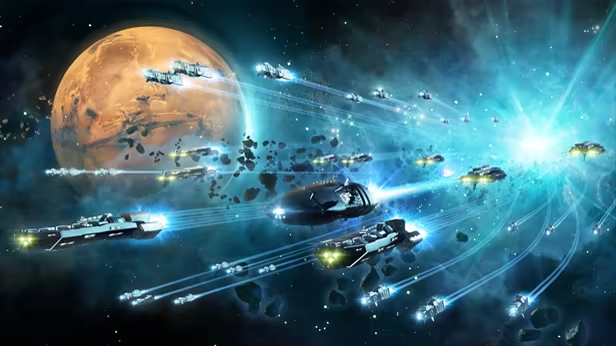
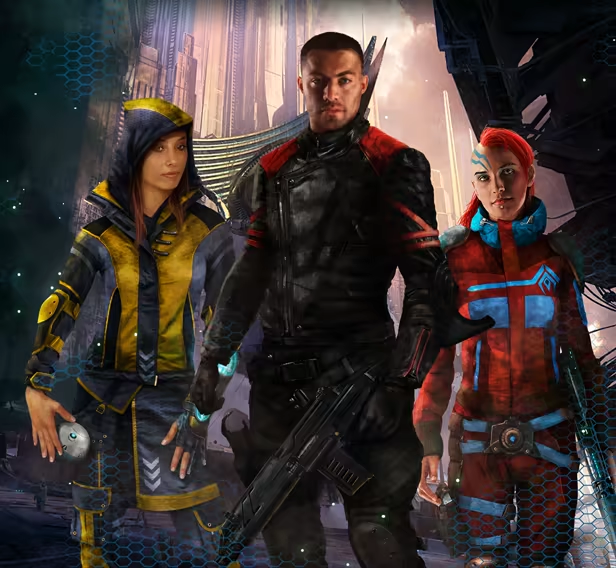
Captain your own space ship and roam the galaxy in 3D in this tactical space simulator with tons of RPG depth ! Space has never looked so inviting - but images can betray...It has been two years since the end of the second Gemini war, the situation in the wartorn system is further from resolution than ever.
Modeled estimate, not a reported figure. How we estimate →
About


Genres
Stats
All-time low is the lowest price we've recorded for this game since we started tracking it.
Languages: English*, German*, Russian, Polish, French*languages with full audio support
Engagement
Hours played at review time, across 41 reviews with recorded playtime.
Reviews
Themes across 40 recent reviews and how positive each mention is. A keyword signal, not full sentiment analysis.
positive critical· bar length = how often the theme comes up
Reviews
Fun fun game. Need more space games that aren't 4k political nightmares.
Starpoint Gemini 2 is an expansive single-player space RPG and simulator developed by Little Green Men Games that places a strong emphasis on player freedom, ship progression, and open-ended exploration within a large, faction-driven galaxy. Rather than focusing on small fighters or fleet micromanagement, the game makes the bold decision to anchor the entire experience around commanding a single capital ship. This design choice fundamentally shapes the game’s identity, giving combat a slower, more deliberate weight and encouraging players to think like a captain rather than a pilot. From the moment you enter the Gemini system, the game establishes itself as a slow-burn space adventure that rewards patience, planning, and long-term investment over instant gratification. The universe of Starpoint Gemini 2 is structured as a vast sandbox layered on top of a loose narrative framework. You can follow the story campaign, which centers on political instability, hidden conspiracies, and the legacy of powerful figures within the system, or you can largely ignore it and carve out your own path. The sandbox approach is where the game truly shines, offering a wide array of activities such as bounty hunting, escort missions, piracy, trading, exploration, and faction warfare. Missions are plentiful and dynamically generated, ensuring there is almost always something to do, even if many of these tasks share familiar structures. The real appeal lies not in the individual missions themselves, but in how they feed into your broader goals—earning credits, improving reputation, unlocking licenses, and slowly transforming your ship into a fearsome presence in the sector. Combat in Starpoint Gemini 2 is methodical and tactical, reflecting the scale of the ships involved. Battles are not about twitch reflexes but about positioning, timing, and loadout decisions. Shields are segmented, encouraging flanking maneuvers, and weapons vary widely in function, from long-range beam cannons to devastating torpedoes and heavy turret systems. Each encounter feels deliberate, with engagements often unfolding over several minutes rather than seconds. While this slower pace can feel cumbersome to players expecting fast-paced dogfighting, it suits the game’s emphasis on capital-ship warfare and reinforces the fantasy of commanding a massive vessel bristling with firepower. One of the game’s strongest aspects is its progression and customization systems. There is an impressive roster of ships available, each with distinct strengths, weaknesses, and upgrade potential. Outfitting your ship involves far more than simply buying better guns; you must consider reactor output, shield coverage, turret arcs, and auxiliary systems that can dramatically alter how your ship performs. On top of this, your captain develops through a robust skill tree system, allowing specialization into roles such as damage-focused gunners, support-oriented commanders, or engineering-centric builds that emphasize survivability and efficiency. Officers and mercenaries further deepen this system, providing bonuses and abilities that encourage thoughtful crew composition and long-term planning. Exploration and the in-game economy are tightly interwoven with progression, giving the Gemini system a sense of scale and lived-in complexity. Numerous factions occupy different regions of space, each with their own political agendas, enemies, and economic interests. Your reputation with these groups affects everything from mission availability to access to powerful licenses that unlock unique bonuses. Trading and mining offer viable paths to wealth, especially for players who prefer a more peaceful or strategic approach, and learning the ebb and flow of commodity prices can be just as rewarding as winning a large battle. The galaxy feels busy and reactive, with faction conflicts and territorial control shifting over time, subtly reflecting your actions within the larger system. Visually, Starpoint Gemini 2 delivers a convincing sense of space despite its age. The environments feature colorful nebulae, asteroid fields, derelict stations, and large-scale fleet engagements that emphasize the enormity of the setting. While the graphics are not cutting-edge by modern standards, the art direction and scale help maintain immersion, particularly during long journeys between systems or when watching massive ships exchange volleys of heavy fire. Sound design and music further reinforce the atmosphere, lending weight to combat and a quiet sense of isolation during exploration. That said, the game is not without its shortcomings. The learning curve can be steep, and the interface initially feels dense, with many systems layered on top of one another. Some missions can become repetitive over time, especially during the early stages before your ship is powerful enough to handle more varied encounters. The story campaign, while serviceable, often takes a back seat to the sandbox systems and may feel underdeveloped compared to the freedom offered elsewhere. These issues can make the experience feel uneven, particularly for players looking for a tightly paced narrative or streamlined mechanics. Ultimately, Starpoint Gemini 2 is a game that thrives on ambition and scale. It offers a richly detailed space sandbox that rewards players who enjoy gradual progression, deep customization, and the freedom to define their own goals. While it may not appeal to everyone due to its slower pace and complexity, it stands as a compelling experience for fans of space RPGs who value depth, immersion, and the satisfaction of building a powerful ship over time. For those willing to invest the effort, the Gemini system becomes a vast playground of opportunity, danger, and discovery that can easily absorb dozens—or even hundreds—of hours. Rating: 7/10
My friend who I play CS:GO with said if I post a review on this game and it gets 200 likes and 200 Awards that he will buy me a RTX 4060 and 2 Litres of Jizz. So I'm just gonna leave this here. Help a brotha
Not so good a Euro-junk. The story is not engaging, while most of the game play (the so called freedom) is a simple grind-upgrade loop. The combat system is shallow and boring: the targeting priority of auto-fire is confusing or even random, while there's no trajectory prediction indicator for manual shooting. So the space combat is basically just flying around enemies, let turrets to auto fire and hit missile/4 skills/4 items keys every few seconds. The whole thing is horrible. Players might have to farm repetitively for hours or cheat to simply finish the campaign. It is shocking to see how easy to satisfy people's desire of a modern Freelancer.
Space RPG done well. Don't worry about realism, this game is just fun as it is. The physics is well done, but the Gemini system objects are fixed in space ie. planets don't move. There are lots of interesting "terrain" features in the form of wormholes, riftways (space rivers), radiation zones, lightning zones, etc. There is also lots of space sound, space fire, space debris and space rocks. Combat is basically space tanks. Freighters are available if you want to mine or scavenge. You can build a small fleet and command it in battle. Only con is space flight can get tedious. Space is BIG. No multilplayer, but SG wasn't meant to compete with eve online or any of its derivatives in the multiplayer arena. Lastly, you can ignore the campaign and just play the game factions against each other and space battle forever as good or bad or any level in between depending on your reputation. I have not tired of this yet, although it gets a bit samey after a while. On (Kubuntu) Linux I had to auto-hide my taskbar to get it to work properly in fullscreen. I played around with different proton versions. 10 has worked best for me. SG2 DLC are ok, nothing specially different except a badass ship of your choice. I will review origins once I finish it.
A good game overall. The only other space sim I've played is X3:TC, so I'll compare it to that. Pros: - Easier to get started, probably a better "first space sim" - Better story (not *great*, but there is more emphasis on a main campaing than in X3) - I liked the RPG aspect: levels, perks, and abilities. Cons: - There's no fleet or empire to control, so i guess the sandbox experience is reduced. but I guess that's why they created "warlords", which I'll try soon-ish. - Trading is mostly pointless, you soon find out the only way to make money is to capture ships (which is much easier than in X3) - Factions and ships are a bit more "semi-ish" - The balance is quite bad; you're either under or overpowered most of the time. Very annoying. Overall i enjoyed it. A more than decent game for RPG enjoyers wanting to get into space sims. Decided to skip the DLCs but I hope Starpoint Gemini Warlords will strike better the balance i crave between space sim sandbox and RPG narrative.
A long overdue thumbs-up for this game! Steam says I've got about 30-odd hours on it. Twenty-something of that was back in 2015. I enjoyed it a lot at the time, but I got distracted by one spacey-game after another and kinda forgot about it. Flash-forward a decade, and I had a space game itch that the usual suspects weren't quite scratching. On a whim I went back to Rebel Galaxy and this game - and I'm glad I did! This is a fun and chill game, and was exactly what I needed. I'm just playing the Free Roam game, as I like that freedom best. I started from scratch again and have been enjoying the gradual build from zero to now 'just-slight-more-than-zero'. Chill exploration, mining, and missions, with a side order of trade and combat. It's got its quirks, and its not perfect, but it's very enjoyable. A little hint of Freelancer, some similarities to Rebel Galaxy and maybe Astrox Imperium, but very much its own thing. A fun spaceship rpg game, and a great way to escape and chill. Now that I've re-discovered it, I suspect I'll be putting a good bit more game-time into it. So: Yes, a recommend - even now, a decade after release.
An entertaining free-roam space game with satisfying progression and an ultimately forgettable and awkward campaign. If you've played SPG: Warlords like I have, it's basically the same, but with fewer features. Warlords is definitely the better game, but if you can do without territory control and RTS mechanics, you'll have a fun time. Be careful, though, as I ran into a few crashes and soft locks during my playtime, so make sure to anchor to stations and save often. For the prices this goes for on sale nowadays, if you're a fan of space games and upgrade chasing, this is a no-brainer.
Starpoint Gemini 2 is a game I can't believe I paid real money for. It's one more garbage Freelancer clone on a pile of trash. The game goes like this. You start the campaign, and after a three minute or so cutscene with one of the most generic Freelancer clone plots imaginable, you get control of a ship while the game bombards you with tutorial prompts that don't actually tell you anything. Your goal is to fly to a planet and the game is spamming you with "Here's how you reticulate your gravity fluctuators" and other crap that has nothing to do with your current situation. I had to kill the prompts and then had to dig through the controls to figure out how to make my dumpster of a ship go forward, because the tutorial wasn't going to tell me. Then you get to the fun part. Your ship moves at a snail's pace and there is NO WAY TO SPEED IT UP. Your goal is to fly 9,000 kilometers to a planet, and you move at maybe 30 kilometers per hour. You are in space and not even doing highway speeds. It took me ten minutes of the sixteen I played to fly there, and then I got a prompt to stop at the planet and fly back to where I came from. At that point, I started looking for some kind of "warp speed" button like Freelancer had.. except it doesn't exist. You are stuck moving like a grandmother driving down the interstate at 9:30 on Sunday morning toward your objective, and there is no way to speed it up. You can't even AFK it because like Desert Bus, your ship will drift slightly and you'll eventually wind up off course. In a game like EVE, where the very slow movement is part of the game balance, that makes sense. It does not make sense in a singleplayer game, and as soon as I realized this was the intended experience I quit and uninstalled. Avoid.
👎
Related
Related
Trends
Modeled estimate over time, reconstructed from Steam's monthly review histogram.
Audience
Estimated from the language of this game's reviews — a proxy for where players are, not official Steam demographics.
Related
| AaaaaAAaaaAAAaaAAAAaAAAAA!!! for the Awesome | $460.8K | 1.1K | 74% | $9.99 |
| Tribe: Primitive Builder | $460.6K | 788 | 81% | $19.99 |
| Demon Slayer -Kimetsu no Yaiba- Sweep the Board! | $460.9K | 215 | 92% | $59.99 |
| Ways of Alchemy | $460.9K | 717 | 75% | $17.99 |
| Medieval Blacksmith | $460.9K | 591 | 80% | $19.99 |
| I Expect You To Die 3: Cog in the Machine | $460.3K | 630 | 92% | $24.99 |