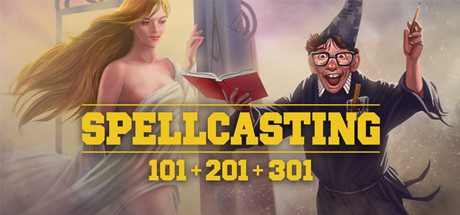
Steve Meretzky's trilogy of magic-themed collegiate text adventures-with-graphics for Legend. The sometimes-smutty but never-beyond-softcore stories put the player in the shoes of one Ernie Eaglebeak, a wizard-in-training at at Sorcerer University.
Modeled estimate, not a reported figure. How we estimate →
Media
About
Stats
All-time low is the lowest price we've recorded for this game since we started tracking it.
Languages: English
Reviews
The Spellcasting Collection is a trilogy of classic text adventure titles, designed by Steve Meretzky during his run at Legend Entertainment. The games follow the antics of our plucky, nerdy protagonist Ernie Eaglebeak during his first three years at Sorcerer University. Meretzky actually had a fourth game (and beyond) planned, but market forces had other ideas, and text adventures succumbed to the combined might of more accessible point-and-click games and the Id Software juggernaut that would change PC gaming forever. Regardless, all three games are bona fide classics, full of clever puzzles and satirical wit. Despite predating Hogwarts by several years, the games are usually described as 'Harry Potter in his wild college years,' and that's fairly apt. The tone is more Terry Pratchett than J.K. Rowling, however, with Meretzky using an effective blend of classic fantasy elements and real-world satire. Peloria is a realm which features both mighty sea serpents and relatively modern cities, and much like Discworld, the combination works really well. The other frequent comparison point is the Leisure Suit Larry series. There's some inherent logic to that, as both games feature deliberately dorky protagonists carousing with women way out of their league. There are some notable differences, though, largely in tone. The quest for sex is the entire point of the Larry games, while in the Spellcasting games, it's more incidental. It's controversial sizzle, presumably added to make an aging format more marketable, and the sex scenes themselves are relatively tame. In fact, you have to turn on the 'naughty' mode in each game if you want to see most of that content at all. Many will likely prefer to keep the games in their default 'nice' mode, where the sex scenes are replaced with deliberately tongue-in-cheek, PG-rated activities. When I first played these games as a teenager, I of course turned on 'naughty' mode within seconds. But as a jaded adult, I find it funnier to help Ocarina finish a crossword puzzle instead of giving in to our baser urges. In a world where anyone can access high-definition streaming smut within seconds, it's unlikely anyone will be buying these games for the promise of VGA nudity. Spellcasting 101 is the most traditional fantasy epic of the three, and a terrific entry into the world of Peloria. While the game features some quality time at Sorcerer University, it eventually expands into an island-hopping adventure across a vast ocean. Most islands revolve around a unique theme or gameplay gimmick, be it a land where time runs backwards or, most infamously, trying to escape an army of lonely Amazons who aren't about to let the only man in town just waltz on out of there. The puzzle variety is terrific and helps keep the game fresh as you go along. My personal favorite is the Island Of Lost Soles, based on a curse where the 80 residents were transformed into objects representative of their real names. It's the perfect setting for getting a few people around the keyboard to help each other figure out every last name. ("Okay, so it's a bunch of logs lined up end to end... Timber, no, that's not a common name... uh, Loggy? Lumbro? Wood.... WOODROW! GAH, FINALLY!") It also has a terrific endgame, featuring multiple 'brick jokes' that land beautifully and a delightfully silly showdown. 201 is my favorite of the three games, although much of that is for personal reasons. (Due to circumstances I can't even begin to remember, it's the only game of the three I didn't play when it first came out, so I ended up playing it several years later when I was actually IN college and it resonated more as a result.) Most of the game takes place on the Sorcerer University campus, giving it a much more intimate atmosphere than 101 had. The game is also much more structured, with each day centered around Ernie trying to complete (and survive) an increasingly absurd hazing ritual in his quest to join the Hu Delta Phart fraternity. (Alas, as the series ended prematurely, we never did find out who dealt said phart. It shall forever remain a tantalizing mystery that confounds our finest academics.) The plot ends up thickening, as you might expect, and Ernie must use both his wits and the mysterious Sorcerer's Appliance to save the day. An Appliance that, incidentally, allows you to eventually design and create your own dream woman that does just about anything you tell her to. Named Eve. *Awkward cough.* Some people may take issue with this, so I figured I should include this aspect of the game as fair warning. While Meretzky periodically flirts with bad taste (and occasionally open-mouth kisses it), I don't think his intent was to offend. Still, if Eve vexes you for religious or political reasons, I totally get it. '301' is the sleekest entry of the three, largely sidelining the fantasy elements of the series to deliver what is essentially a text adventure take on those 'beer and babes' comedies that helped fill out Cinemax's programming schedule back in the nineties. The Pharts show up to Spring Break for a good time, but wouldn't you know it, they run afoul of the big lugs of a rival school. Then, in record 'excuse plot' time, a lady appears and instantly sets up a series of contests between the two fraternities, which everyone readily accepts because let's just get this game's core premise going already. What follows is delightful nerd vs. jock shenanigans, with a backdrop of skewering Spring Break culture and the tacky resort trappings that go along with it. Many will likely gravitate to '301' out of the three games, as the bright and colorful setting is instantly appealing, and it's the only game in the series with a full (and largely terrific) soundtrack. And when you leave the 24-hour party of the resort area and explore the fringes of Fort Naughtytail, the melancholy music and largely abandoned locations provide a lovely mood contrast that makes for a wonderful overall experience. While it's a shame that the series ended early, '301' is a great swan song. Heck, is the series REALLY over? This is the crowd-funding era, where nothing truly dies so long as people have both nostalgia and disposable income. Someone turn on the Meretzky Signal! It's obvious that I love this series; the more pressing question is whether YOU will. First, you obviously have to enjoy the text adventure game genre. The series spruces up the format with quality artwork and some nice musical flourishes, but many will find it hard to go from playing games where you fight gloriously rendered alien warriors in intense 60 FPS combat, to having to retype a command because you misspelled 'pomegranate.' Granted, the indie market and the success of deliberately retro video games have probably made the world slightly safer for more old-fashioned design. The trickier bit might be the copy protection involved in all three games. You see, before there was DRM, game publishers used more archaic measures to try and ward off piracy, usually based around hard-copy printed material included in the game box which contained information you'd need at key points of the game to progress. The Spellcasting games are no different, and there's no way to "fix" this, as the copy protection elements are woven (often quite elegantly) into the structure of the game. This collection DOES come with quality scans of all of the essential goodies, but I had to dig through the file directories on my PC to unearth them. But I think it's worth the effort. For $6, I say give it a shot. And try to avoid the temptation of the included hint books as long as you can. (But read them eventually; they're great!) As long as we understand what it is, I think nostalgia is a lovely thing indeed.
It's Larry Potter.
hmm way too 90s for me to understand any of it, but it was fun,
Spellcasting Collection is not for everyone. You have to like text adventure games, because this trilogy uses a text parser. You can play in 'nice mode' or in 'naughty mode' for a more adult approach (language and partial nudity). Some puzzles and the story itself is somewhat obtuse. But there is plenty of sarcasm and humour to contend with, which turns the games into a very nice experience. It's important that you read the manuals to understand the story context and because there are some essential clues there, as well as copy protection. Yeah! This games came out in diskettes, so there is that! The two first games can be played in VGA, but the third supports SVGA graphics. For music, the best option is the Roland MT-32. In my opinion this collection scores 7/10.
Sorcerers get all the girls
Spellcasting Collection состоит из 3-х текстовых квестовых игр: Spellcasting 101: Sorcerers Get All the Girls; Spellcasting 201: The Sorcerer's Appliance и Spellcasting 301: Spring Break. Все три игры очень тяжёлые и не понятные для современного геймера, особенно не знакомого с английским языком. Но в интернете я нашёл мануалы, которые помогут пройти все игры. Ну или на крайний случай видео прохождение. Главная особенность игры сиськи и юмор. Много сисек. Особенно в 3-й части. В отличие от других текстовых игр того времени, эта игра имеет визуальное окно. В нём показывается местность, действующие персонажи и вообще отображаются все действия которые игрок пропечатывает в командной строке.
Leisure Suit Larry + Harry Potter = Spellcasting
Spellcasting Collection, developed by Legend Entertainment and published by Ziggurat, brings together three classic interactive fiction adventures from the early 1990s into a single package that showcases both the creativity and quirks of its era. Centered on the misadventures of Ernie Eaglebeak, a somewhat hapless student of magic, the collection follows his journey through increasingly bizarre and comedic situations, blending fantasy tropes with college-life satire. Rather than focusing on epic storytelling or high-stakes drama, the games lean heavily into humor and absurdity, creating a tone that feels distinctly different from many other adventure titles of the time. The gameplay is rooted in traditional text-based mechanics, enhanced by a graphical interface that allows players to interact with the world using both typed commands and clickable options. This hybrid approach reflects a transitional period in adventure game design, where developers were experimenting with ways to make text adventures more accessible without sacrificing their depth. Players explore various locations, gather items, and solve puzzles by combining logical reasoning with creative thinking. The inclusion of magic as a central mechanic adds variety, as spells can be used to manipulate objects or alter situations in ways that often lead to unexpected results. Puzzle design is one of the defining features of the collection, and it carries both its greatest strengths and its most noticeable challenges. Many puzzles require lateral thinking and a willingness to experiment, often rewarding players for interpreting clues in unconventional ways. However, this same design can also lead to moments of confusion, as solutions are not always clearly indicated. Like many games from this era, there is little in the way of guidance, and progress can sometimes depend on trial and error. For players who enjoy unraveling complex problems, this can be highly satisfying, but for others it may feel frustrating or unnecessarily obscure. Narratively, the games prioritize humor over depth, delivering a steady stream of jokes, puns, and exaggerated scenarios. The writing is lively and often self-aware, embracing its own silliness while maintaining a consistent sense of charm. The inclusion of optional mature-themed content adds another layer to the experience, reflecting the developers’ willingness to push boundaries at the time. This aspect gives the series a unique identity, though it also makes it clear that the tone and humor are aimed at a specific audience. The overall story structure is episodic, with each installment presenting its own set of challenges while loosely contributing to Ernie’s ongoing journey. Visually, the collection reflects its origins with simple, static graphics that serve primarily as a complement to the text. While these visuals lack the detail and dynamism of modern games, they help establish a sense of place and provide context for the player’s actions. The interface, though dated, remains functional and highlights the experimental nature of the design, bridging the gap between purely text-driven gameplay and more graphical adventure formats. This combination gives the games a distinct identity, even if it requires some adjustment for players accustomed to modern interfaces. One of the most striking aspects of the collection is its unapologetic commitment to its design philosophy. It does not attempt to modernize its mechanics or simplify its challenges, instead preserving the original experience as it was intended. This makes it both a fascinating piece of gaming history and a demanding experience that may not appeal to everyone. The lack of modern conveniences, such as clear objectives or hint systems, means that players must rely on their own persistence and attention to detail to progress. Despite these challenges, the Spellcasting Collection offers a rewarding experience for those willing to engage with its systems. The combination of clever writing, inventive puzzles, and a distinctive tone creates a memorable journey that stands out even decades after its original release. It captures a time when adventure games were driven by imagination and experimentation, resulting in an experience that feels both nostalgic and uniquely personal. In the end, the collection is best appreciated as a snapshot of a different era in game design, one that valued complexity and creativity over accessibility. While its dated mechanics and occasionally obscure puzzles may limit its appeal, its charm and originality remain intact. For fans of classic interactive fiction or those interested in exploring the roots of adventure gaming, it provides a rich and engaging experience that continues to hold its own. Rating: 7/10
I really liked the Gateway games from Legend Entertainment, but next I played Eric the Unready which I didn't really care for, and now with this game.... Well, in some ways it's a bit better than Eric, the beginning of the game where you actually go to school and your classes progress on a schedule feels like a prototype to exploring the Gateway asteroid and I quite enjoyed that. Unfortunately, you quickly leave the University and never come back. It's a bit disappointing since I expect the game to mostly take place there. Instead, much like Eric the Unready and the first Gateway game, the majority of the game is a series of mini text adventures, the first two (the island of lost souls and the island where time runs backward) are pretty good, and the rest of the game is not at all. The island of the gods is really dumb and the final sequence is just so poorly told and hamfisted. A bunch of characters you haven't seen since the beginning of the game and haven't thought about since just info dump on you while you solve some timed puzzles. it's really weak and that combined with the complete absence of personality for the ladies in the game (the seduction of whom is supposedly a selling point of the game) really leaves a bad taste in your mouth. So, despite a few highlights like the two islands I mentioned and even a few clever puzzles here and there, I guess I can't really recommend this. I mean it just comes down to the writing. Why would you play a text adventure rather than a normal game if the writing isn't up to snuff? That's its selling point. If I continue to parts 2 and 3 I will update my review with my thoughts on the sequels, but I'm not sure I will.
Three of the best graphical text adventures ever made.
Related
Related
Trends
Modeled estimate over time, reconstructed from Steam's monthly review histogram.
Momentum
Pace estimated from the game's recent review growth (our daily snapshots) at its own sales-per-review ratio — a momentum signal, not booked sales.
Related
| 1000$ | $1.5K | 54 | 59% | $0.99 |
| Sons of Triskelion | $1.5K | 62 | 56% | $0.79 |
| STRAY KITTEN | $1.5K | 120 | 85% | $0.49 |
| Super Arcade Soccer 2021 | $1.5K | 66 | 53% | $0.89 |
| Webcam Sex | $1.5K | 77 | 83% | $0.69 |
| Ninja Stealth 4 | $1.5K | 154 | 75% | $0.49 |