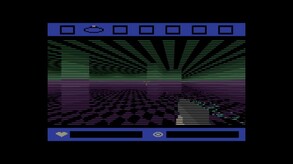
Spectral Trail by LGV is a compact retro-inspired first-person shooter that builds its identity around speed, simplicity, and a deliberately old-school approach to design. Rather than aiming for cinematic storytelling or expansive mechanics, it drops the player into a confined, maze-like structure with a clear objective: survive, explore, and recover a set number of hidden rings in order to escape. The setup is intentionally minimal, serving as a framework for a gameplay experience that emphasizes movement, awareness, and quick decision-making over narrative depth.
The game’s visual style immediately establishes its tone. It adopts a pseudo-3D aesthetic reminiscent of early-era shooters, with flat textures, angular environments, and a limited color palette. This choice works well in reinforcing its retro identity, but it also has practical consequences for gameplay. The maze is intentionally disorienting, and the lack of strong visual landmarks can make navigation challenging. Corridors and rooms often look similar, which heightens tension but can also lead to frustration when trying to retrace steps or locate missed objectives. The environment feels more like an abstract space than a grounded setting, which aligns with the game’s focus on mechanics rather than world-building.
Gameplay revolves around traversing interconnected sectors while avoiding or confronting spectral enemies that roam the maze. Movement is fast and responsive, encouraging players to stay in motion rather than approach encounters cautiously. Combat is straightforward, built around a small selection of weapons that rely on an energy-based system instead of traditional ammunition. This mechanic adds a subtle layer of resource management, as players must be mindful of when to attack rather than firing continuously. However, the combat itself remains fairly basic. Enemy behavior is predictable, and encounters tend to repeat similar patterns, making the challenge feel more about positioning and timing than tactical depth.
One of the more distinctive mechanics is the trail left behind by damaged enemies, which serves as a kind of visual breadcrumb system. This feature can help players orient themselves within the maze, offering a limited form of guidance without breaking immersion through maps or markers. It is a clever addition that fits naturally within the game’s design, though it does not entirely solve the issue of navigation. Players can still find themselves wandering aimlessly, especially in later sections where the layout becomes more complex.
The pacing is brisk, with the entire experience designed to be completed in a short amount of time. This brevity works in favor of the game’s arcade-like structure, ensuring that the core loop does not overstay its welcome. The inclusion of a timer further reinforces this approach, encouraging players to replay the game in pursuit of faster completion times. For those who enjoy optimizing routes and refining performance, this adds a layer of replayability. For others, the limited content may feel insufficient, as the game does not evolve significantly beyond its initial mechanics.
Level design attempts to strike a balance between freedom and direction. While the maze gives the impression of open exploration, it is subtly segmented in a way that guides progression without being overtly linear. This structure keeps players moving forward, but it does not eliminate moments of confusion. The lack of a detailed navigation system can make the experience feel uneven, alternating between smooth progression and periods of disorientation.
Sound design supports the gameplay without becoming a defining feature. Ambient effects and enemy cues contribute to the atmosphere, helping players stay alert to potential threats. However, the overall audio presentation is relatively subdued, with little in the way of memorable music or dynamic soundscapes. It complements the experience but does not significantly enhance it.
Spectral Trail ultimately feels like a focused experiment in retro shooter design. It captures the essence of fast-paced, objective-driven gameplay with a minimalist approach that prioritizes immediacy over complexity. At the same time, its limitations are clear. The short runtime, repetitive encounters, and lack of mechanical depth prevent it from leaving a lasting impression beyond its initial playthrough. It is a game that delivers a concise experience rather than a comprehensive one.
For players who appreciate old-school shooters and are looking for a quick, replayable challenge, Spectral Trail offers a solid, if modest, experience. For those seeking variety, deeper systems, or a more developed world, it may feel too limited to fully satisfy. It succeeds within its scope but does not attempt to go beyond it.
Rating: 6/10