Species: Artificial Life, Real Evolution is an ambitious and unconventional simulation game developed and published by Quasar that sets out to model evolution not as a scripted progression, but as an emergent system driven by genetics, mutation, and environmental pressure. Rather than offering traditional goals, storylines, or victory conditions, the game invites players into a living sandbox where artificial organisms are born, adapt, diversify, and die according to rules inspired by real evolutionary biology. It is a title that prioritizes observation, experimentation, and long-term systems thinking over immediate feedback or spectacle, making it both fascinating and demanding in equal measure.
At the heart of the experience is a genetic simulation that governs every creature in the world. Each organism possesses a unique genome that influences its physical structure, behavior, and survival traits. As creatures reproduce, mutations occur naturally, introducing variation that may or may not prove beneficial in the current environment. Over time, populations diverge, species branch into distinct clades, and entire evolutionary lineages rise or collapse based on subtle shifts in conditions. This process unfolds continuously, creating a sense that the world is alive even when the player is doing nothing at all.
Player involvement is deliberately flexible. You can choose to act as a passive observer, simply watching ecosystems develop and collapse over long spans of simulated time, or take a more active role by nudging evolution in specific directions. Tools allow you to influence reproduction, selectively remove or protect individuals, and manipulate environmental factors such as climate, terrain, or catastrophic events. These interventions never guarantee a desired outcome, however, reinforcing the idea that evolution is probabilistic rather than deterministic. Even carefully designed genetic changes can fail if the environment does not support them, which lends the simulation a sense of authenticity and unpredictability.
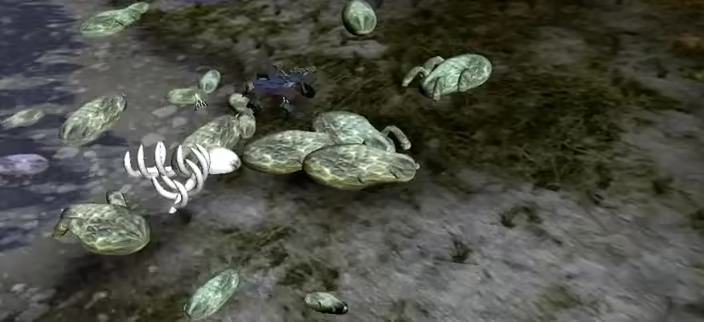
One of the most striking aspects of Species is how unglamorous evolution can look. Creatures often begin as simple, ungainly organisms and may remain visually awkward even after many generations. Evolution does not necessarily produce elegant or recognizable forms, and many lifeforms appear strange, inefficient, or redundant. This can initially feel underwhelming to players expecting dramatic transformations, but it aligns closely with the game’s scientific grounding. Adaptation is slow, messy, and often unintuitive, and Species embraces that reality rather than smoothing it into something more conventionally “fun.”
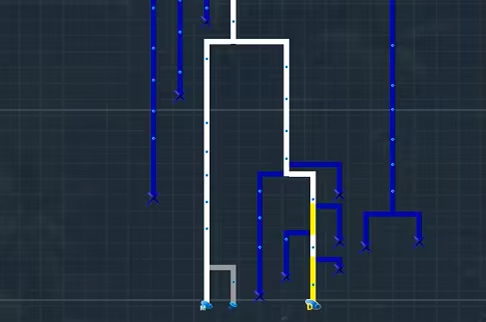
The game provides a suite of analytical tools to help players understand what is happening beneath the surface. Evolutionary trees visualize how species are related, distribution maps show where populations thrive or struggle, and detailed inspection screens allow you to examine individual genomes and traits. These tools are essential, as much of the simulation’s depth is invisible without them. Learning to read and interpret this data is a major part of the experience, effectively turning the player into a virtual biologist studying an artificial ecosystem.
Visually and technically, Species is functional rather than polished. Animations are basic, creature behavior can appear erratic, and the overall presentation lacks the refinement seen in mainstream simulation games. However, these limitations are closely tied to the game’s systemic complexity. Resources are clearly devoted to simulation depth rather than visual fidelity, and players who value systems over aesthetics are more likely to appreciate this tradeoff. That said, the rough presentation can make it harder to intuitively understand why certain evolutionary outcomes occur, especially for newcomers.
The learning curve is steep, and the game makes few concessions to accessibility. Concepts like genetic drift, selection pressure, and environmental bottlenecks are not simplified, and players unfamiliar with evolutionary theory may struggle to understand why certain interventions fail. Patience is essential, as meaningful change often requires long stretches of simulated time. This slow pace can be deeply rewarding for players who enjoy watching complex systems unfold, but frustrating for those seeking quick feedback or clear progression milestones.
Community reception reflects this niche appeal. Many players praise the game for its ambition, educational value, and willingness to simulate evolution in a way that resists simplification. Others criticize it for feeling opaque, slow, or underwhelming, especially when expected evolutionary breakthroughs fail to materialize. Both perspectives are valid, as Species is less a traditional game and more a scientific sandbox that demands curiosity and tolerance for ambiguity.
Ultimately, Species: Artificial Life, Real Evolution is a rare and thoughtful experiment in simulation design. It does not attempt to entertain through constant rewards or dramatic moments, but through the quiet satisfaction of watching complexity emerge from simple rules. For players fascinated by biology, systems-driven gameplay, and open-ended experimentation, it offers an experience unlike almost anything else on Steam. For those seeking clear objectives, visual spectacle, or fast-paced interaction, it may feel alienating. In committing so fully to its premise, Species succeeds not by appealing to everyone, but by offering a deeply focused and intellectually engaging exploration of artificial evolution.
Rating: 7/10