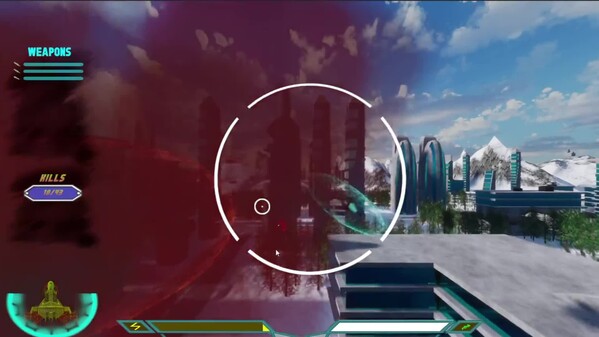
A blend between Shoot'em ups and Looter Shooters. Take on the story or randomly generated missions to level up your pilot and collect loot to build your ships up to take on bigger challenges.
Modeled estimate, not a reported figure. How we estimate →
Media

About
Blast your enemies with countless combinations of weapons which you'll loot like crazy.
Choose from three different pilots and level up their skilltrees to create your ultimate Spaceship.
Endless Newgame+ where you will face increasingly stronger enemies.
Upgrade your components with the Overclock function to keep your favourite weapons tuned for destruction.
-Three Pilot Classes with three skilltrees each.
-10 ships to choose from from light ships to the Titan assault ship
-Multiple weapon systems like missiles, cannons and laser and more exotic weapons.
-Unique weapons for each category, funny weapons like the banana thrower.
-Different game modes ranging from stealth data delivery to boss fights
Stats
All-time low is the lowest price we've recorded for this game since we started tracking it.
Languages: English
Reviews
Short version: An indie third-person rail shooter that mixes the vibes of Space Harrier and Zigfrak. It’s rough around the edges, but fun if you know what you’re getting into. Full review: This game feels like a mix between Space Harrier and Zigfrak, but with its own twist. It’s clearly an indie project, so don’t expect flashy AAA graphics or polish — but if you’re into the genre, there's a lot to enjoy here. After a short tutorial mission, you choose one of three pilots to start with. Each one has three separate skill trees, letting you customize your playstyle a bit. Once you're done with that, you're dropped into a space station that works as the main hub. From there, you can buy and sell gear, upgrade your ship, assign skill points when you level up, and pick missions — either random jobs or story-related ones. As you level up, you unlock access to better ships: one at level 5 (a medium one), another at level 10 (a heavier one), and a final upgrade at level 15 (more focused on combat). Each has different loadout options depending on its type, so you can experiment a bit with weapons and gadgets. The missions themselves are pretty varied — from simple "blow up X enemies to summon the boss" types, to time trials and even a few stealth ones. Nothing super complex, but enough to keep it from getting boring. Bugs? Yeah, they’re there. But the developer seems active and is clearly trying to fix things, which is always a good sign. All in all, it’s not perfect — but it doesn’t have to be. This is one of those games that’s great for short sessions when you just want to turn your brain off and shoot stuff in space. I’d recommend it to fans of old-school arcade shooters or anyone looking for something chill to play after a long day at work or school.
Has the exact same issues as the first game but even worse controls. And yes, this game's controls feel EXTREMELY clunky on controller. You lose all loot you barely scrape by due to tiny magnet radius and the fact loot can spawn straight up behind or below you while you are moving if you fail and you can easily fail due to scratching a TINY odd rock or so. You get not even a pity sum of credits if you lose, meaning you will spiral downwards further and further if you just keep losing if you want to try out different weapons in the shop.
Spacefighter Rukia 2, developed and published by AstroMonkey, is an energetic hybrid that attempts to merge the intensity of arcade-style space shooters with the long-term progression systems of a loot-driven RPG. As a sequel, it builds on a foundation that already leaned toward experimentation, pushing further into customization and replayability while maintaining a focus on fast, chaotic combat. The result is a game that feels ambitious in concept, blending two styles that do not always naturally align but can create engaging moments when they come together effectively. The core gameplay revolves around piloting a customizable spacecraft through a variety of mission types, most of which emphasize high-speed combat and constant movement. Encounters often resemble bullet-heavy arcade shooters, where the screen fills with enemy fire and the player must weave through attacks while returning fire. Controls are responsive and designed to handle this level of intensity, allowing players to maneuver quickly and react to rapidly changing situations. Combat is immediate and visually busy, with a wide range of weapons available that alter how engagements unfold. From standard cannons and missiles to more unconventional options, the variety encourages players to experiment and find combinations that suit their preferred playstyle. A significant portion of the game’s appeal comes from its progression systems. Players can choose between different pilot archetypes, each with its own skill tree that shapes how the ship performs in battle. As missions are completed, experience and loot are earned, feeding into a loop of constant improvement. Ships themselves can also be swapped and upgraded, with differences in speed, durability, and firepower allowing for distinct approaches to combat. This layered system creates a sense of growth that extends beyond individual missions, giving players a reason to keep pushing forward in search of better equipment and stronger builds. The structure of the game supports this progression through a mix of structured and repeatable content. There is a basic campaign framework that provides direction, but much of the gameplay revolves around replayable missions and scaling difficulty modes. As players advance, challenges become more demanding, requiring both better equipment and improved execution. This creates a cycle of refinement where each run contributes to a stronger setup for the next. While this loop can be engaging, it also relies heavily on repetition, and the variation between missions is not always enough to keep the experience feeling consistently fresh. Visually, the game adopts a functional 3D style that prioritizes readability during intense combat sequences. Effects, projectiles, and enemy movements are designed to stand out clearly, which is essential given how quickly situations can escalate. The sci-fi setting is reinforced through glowing weapon effects and mechanical ship designs, though the environments themselves tend to feel secondary to the action. While the presentation is effective for gameplay purposes, it lacks the variety and detail needed to create a strong visual identity over longer sessions. One of the more distinctive aspects of Spacefighter Rukia 2 is its willingness to embrace variety in its systems. The inclusion of unusual weapons and different mission types adds some unpredictability, and there are moments where the game’s hybrid design feels particularly successful. However, this same ambition can also lead to imbalance. The reliance on loot progression means that equipment can sometimes overshadow player skill, making success feel more dependent on gear than on mastery. This can create a disconnect between the fast-paced, skill-driven combat and the slower, incremental nature of RPG progression. Replayability is a central focus, with scaling difficulty modes and repeated mission runs forming the backbone of the experience. Players who enjoy optimizing builds and chasing stronger gear will find a satisfying loop here, especially as the difficulty increases and demands more efficient setups. However, the lack of significant changes in gameplay structure means that repetition becomes more noticeable over time, and the game does not always introduce enough new elements to maintain a strong sense of progression beyond numerical improvements. Despite these limitations, the game delivers moments where its systems align in a satisfying way. When a well-constructed loadout cuts through waves of enemies while narrowly avoiding incoming fire, the combination of action and progression feels rewarding. These moments highlight the potential of the game’s design, showing how its hybrid approach can create a unique and engaging experience, even if it does not consistently maintain that level of impact. In the end, Spacefighter Rukia 2 is a creative and fast-paced title that succeeds in blending elements of arcade shooters and loot-based progression into a cohesive, if uneven, package. It offers a compelling gameplay loop for players who enjoy customization and high-intensity combat, but it is held back by repetition and a lack of deeper mechanical evolution. It stands as an interesting experiment that delivers bursts of excitement, even if it does not fully realize the potential of its ideas. Rating: 6/10
Spacefighter Rukia 2 is an indie-developed third-person shooter in the line of Galaxy Force II for the SEGA Mega Drive: the camera is sitting behind your spaceship and you control it zooming and shooting across different landscapes. But it is, luckily, much more evolved than Galaxy Force II - you can pick different spececrafts to pilot and there are different kind of missions, which not always focus on destroying as many targets as possible without being shot down. There are campaign missions with some background lore and story behind them, and in between them you can take on random challenges or "jobs" to grind experience and credits while you're readying yourself to progress with the story. There's an RPG component as well, as your pilot gain experience which can be spent to unlock traits and perks to fit your playing style, as well as the inevitable looting system which we didn't know we needed before Diablo (more like Diablo II actually) hit the shelves. Do games still "hit the shelves" these days? I wonder. Nevertheless, the itch to get that new weapon type that you've never tried before or an entire new spacecraft might be enough to push you through that "one mission more and then I'll stop". For a one-man effort, Spacefighter Rukia is quote remarkable. Still needs some polishing, but the game is there. I appreciate they didn't go for the *lazy* pixel-art style graphics that have flooded the market in the past few years (and that can't quite hold the comparison with the *real* pixelart stuff made in the 80's and early 90's - yes I'm old, how did you guess it?). Maybe the sound effects are not stunning but the soundtrack fits quite well, with chill new-age melodies soothing your anger while looking for upgrades in the hangar or deciding which random mission to take on next, with more dramatic and fast-paced tracks following you on your missions. And now that I'm doe writing this, I realised this is probably my first ever review on Steam. Cheers.
A good game with nice backgrounds , a good level of difficulty from the start to make you want to play it
Lo stile grafico dei personaggi e dei menù è un po' bizzarro, almeno per me, ma le sessioni di volo sono molto valide. Specialmente le missioni dove puoi concentrarti sull'abbattere i nemici.
Related
Related
Trends
Concurrent players on Steam, sampled daily since tracking started.
Related
| Defendoooooor!! | $683.5 | 69 | 45% | $0.49 |
| Z-End | $683 | 57 | 58% | $0.79 |
| Furry Puzzle | $687.3 | 110 | 63% | $0.49 |
| Ninja Frog | $687.9 | 55 | 91% | $0.99 |
| Kimono Girls | $688 | 101 | 85% | $0.99 |
| Project Lounge | $681 | 110 | 65% | $0.49 |
Related
| 7 Days to Die | $425.3M | 403.6K | 87% | $44.99 |
| Mount & Blade II: Bannerlord | $309.8M | 294K | 88% | $49.99 |
| Palworld | $279.6M | 447.5K | 94% | $20.99 |
| Clair Obscur: Expedition 33 | $233.9M | 273.3K | 95% | $47.99 |
| Terraria | $187.5M | 1.5M | 97% | $9.99 |
| Don't Starve Together | $164.7M | 539.5K | 95% | $14.99 |