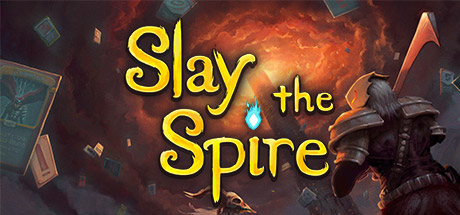
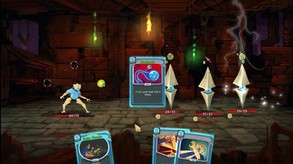
We fused card games and roguelikes together to make the best single player deckbuilder we could. Craft a unique deck, encounter bizarre creatures, discover relics of immense power, and Slay the Spire!
Modeled estimate, not a reported figure. How we estimate →
Media

About
Genres
Stats
All-time low is the lowest price we've recorded for this game since we started tracking it.
Languages: English, Simplified Chinese, French, German, Korean, Russian, Japanese, Polish, Ukrainian, Spanish - Spain, Italian, Dutch +5 more
Updates
Build ids and update times come straight from Steam's PICS — the same source SteamDB reads. Patch history grows as we record new builds.
Engagement
Hours played at review time, across 650 reviews with recorded playtime.
Reviews
Themes across 646 recent reviews and how positive each mention is. A keyword signal, not full sentiment analysis.
positive critical· bar length = how often the theme comes up
Reviews
I may be late to the party, but after finally playing Slay the Spire, I completely understand why it's considered one of the greatest roguelikes ever made. Don't let its simple graphics fool you. Beneath that minimalist presentation lies a remarkably deep and mathematically rich strategy game. It's genuinely challenging, rewarding careful planning, adaptation, and consistency far more than luck. The Ironclad follows what I would call a linear mathematical model. His strategy is based on increasing Strength, which directly scales the damage of almost every attack. In simple terms, if an attack deals (D) damage, increasing Strength by (S) turns it into roughly (D + S) for every hit, making scaling intuitive and powerful. From my experience, the most reliable approach is to build around Strength, with cards such as Inflame, Limit Break, and Heavy Blade forming the core of the deck. The Silent is a game of probability and deck cycling. Instead of maximizing one statistic, she maximizes the likelihood of drawing the right cards at the right time. My favorite approach was a Shiv build supported by passive damage and scaling, where Blade Dance, Accuracy, and After Image transform many small attacks into a highly efficient engine. The Defect is based on combinations. Individual cards are often average on their own, but together they create exponential value. Focus strengthens every Orb, additional Orb slots multiply that benefit, and energy generation keeps the engine running. I had the most success with an aggressive Lightning build using Defragment, Electrodynamics, and Ball Lightning. The Watcher is all about rhythm and sequencing. Her strength comes from playing cards in the right order and chaining stance changes together. Rather than relying on the popular Tantrum strategy, I built a small deck around Flurry of Blows and frequent stance switching. Every transition brought Flurry back to my hand, creating a fast, fluid combat style that was both powerful and incredibly satisfying. Slay the Spire proves that outstanding game design doesn't require realistic graphics or a massive budget. Its depth comes from elegant mechanics, meaningful decisions, and four completely distinct characters that each feel like solving a different mathematical puzzle. Few games are this replayable while remaining this consistently rewarding.
Addicting as hell and could ruin your life, incredibly fun if you like card games and can see myself being able to go countless runs in this game without getting bored.
I hate card games. Hate fantasy settings. Hate strategy games. Love Slay the Spire. 10/10.
I've never felt so driven to play a game I dislike so profoundly. I love deckbuilders, but Slay the Spire has almost none of the aspects of deckbuilding that I enjoy. My favourite part of a deckbuilder is the bit where your deck is starting to click into place and really starts to hum, with 80% of your turns feeling like you've beaten the streakiness out of it and you get loads of fun combos to play. That happens maybe one run in 10. So many runs are spoiled by ♥♥♥♥♥♥♥♥♥ card or relic selections, with zero rerolls or randomness mitigations except a special 'constructed' mode, but that builds very good decks that feel like cheating. From other reviews, it seems like eventually you just learn the game's quirks and git gud, but the game seems really dedicated to making sure you hate most of your time with it up until that 100-hour benchmark. It feels like gambling with your free time, where the currencty you're wagering is enjoyment. Slay the Spire feels less like a traditional deckbuilder and more like you're grappling with the streakienss of the common deck in a tableau builder or card drafting game. Think more Thunderstone than Dominion. It lacks the tools baked in to the best of those games to give you agency when adding cards to the deck, like the search function in Race for the Galaxy or simlar games such as Everdell. Another problem is it speaks in the slightly obtuse mechanical grammar of Arkham Horror, in which 'action compression' is more important than traditional card advantage (though card advantage is still useful of course). The card synergies are strange and show up in weird places - it's not like Magic where you just look for keywords, it's more like Arkham where you will be surprised by card interactions. And every enemy hits like a truck, so whenever you die it just feels like the game didn't give you the tools you needed to win it - which is why there are so many complaints about RNG. All in all, it's an obtuse and often very frustrating experience, with the good moments fairly few and far between. And for some reason I spend most of my free time playing it? I hate this.
Великолепно ограненный бриллиант жанра карточных рогаликов, заслуженно снискавший славу и популярность! Четыре различающихся по механикам деки - Латоносец, Безмолвная, Дефект и Созерцающая - с вариативностью построения колоды, усложнения от возвышений, разнообразие противников и случайных событий легко подарят ценителям жанра сотни и тысячи часов неповторимого приключения. А когда станет скучно или захочется настоящего вызова - десятки модификаторов свободной вылазки перевернут привычные этажи шпиля в нечто неузнаваемое! А для кибер-котлет - Еженедельная гонка за счетом с другим игроками.. Отличная игра, строго рекомендую! З.Ы. Да, я 7 лет думал, что написать..
Game is good, but unfair, even after you unlock all the cards, relics and so on, it still too difficult, had to try 4 times before beating it for the first time, also luck plays a big role here. BUT, there is a difference betwen annoying and challenging, this game didnt get it.
прошёл за одну ночь попутно слушая малис мизер, а потом ни разу не заходил. 8/10
Sometimes you slay the spire, other times you get touched and it does not feel so good.
Highly enjoyable deckbuilder with really solid and fun mechanics. I barely regret installing it on my office hours.
新作を値引きも無しに買った奴らが文句言ってるのが許せない 2800円という大金を注ぎ込めるほどの金銭的余裕のある富豪がなに不満垂れ流しとんねん 自分のめぐまれた環境の素晴らしさに感謝しろよ この豪遊家が 不労所得が 上級国民が 私は当然新作を買う金なんて無いので旧作に怒りの愚痴を書き込むしかできません ところで自分は一体いくらでこのゲームを買ったんだろう、と調べてみたところ 995円で買ったのを返品した後、何故か1285円で買い戻してました ただのあほやんけ 失礼しました
Related
Related
Trends
Modeled estimate over time, reconstructed from Steam's monthly review histogram.
Engagement
DAU/MAU are modeled from peak concurrent players (≈×8 and ×28) — Steam publishes no active-user counts, so treat these as rough estimates, not reported figures.
Audience
Audience
Estimated from the language of this game's reviews — a proxy for where players are, not official Steam demographics.
Games most often reviewed by the same players — an audience-affinity signal from our review sample, not full ownership data.
Related
| Persona 3 Reload | $80.1M | 59.9K | 94% | $59.99 |
| Gray Zone Warfare | $80.9M | 77.7K | 72% | $39.99 |
| Middle-earth™: Shadow of War™ | $81.1M | 87K | 89% | $49.99 |
| Dune: Awakening | $81.5M | 77.6K | 71% | $49.99 |
| Rise of the Tomb Raider™ | $82.3M | 154.1K | 94% | $29.99 |
| DOOM Eternal | $77.6M | 216K | 91% | $29.99 |