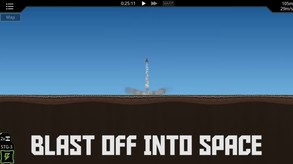
I am excited to release my first game on Steam! SimpleRockets was released in 2013 for mobile and I've put a ton of work into it to get it ready for PC and Mac. It was inspired by KSP, and it offers a simpler 2D experience for building rockets and exploring space with realistic orbital mechanics.
Modeled estimate, not a reported figure. How we estimate →
About
Genres
Stats
All-time low is the lowest price we've recorded for this game since we started tracking it.
Languages: English
Engagement
Hours played at review time, across 40 reviews with recorded playtime.
Reviews
Themes across 40 recent reviews and how positive each mention is. A keyword signal, not full sentiment analysis.
positive critical· bar length = how often the theme comes up
Reviews
good game but it now
In case you don't have the budget to play KSP
its just spaceflight simulator on a budget. pretty decent.
手机上补票来的
About the most amazing 2D space adventure you can have. Works on mobile. Works on Tablet PCs with only 1GB of RAM. Simple controls and easy to understand systems. If you like minecraft, this is a great addition to your playtime. Simplerockets 2 is 3D and a wonderful next step once you master Simplerockets 1.
So Fun
Not only is it not fun but there is already a better game than this that is older-- Kerbal Space Program-- I'd recommend you buy that instead of this.
SimpleRockets by Jundroo, LLC is a deceptively modest space simulation that hides a surprisingly thoughtful and rewarding experience beneath its clean 2D presentation. At first glance, it looks like a stripped-down take on the rocket-building genre, but once you begin interacting with its systems, it becomes clear that the game is carefully designed to capture the essence of real-world rocketry without overwhelming the player. It strikes a delicate balance between accessibility and authenticity, making it equally suitable for curious newcomers and players who enjoy tinkering with physics-driven systems. The construction aspect is where the experience begins, and it is immediately intuitive without being shallow. Players assemble rockets from a selection of components—command pods, engines, fuel tanks, separators, and utility parts—using a drag-and-drop interface that feels clean and responsive. Early builds can be as simple as stacking parts into a functional rocket, but the system quickly reveals its depth as players begin to experiment with staging, weight distribution, and thrust alignment. Designing a rocket that can not only lift off but also reach orbit or return safely requires careful planning, and each failure becomes part of a natural learning process. Explosions, misfires, and unstable launches are frequent in the early stages, but they rarely feel punishing; instead, they encourage iteration and refinement. Once a rocket leaves the ground, the game shifts into its simulation phase, where its physics model becomes the centerpiece. SimpleRockets incorporates realistic orbital mechanics, meaning that reaching space is only the first step. Achieving a stable orbit, adjusting trajectories, and navigating between celestial bodies all require an understanding of how gravity and velocity interact. The game does not hold the player’s hand excessively, but it introduces concepts gradually through both structured challenges and open experimentation. Each planet and moon presents different conditions, forcing players to adapt their designs and flight strategies, which adds a sense of progression without relying on traditional leveling systems. The challenge mode provides a useful framework for players who prefer guided objectives, offering tasks that range from simple altitude goals to more complex missions involving precise landings or orbital maneuvers. These challenges serve as both tutorials and milestones, helping players build confidence while introducing more advanced concepts step by step. However, the true appeal of SimpleRockets lies in its sandbox nature. Once the basics are understood, the game opens up into a space where players can set their own goals, whether that means designing efficient multi-stage rockets, attempting ambitious interplanetary journeys, or simply experimenting with unconventional builds to see what works. Visually, the game keeps things minimal, but this simplicity works in its favor. The 2D perspective ensures clarity, making it easy to track trajectories and understand how your rocket behaves during flight. While it lacks the visual spectacle of more complex simulations, it compensates with readability and smooth performance. The interface is straightforward, avoiding unnecessary clutter and allowing players to focus on the mechanics. Sound design is subtle but effective, with engine roars and explosive failures adding just enough feedback to make each launch feel impactful. One of the most compelling aspects of SimpleRockets is its educational value, though it never presents itself as a teaching tool outright. Through experimentation, players naturally develop an understanding of core principles like thrust-to-weight ratios, staging efficiency, and orbital dynamics. Success feels genuinely earned because it comes from applying these concepts rather than following scripted solutions. This sense of discovery gives the game a lasting appeal, particularly for players who enjoy learning through hands-on interaction. That said, the game’s simplicity can also be its limitation. The lack of visual variety and narrative context may make the experience feel sparse for players who are looking for a more immersive or story-driven adventure. Controls during flight can take time to master, especially when performing delicate maneuvers, and the absence of extensive guidance may leave some players feeling lost once the initial challenges are completed. Without self-directed goals, the sandbox can lose momentum, making long-term engagement dependent on the player’s own creativity and curiosity. Despite these drawbacks, SimpleRockets succeeds in delivering a focused and satisfying simulation experience that respects the player’s intelligence while remaining approachable. It captures the joy of building something from scratch, watching it succeed—or fail—and using that knowledge to improve the next attempt. It may not have the scale or complexity of larger space simulators, but its clarity, depth, and sense of experimentation make it a standout in its niche. Rating: 8/10
I like sfs more (sfs = Spaceflight Simulator)
同年回忆
Related
Related
Trends
Modeled estimate over time, reconstructed from Steam's monthly review histogram.
Momentum
Pace estimated from the game's recent review growth (our daily snapshots) at its own sales-per-review ratio — a momentum signal, not booked sales.
Audience
Estimated from the language of this game's reviews — a proxy for where players are, not official Steam demographics.
Related
| UFO: Afterlight | $103.6K | 535 | 65% | $6.99 |
| Hospitalize | $103.7K | 171 | 40% | $15.99 |
| The Baconing | $103.7K | 262 | 78% | $14.99 |
| Nayuta no Kiseki: KAI | $103.7K | 152 | 86% | $34.99 |
| BAZOOKA: Rhythm Game | $103.6K | 674 | 99% | $7.99 |
| Breath of Death VII | $103.7K | 1.5K | 84% | $0.71 |