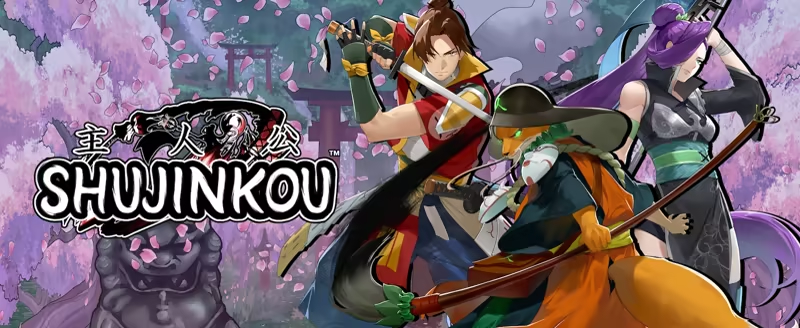
Shujinkou is a story-driven, turn-based dungeon crawler that provides players with the option to learn Japanese as they play. Play through an enthralling 80-hour story campaign as Shu, Jin, and Kou in a fight to save the world from the Akuma.
Modeled estimate, not a reported figure. How we estimate →
Media

About


Aiming to appeal to both speakers and non-speakers of Japanese, play as Shu, Jin, and Kou as you try to save the world from the Akuma in this single player JRPG!

A retired samurai (主) is entrusted with saving his home from intelligent, language-devouring "Akuma" alongside an eccentric fox (人) freed from a cursed abode and an astute princess (公) with her own ambitions.
Shujinkou is a dungeon-crawling JRPG that offers a unique opportunity to learn Japanese as you play. It features thousands of Japanese words, phrases, kana, kanji, and grammar elements that players can master through focus, diligence, and consistency. The language content spans from JLPT N5 to N1 standards, accommodating learners at any stage. Shujinkou is NOT purely a learning tool—it is a video game with optional, but comprehensive language learning functionalities embedded into various gameplay mechanics.
However, learning Japanese is entirely optional. For those more interested in the adventure, Shujinkou delivers a rich JRPG experience. Players can immerse themselves in hundreds of skills, items, equipment forging, cooking, fishing, quests, minigames, shops, and countless achievements and records to break. Explore a vast world, engage with a riveting story, meet multifaceted characters, enjoy stunning artwork, and lose yourself in hours of dynamic music.
All of these elements are woven together through an 80+ hour story campaign with over 200 hours of gameplay content, gradually introducing a complex set of RPG mechanics throughout the journey to create a truly comprehensive experience.
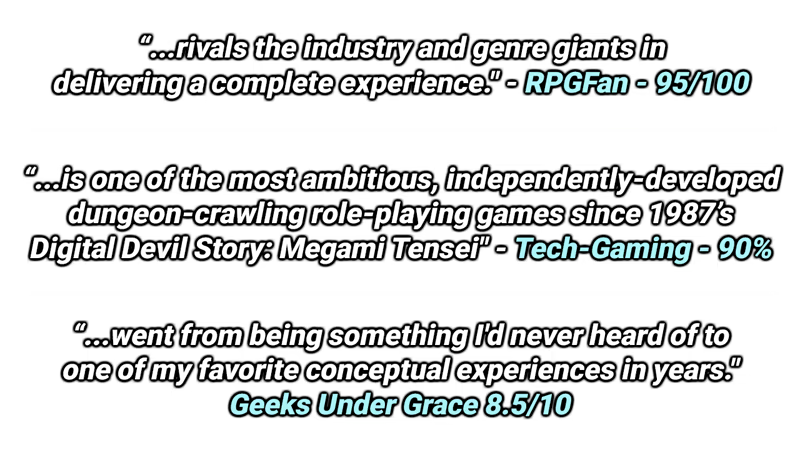
We hosted a Closed Beta testing period from June to July 2024, where we received feedback from many players who played the Windows version of Shujinkou. They had access to around 30% of the story campaign. Here are some of the comments we received:
✅ "I really love how much Japanese integration there is while still retaining a full game scenario—an ultimate success in gamified learning!"
Player who knew hiragana and basic vocabulary before playing.
✅ "My favorite part was that I'm learning a skill I can use with time, so it's not even that guilty of a pastime like most other games."
Player who had no knowledge of Japanese before playing.
✅ "I basically played it every day I was able to, and found myself genuinely learning things to the point that I, without any help, read what someone wrote (in Japanese) on a Discord server the other day."
Player who has wanted to, but struggled to learn Japanese for over a decade.
✅ "Shujinkou has been great for getting me to reengage with learning Japanese and I basically enjoyed all of the characters that I met from minor NPCs to the playable cast, which isn't a small feat."
Player who actively studied Japanese in the past.
✅ "The Art team did a very good job in the character designs and the monsters, both in the open world and while fighting—the huge art of the Yajuu was badass. Oh, and good lord did the Music team nail it. I just cannot express to you how well they came off to me as music is a very big part of my overall enjoyment and experience in a game."

Player who has looked for a legitimate game to properly teach them Japanese.

Explore over a dozen labyrinths and over 40 handcrafted maps spanning tens of thousands of tiles, looking for Kanakae Orbs, orbs imbued with elements of nature and Japanese kana and kanji, and avoiding large, dangerous foes called "Yajuu" (野獣, やじゅう)
Each labyrinth is filled with unique gameplay mechanics, puzzles, dozens of akuma, treasure chests, resource harvesting points, and more.
Shujinkou also has a 4-way Time System (Day, Dusk, Night, Dawn) that is present in various towns and labyrinths.
Shujinkou's Battle System is filled with dozens of mechanics, including Battle Skills (Arawasu, 現す, あらわす), Akuma Negotiation (Koushou, 交渉, こうしょう), the Escape Minigame, and more. However, the most effective way to defeat the akuma of Shujinkou is by striking their Elemental Weaknesses and Ontological Weaknesses.
Use the seven elements of Shujinkou to strike enemy weaknesses and deal extra damage.
Use the Kanakae Orbs (カナ変え, かなかえ) to reveal the names of akuma—the more of an akuma's name you reveal, the more damage everyone is able to deal! Grinding your Japanese skills only helps make battles easier and quicker to trounce through!
Shujinkou has plenty of side-content for players who want to take their time and experience the story over a longer period of time.
Play through over 200 quests (Youkyuu, 要求, ようきゅう), earning thousands of EXP, special items, and lots of money—by fulfilling these requests, learn more about the backstories and personalities behind hundreds of civilians that live in Shu's home nation, Genya, and other foreign nations!
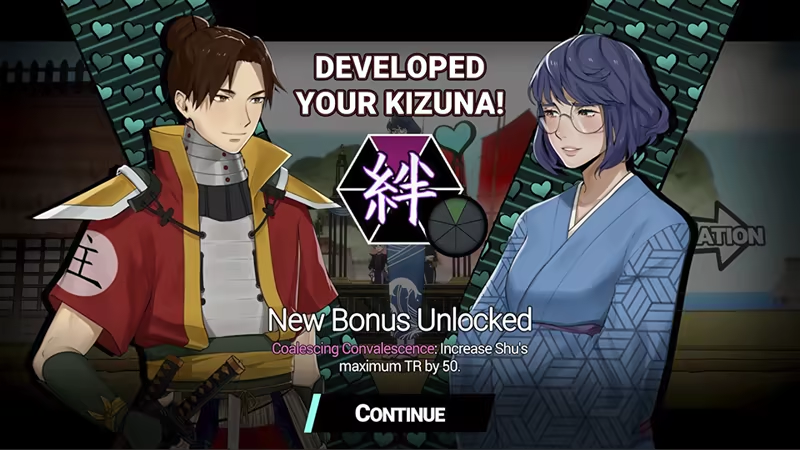
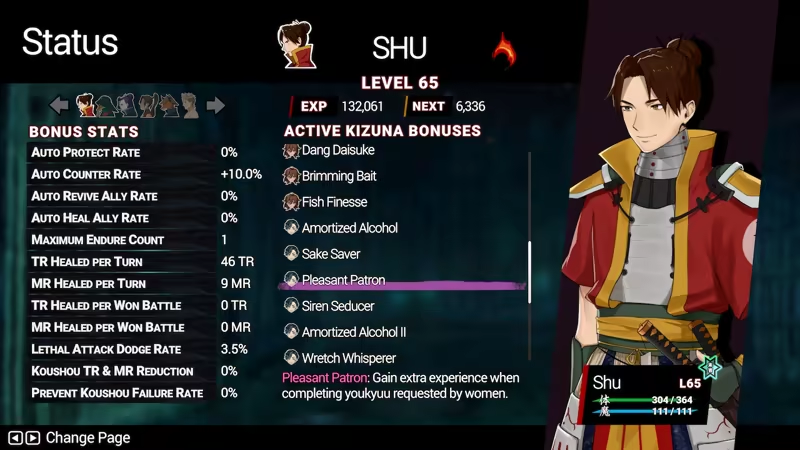
Develop a special bond called the Kizuna (絆, きずな) with up to SIX PARTNERS by helping them with their private, personal requests! The stronger your bond is with them, the more bonuses you will obtain—unlock over 40 Kizuna Bonuses that can augment your skills in battle, make it easier to win minigames, provide useful discounts for goods at shops, and much, much more.
Through the Moji Kiroku (文字記録, もじきろく), practice writing hundreds of Japanese kana and kanji as you progress through Shujinkou's story and discover new Kanakae Orbs! Stroke order, writing accuracy, example words, most commonly used kunyomi (訓読み, くんよみ) and onyomi (音読み, おんよみ) readings for kanji, and more can be reviewed as you collect more and more Kanakae Orbs.
Thousands of words, phrases, sentences, explanations for grammar, and more are present in various dialogue and signboards throughout Shujinkou.
Shujinkou's overall story and side-quest content exceeds over one million words, edited and revised for both language accuracy and the narrative style that was often seen in JRPGs in the 90s and 00s.
All words and phrases covered can be viewed at any point in time in the Blue Text Menu.
Grammar concepts and Japanese concepts that require deeper explanations are found in the hundreds of Kanban (看板, かんばん, Signboard) scattered through the labyrinths.
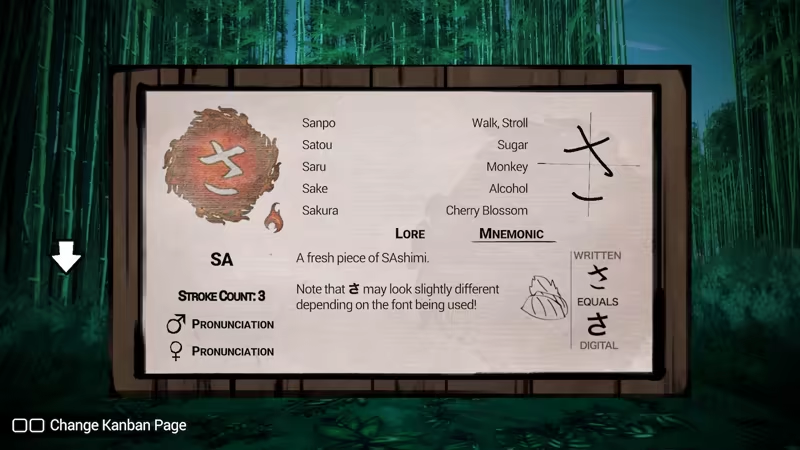
Shujinkou is able to swap the majority of its user interface text into one of four displays—English, Japanese, Furigana (helper kana for kanji), and Romaji (romanized Japanese).
If you are not using any English displays but feel a bit worn out from all of the Japanese, you can immediately swap the game into "English Mode" at the click of a button, and continue to play through Shujinkou just like you would any other JRPG.
Shujinkou is filled with dozens of other gameplay and learning mechanics, woven into the overall experience in such a way that each and every player will feel like their playthrough is unique. Whether you want to treat Shujinkou like a full-scale learning tool for Japanese, or play it like a story-driven, mechanically complex JRPG inspired by some of the most timeless, classic role-playing games, Shujinkou is at your fingertips, ready to provide you with an unforgettable time.
Our soundtrack is filled with over 150 tracks of music, including a wide array of genres from classical to metal, jazz to electronic, gypsy to Eastern, and plenty more!
Experience a full-fledged Jukebox that allows players to listen to all of the music in the game. The Jukebox music continues to play while actively checking any and every menu.
Reminisce on the dozens of fullscreen illustrations drawn by our talented Art Team through the Gallery Menu, which gives players access to all of the illustrations that they have seen throughout Shujinkou's story and side-content.

We hope so! Shujinkou is Rice Games's first commercial release—if you have been craving a content-packed single-player role-playing game with tremendous love & care poured into ALL aspects of its development, while offering the ability to help you learn a useful, real life skill as you play, Shujinkou may just be what you are looking for. We promise you will not be disappointed!
If you have any questions, please join our community on Discord and feel free to ask away! We'll promise to answer or enter the discussion as soon as we can!
Stats
All-time low is the lowest price we've recorded for this game since we started tracking it.
Languages: English
Engagement
Hours played at review time, across 25 reviews with recorded playtime.
Reviews
Great for foundational learning, Get's lost in the mechanics of being an RPG and that can get in the way of learning. All it needs is a learning focused mode where it doesn't cost a turn to select different letters or where you can pick any letter in the whole list to attack rather than selecting just 5. as it is now, solid 7-8/10.
Honest thought on this game as I’ve now: incredible. For those who intend to learn Japanese using this game, it’s a good tool to use for studying both inside the game and outside. What keeps it interesting is that it’s a game at heart. What I’ve come to know about the game is that the community is its soul. The team at Rice Games Inc has put their heart into it!
Lots of story, both the main quest and with town NPCs which get new dialog as you progress. It does tend to break up the action a bit during labyrinth runs, but wasn't too bad. I quite enjoyed the music. Very memorable, with each town having day/night themes and each labyrinth having unique area and battle themes. Enemies having an additional weakness of the characters that make up their name was an interesting twist. I feel the game is a decent supplemental during a Japanese language journey, but won't replace other learning methods. The ability to go back and forth between Japanese and English on the fly for things like menus and battle text is very helpful, but unfortunately the story itself is still only in English.
Having fun playing at my own pace using this as a language learning tool. I've wanted to learn Japanese for a long time but struggle to stick with routines, this gives me a great way to get some studying in for as little as 10 minutes before bed or playing for a little longer if I want to just treat it like a game. It plays like a standard RPG so if you're not interested in learning the language you can set it up to simply play normally so you're not forced to play it in any specific way you don't want. The music in this game is absolutely fantastic, I highly recommend keeping it turned up especially when you're on bosses. The art is good and has unique enemies in each section with a pretty interesting story thus far. It definitely holds its weight as a standalone game. The creator Julian and his indie team over at Rice Games have been really great with the community they've built, they're communicative and take feedback very well so I hope to see this game have success. Hopefully the price tag doesn't scare people off and they're willing to give it a chance but bear in mind if you buy this game that the beginning is the slowest part of the game and it does pick up and unlock a lot more. I can definitely see myself playing this game for a very long time so that I don't go too long without studying Japanese and will definitely have triple digits hours of played time.
I own this on PC and on Switch. I'm a beginner Japanese learner and a JRPG fanatic who enjoys DRPG's, but I'm rather particular about them. I've played A LOT of Japanese learning games. I've truly enjoyed only a few. As a product to learn Japanese I find Shujinkou to be a very unique case. Most of these games feel very centric to a learning tool and less centric to being an enjoyable game. Shujinkou feels much more like a game, to the point that on easier difficulties I didn't even really feel like I was learning a lot. The way the mechanics work though you learn through repetition whether you want to acknowledge that or not. It wasn't until just very recently I realized how many Hiragana I had learned and how many words and grammar points I've learned as I get to the next set of things to learn in the game. There's a lot grammar points on signs in the dungeons and some history about creatures which is really well done and includes voiced examples. You definitely get what you put into the game. Another thing I learned over time is that the farther you get into the game the deeper the mechanics get and the more options you have, which makes it hard to talk about the overall product before completing it. I have about 23 hours and I've just started so all I know is that I don't know it all. There's fun stuff too like powerful enemies you can't beat initially which gives you good reasons to come back later to tackle them, or if you're a tough guy/gal you can probably use god tier strategy to take them down. I prefer grinding though and it's really fun to use the side missions to level up, get items and money, and to learn more about the monster mechanics. Ex: some enemies only show up at certain times of the day and/or day of the week. There's also crafting items to find in specific spots and fun crafting that expands the more you play. The towns are fun to explore, there's loads of side missions which develops out minor people in town's lives, and each town I've seen so far has a unique style and interesting landmarks. Audio wise, I love the sound design and especially the music. There's a huge number of very interesting tracks so much so that I bought the soundtrack to listen to outside of the game. I'm not super big on listening to game music outside of games, but this one is great. Overall I find the game really enjoyable so far and I'm excited to continue with it. The characters develop well and I'm very curious to see where the story goes. It starts off a little simple, but things start to unravel and expand as you play. I will need to update this later on as I play more as I really am just touching on some basics in a first impression after 20 hours. I know a few people say that the game is so centric to learning Japanese, and yeah it's baked into the game deeply, but as someone who's played so many "learning games" I feel like this one goes above and beyond to make it as much of a game experience as a learning experience. I'm just as invested, if not more invested in the world and the gameplay mechanics as I am to learn Japanese.
Good resource to supplement your learning of the Japanese language.
[h2]Shujinkou Review[/h2] Amazing game, but it really gets most interesting after the main heroes get unlocked, around maybe 15-20 hours in. Amazing music, a story and world that is better than 80% of the jrpgs out there, and challenging gameplay. Will finish the second half next year!
Shujinkou a game you'll love or hate and locking at how many hours I put in it I say I love it. At surface is a simple 2D JRPG with visual novel portraits and first person dungeon exploration. A simple and decent story with some memorable characters. The puzzles are ok and a little challenging latter but doable. Fighting can be tuff and challenging especially some optional bosses if you're underlevel gut you can grind verry easy buy doing sidequests since they give a lot of exp and you can do the main quests verry easy. Fighting is you're typical JRPG turn base attacks in first person, every character and enemy has a turn and it depends on each character speed if you want to attack first. Besides normal physical attacks you can use elemental magic (fire, water, earth, light, etc.), buffs, debuffs, special attacks and ultimates, verry standard JRPG. The difference is and is linked to the other main attraction of the game and that is learning japanese. When exploring the main dungeons you came across special elemental orbs that represents a letter from the 3 japanese alphabets. You can equip this orbs to your weapons and when attacking an enemy you have to form its name using this orbs to weaken its defenses and do more damage. After collecting this orbs you can check the menu for explanations, pronunciations and writing. Besides doing the story and sidequests, you cand do bond quest with certain characters (similar to the confidants from Persona) and play minigames with the purpose of learning japanese grammar, sentences, radicals, counting and verb conjugation. It can be verry hard at the beginning since you have to memorize a lot of things but after learning even on the highest difficulty this minigames can be verry easy, can earn a lot of money and good for language practice. In short this game can be the push to make you learn japanese or not, for me it was since I can understand to a certain extend japanese and couldn't read the letters. If not you can disable this learning functions and play it like a normal game but I thing you lose on its charm. And a heads up, when you think you've reach the ending, you've finished only half so there still more to do.
After finishing the demo I like the game so far. The games fun, there's a lot of content to go through, and the language learning feature helps it stand out. Plus the devs are consistently updating the game with fixes, QOL, and more content. Here's hopping the game gets even better as time goes on.
I’ve known about this game since 2021. When I got to play the demo in 2024 and it released last year, I was excited to finally play it on the Steam Deck. An RPG that teaches Japanese was an interesting premise. As time went by, I decided to keep up with my studies with other material (textbooks, workbooks, videos, courses, etc.). Started learning Japanese when I was in college and picked it back up some time after graduating. Started learning Japanese again from the basics and worked my way up to reading books, playing video games, watching dramas. While waiting for this game to release, I feel as though my Japanese has improved and think of this as good review and supplementary learning. They also have a lot of animals that I did not know the names of in the game. Plus, there are some culture points here and there that I found interesting. (Tip: If you want to skip the guessing game of throwing out random kana orbs at an enemy, I suggest playing on easy.) MAIN STORY As of this initial review, I have completed the Genya Arc (aka Part 1) of the game. The story is good so far. I like the character interactions and how the characters in the party have personality. Even the minor characters have some mysterious backstories that I want to venture in knowing more about. AS AN RPG I’ve played a little bit of Persona Q, but dungeon crawlers are still new to me. Luckily, unlike Persona Q, Shujinkou already has logos for chests, mini-bosses, etc. You just have to move around the map and discover what is out there. Plus, there was a lot of QOL implementations after the game came out which helped navigate the dungeon and keep up with which boards you have read. I enjoy the combat more than I thought I would. It does take time to use skills and open the skill tree. However, after a few dungeons and getting all the hiragana kana orbs, it becomes available. I guess this is done to show how far you have come in your Japanese studies and open you up to more possibilities not only in the game but what you can understand. The side quests can be quite the chore once they pile up. There are deadlines for quite a few so I did those and ignored almost the rest of them so I can jump into the next part of the game (Sabaku Arc). MINI-GAMES When entering the underground room, the characters there will give you hints and tips on the game you selected or just talk about the game in general. You can bet money and based on the rank you choose you can get a higher reward if you get that rank in the minigame. It would be nice if they don’t give you the same text after selecting the mini-game. It’s fine if you play it for the first time but seeing them say the same thing every time you play is kind of repetitive. Fortunately, you can skip that dialogue. The good thing about these mini-games is that you can do a review so you can be prepared for the specific game you are playing. On top of that You can talk with Kiyo in the Lobby to review the kana orbs that you have collected so far. I love that it compiles items, enemies and other things depending on the kana orb you select. Unfortunately, when it comes to the mini-games this kind of stuff (counters, grammar, radicals to be more specific) does not show up often in the main game. 1) Bunpou Kake (Grammar Game with Kiyo) A mix of having a poker face and calling out bluffs in your opponent’s statements. Helps build grammatically correct sentences. 2) Kendama Kombo (Counter Game with Sugi) Found this one a bit difficult to pick up on my first go. There are only 5 counter categories one the easiest mode, so perhaps this grows as the difficulty gets higher or as the story progresses. 3) Radical Hunter (Radical game with Hina) Fun and easy to pick up learning radicals through matching the symbols and the radicals. You are also competing with 3 other characters in the game. 4) Okkake no Osakenori (Sentence Game with Otogawa) An interesting concept of trying to help Otogawa stop slurring his speech at his Izakaya while talking to a customer. Surfing your way to fluency with this one. The game allows you to speed through but there are holes here and there that you can fall into. Recently fell through one but was trapped on the edge of the hole. Was able to get out by moving left or right. The track for this minigame is good, too. 5) Sakana Sensou (Verb Conjugation Game with Tsunako) A minigame where you hit fish that match the conjugation form. Also has boss fights at the end of the round which makes for a challenge. The boss fights also have QTE-esque mechanic that can make quick work of the bosses… if the correct verb conjugation is correctly chosen. 6) Kotoba Kyugi (Vocabulary Game with Tatiana) Playing billiards with Tatiana to pocket kana or kanji to make words. For some reason the trajectory lines came off which makes it harder to know what ball is being hit. Changing turns with the opponent is a bit sluggish. Tied with Tatiana on my first go. The mini-game’s concept is interesting but it might be the hardest one to play for me. VERDICT Overall, this is a good game to get into, even if you don’t plan on learning Japanese. If you do want to learn, I can see this as a good game to review your language skills. This game is ambitious and has tons of content for you to sink your teeth into. On top of that, I like that the developers listen to feedback and are willing to change things to make a better experience for the players. Pros - A lot of content to enjoy and all of it is not mandatory - Good supplementary learning tool for Japanese language and culture - Fun combat system (love going back to previous dungeons and taking out the mini-bosses) - Developers listen to feedback and fixes or implement stuff through updates. - Music is fantastic! Cons - Can become a time-sink if you want to do absolutely everything. - Can be slow in the beginning. - Tons of content = Tons of tutorials.
Related
Related
Trends
Modeled estimate over time, reconstructed from Steam's monthly review histogram.
Momentum
Pace estimated from the game's recent review growth (our daily snapshots) at its own sales-per-review ratio — a momentum signal, not booked sales.
Audience
Estimated from the language of this game's reviews — a proxy for where players are, not official Steam demographics.
Related
| 7 Days to Die | $425.3M | 403.7K | 87% | $44.99 |
| Mount & Blade II: Bannerlord | $309.8M | 294.1K | 88% | $49.99 |
| Divinity: Original Sin 2 - Definitive Edition | $169.6M | 204.5K | 96% | $44.99 |
| Don't Starve Together | $164.7M | 539.7K | 95% | $14.99 |
| Middle-earth™: Shadow of War™ | $118M | 116.1K | 89% | $49.99 |
| Mount & Blade: Warband | $101.9M | 171.6K | 98% | $19.99 |
Related
| Hakoniwa Explorer Plus | $45.9K | 605 | 83% | $3.99 |
| Let Them Come: Onslaught | $45.9K | 241 | 90% | $7.99 |
| Drink More Glurp | $45.9K | 261 | 88% | $9.99 |
| You Can Kana - Learn Japanese Hiragana & Katakana | $45.9K | 348 | 98% | $9.99 |
| Cupiclaw | $45.9K | 119 | 89% | $9.99 |
| Trash Horror Collection | $45.9K | 525 | 95% | $5.99 |