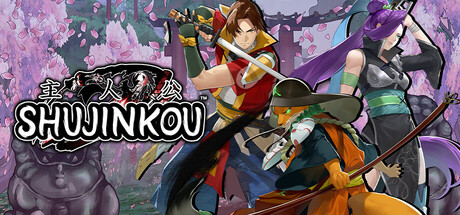
Shujinkou is a story-driven, turn-based dungeon crawler that provides players with the option to learn Japanese as they play. Play through an enthralling 80-hour story campaign as Shu, Jin, and Kou in a fight to save the world from the Akuma.
Modeled estimate, not a reported figure. How we estimate →
Media

About


Aiming to appeal to both speakers and non-speakers of Japanese, play as Shu, Jin, and Kou as you try to save the world from the Akuma in this single player JRPG!

A retired samurai (主) is entrusted with saving his home from intelligent, language-devouring "Akuma" alongside an eccentric fox (人) freed from a cursed abode and an astute princess (公) with her own ambitions.
Shujinkou is a dungeon-crawling JRPG that offers a unique opportunity to learn Japanese as you play. It features thousands of Japanese words, phrases, kana, kanji, and grammar elements that players can master through focus, diligence, and consistency. The language content spans from JLPT N5 to N1 standards, accommodating learners at any stage. Shujinkou is NOT purely a learning tool—it is a video game with optional, but comprehensive language learning functionalities embedded into various gameplay mechanics.
However, learning Japanese is entirely optional. For those more interested in the adventure, Shujinkou delivers a rich JRPG experience. Players can immerse themselves in hundreds of skills, items, equipment forging, cooking, fishing, quests, minigames, shops, and countless achievements and records to break. Explore a vast world, engage with a riveting story, meet multifaceted characters, enjoy stunning artwork, and lose yourself in hours of dynamic music.
All of these elements are woven together through an 80+ hour story campaign with over 200 hours of gameplay content, gradually introducing a complex set of RPG mechanics throughout the journey to create a truly comprehensive experience.
We hosted a Closed Beta testing period from June to July 2024, where we received feedback from many players who played the Windows version of Shujinkou. They had access to around 30% of the story campaign. Here are some of the comments we received:
✅ "I really love how much Japanese integration there is while still retaining a full game scenario—an ultimate success in gamified learning!"
Player who knew hiragana and basic vocabulary before playing.
✅ "My favorite part was that I'm learning a skill I can use with time, so it's not even that guilty of a pastime like most other games."
Player who had no knowledge of Japanese before playing.
✅ "I basically played it every day I was able to, and found myself genuinely learning things to the point that I, without any help, read what someone wrote (in Japanese) on a Discord server the other day."
Player who has wanted to, but struggled to learn Japanese for over a decade.
✅ "Shujinkou has been great for getting me to reengage with learning Japanese and I basically enjoyed all of the characters that I met from minor NPCs to the playable cast, which isn't a small feat."
Player who actively studied Japanese in the past.
✅ "The Art team did a very good job in the character designs and the monsters, both in the open world and while fighting—the huge art of the Yajuu was badass. Oh, and good lord did the Music team nail it. I just cannot express to you how well they came off to me as music is a very big part of my overall enjoyment and experience in a game."
Player who has looked for a legitimate game to properly teach them Japanese.

Explore over a dozen labyrinths and over 40 handcrafted maps spanning tens of thousands of tiles, looking for Kanakae Orbs, orbs imbued with elements of nature and Japanese kana and kanji, and avoiding large, dangerous foes called "Yajuu" (野獣, やじゅう)
Each labyrinth is filled with unique gameplay mechanics, puzzles, dozens of akuma, treasure chests, resource harvesting points, and more.
Shujinkou also has a 4-way Time System (Day, Dusk, Night, Dawn) that is present in various towns and labyrinths.
Shujinkou's Battle System is filled with dozens of mechanics, including Battle Skills (Arawasu, 現す, あらわす), Akuma Negotiation (Koushou, 交渉, こうしょう), the Escape Minigame, and more. However, the most effective way to defeat the akuma of Shujinkou is by striking their Elemental Weaknesses and Ontological Weaknesses.
Use the seven elements of Shujinkou to strike enemy weaknesses and deal extra damage.
Use the Kanakae Orbs (カナ変え, かなかえ) to reveal the names of akuma—the more of an akuma's name you reveal, the more damage everyone is able to deal! Grinding your Japanese skills only helps make battles easier and quicker to trounce through!
Shujinkou has plenty of side-content for players who want to take their time and experience the story over a longer period of time.
Play through over 200 quests (Youkyuu, 要求, ようきゅう), earning thousands of EXP, special items, and lots of money—by fulfilling these requests, learn more about the backstories and personalities behind hundreds of civilians that live in Shu's home nation, Genya, and other foreign nations!
Develop a special bond called the Kizuna (絆, きずな) with up to SIX PARTNERS by helping them with their private, personal requests! The stronger your bond is with them, the more bonuses you will obtain—unlock over 40 Kizuna Bonuses that can augment your skills in battle, make it easier to win minigames, provide useful discounts for goods at shops, and much, much more.


Through the Moji Kiroku (文字記録, もじきろく), practice writing hundreds of Japanese kana and kanji as you progress through Shujinkou's story and discover new Kanakae Orbs! Stroke order, writing accuracy, example words, most commonly used kunyomi (訓読み, くんよみ) and onyomi (音読み, おんよみ) readings for kanji, and more can be reviewed as you collect more and more Kanakae Orbs.
Thousands of words, phrases, sentences, explanations for grammar, and more are present in various dialogue and signboards throughout Shujinkou.
Shujinkou's overall story and side-quest content exceeds over one million words, edited and revised for both language accuracy and the narrative style that was often seen in JRPGs in the 90s and 00s.
All words and phrases covered can be viewed at any point in time in the Blue Text Menu.
Grammar concepts and Japanese concepts that require deeper explanations are found in the hundreds of Kanban (看板, かんばん, Signboard) scattered through the labyrinths.

Shujinkou is able to swap the majority of its user interface text into one of four displays—English, Japanese, Furigana (helper kana for kanji), and Romaji (romanized Japanese).
If you are not using any English displays but feel a bit worn out from all of the Japanese, you can immediately swap the game into "English Mode" at the click of a button, and continue to play through Shujinkou just like you would any other JRPG.
Shujinkou is filled with dozens of other gameplay and learning mechanics, woven into the overall experience in such a way that each and every player will feel like their playthrough is unique. Whether you want to treat Shujinkou like a full-scale learning tool for Japanese, or play it like a story-driven, mechanically complex JRPG inspired by some of the most timeless, classic role-playing games, Shujinkou is at your fingertips, ready to provide you with an unforgettable time.
Our soundtrack is filled with over 150 tracks of music, including a wide array of genres from classical to metal, jazz to electronic, gypsy to Eastern, and plenty more!
Experience a full-fledged Jukebox that allows players to listen to all of the music in the game. The Jukebox music continues to play while actively checking any and every menu.
Reminisce on the dozens of fullscreen illustrations drawn by our talented Art Team through the Gallery Menu, which gives players access to all of the illustrations that they have seen throughout Shujinkou's story and side-content.

We hope so! Shujinkou is Rice Games's first commercial release—if you have been craving a content-packed single-player role-playing game with tremendous love & care poured into ALL aspects of its development, while offering the ability to help you learn a useful, real life skill as you play, Shujinkou may just be what you are looking for. We promise you will not be disappointed!
If you have any questions, please join our community on Discord and feel free to ask away! We'll promise to answer or enter the discussion as soon as we can!
Stats
All-time low is the lowest price we've recorded for this game since we started tracking it.
Languages: English
Engagement
Hours played at review time, across 25 reviews with recorded playtime.
Reviews
First things first, I think it's worth addressing the sort of elephant in the room for many people, which is the price. For me personally, whether or not this was 30 or 60 dollars would not change my own personal life significantly, and I'm happy to help indie teams, or in this case, lone developers, make ends meet. Your personal comfort level with that may differ based on your career and employment or financial situation, and that's fine, I'm just addressing this from my own POV. Now, for the game review. I'm not very far in the game yet, so this is more of a preliminary review. For context, I'm a Japanese learner who is somewhere between N4 and N3, so that's going to color my review a bit. For those of you that aren't really JP learners, that's between 'pre-intermediate' and 'intermediate'. I'll say flat out that if you're not really interested in learning the language, that this game may not be for you. It's something of an 'edutainment' game, in that it features learning quite heavily in the mechanics and systems of the game. For people who are already JP language learners, this game starts you off at the pre-N5 level, in other words, teaching the kana. If you haven't started learning Japanese, and you want to, I can recommend this game as a great way to get your foot in the door. If you want to, you can and will quickly learn the kana using this game, and I'd say you'll be able to read anything in hiragana (+ with furigana) pretty fast. Regarding that, so far, most of the learning seems vocab based, with enemies using romaji names that you must (or really, should) match to their appropriate kana. So far I've only encountered hirigana, but I assume that katakana will appear, and I assume kanji will, at some point, start showing up as well. The rest of the instruction for language, so far, have been in boards spread across the labyrinth, which teaches (so far) the stroke order for the hirigana kana and their histories (which was interesting!) as well as some simple grammar. I'm not sure if grammatical concepts will ever play a role in the game itself, though I think there'll be some degree of deeper complexity in how it uses the language. Incidentally, the game does seem to not follow 'standard practice' in teaching the kana, which I found kind of interesting; you learn the ten ten forms of the k and s lines before you learn the m or n line, while normally you'd learn all the kana, and then all its variants. I don't really mind it, just curious what the reasoning there was. As far as the gameplay and polish goes, so far, it's pretty good. Combat is a mixture of snappy and slow, but is adjustable. As far as other dungeon crawlers go, this is somewhere closer to Etrian Odyssey or Labyrinth of Yomi compared to the Refrain series. Unlike EO, there's no rows (yet, at least, they may be introduced later), and elements play something of a bigger role, at least early game. Like in EO, there's resource spots in the world that you can harvest from, and a lot of directional shortcuts that really did evoke EO3 or 4. So far, the combat hasn't been fleshed out, but given that there's additional greyed out options for me, I'm sure it'll develop much more and get more complicated, which is exciting for me. That said, at least so far, unlike most DRPGs, you don't pick from classes or create your own characters, which has its ups and downs. Personally, I don't really like the hyper minmax elements of a lot of DJRPGs, so I'm ok with that, but if your favorite part of EO3 is running around with the crazy broken builds, then I don't think that you're going to get what you want. In some ways, I think that speaks to the polish (so far), since a lot of the old EO game breaking builds were bugs or improperly balanced. YMMV there. A fun addition is a day/night cycle, but also a week cycle where each day corresponds to a day of the week which is related to its element. Storywise, I'm enjoying it, though I don't have a lot of buy in just yet. It doesn't have the emotional weight for me that Gallaria had, yet, for instance, but it certainly is more story focused than any of the EOs or Labyrinth of Yomi. A big part of that is that the characters are predefined, and so there's quite a lot of dialogue of them talking. I like text heavy, story heavy games and VNs, so this doesn't bother me, but if your only goal is to run around a maze and hit things DJRPG style, know what you're getting into. I think the setting (so far) is kind of like Japan with the name filed off, but again, I'm in the very early game (cleared Dungeon 1, second town), so I expect it to open up considerably. As far as complaints, I don't have many yet, though it's certainly not a perfect game, but I'm happy with what it is. I think my biggest nitpick is that I'm not really a fan of the kanji font, which isn't a real problem.
I'm pretty obsessed with learning Japanese so when I heard about this game a few years ago I've been waiting in excitement for its release. I've never played a dungeon crawler game before and was honestly worried I wouldn't be able to play due to motion sickness. Camera Bobbing (Labyrinth) can be disabled in the settings. When in the labyrinth I can have the map on full screen so when I'm doing a bunch of turns in the labyrinth my motion sickness doesn't get triggered as my eyes have something still to focus on. So yes this game is motion sickness friendly! When the demo came out I played the main story and did ALL the side missions which are on the 要求看板 Youkyuu Board. The missions you do on this board are requests from citizens within that town that are in need of help. 要求 (ようきゅう) 看板 (かんばん) Doing the side missions on the 要求看板 helps you gain money and EXP in the game which is especially helpful if you are struggling in a labyrinth and need help with leveling up and getting better combat items at the 木武器屋 (もくぶきや). If you are a sushi lover then beware as there is A LOT of sushi in this game which you can get at the 黒寿司 (くろずし). This game only strengthens my sushi cravings!!! Language settings can be changed at anytime and even though setting it in Japanese (kanji/furigana) doesn't turn the entire game into Japanese it still does effect change to when exploring areas like the towns, buying items, special abilities (which get unlocked later in the game), the menu screen, etc. The dialogue is still in english and the blue text for words is usually shown in english or romaji (you can press 3 on the keyboard to see the kanji/furigana of the blue text word. The game is dialogue heavy which is fine with me since a large percentage of games I play are 乙女ゲーム, so if you don't like text heavy games then this may not be a game you'll enjoy. The Labyrinths I feel are a good brain workout as when you enter the map only shows where you have gone in the labyrinth (what tiles you have walked through) so if it's your first time then the entire map is blank only showing the spot where you are at. You have to explore the labyrinth to reveal more on the map. In the labyrinth there are 悪魔 (あくま) akuma which are usually animals that have been corrupted and the dangerous 野獣 (やじゅう) Yajuu!!! In combat against for example the 悪魔 you can damage it 3 different ways. 1st way is using a kana character that is part of their name, 2nd way is using an elemental orb that matches with the day of the week, and 3rd is using the elemental orbs they are weak to. Speaking of elemental orbs I wasn't excited about them at first as that is how we learn the kana is through these orbs which take awhile to get through and I already know the kana. I would say learning that the orbs can be used in 3 different ways as mentioned above during combat and also that we get introduced to a word that uses that kana when first getting the orbs I actually liked a lot as it often exposed me to words I didn't know at all. I've been so busy with the main story and the 要求看板 side missions that I haven't even tried out the 風ロビー (ふうろびー) Fuu Lobby which has a bunch of different Japanese practice mini games such as a Japanese counter game, grammar games/sentence forming, verb conjugation, radicals game, vocabulary game, etc. There is just so many activities and things to do in this game it's insane! (And looking through it looks like there are 3 minigames that haven't been unlocked yet so I don't even know what those will be until I get further through the story, and this is me at about 100 hours of game time/I have cleared 5 labyrinths.) And let me just say real quick that the music in this game is incredible especially when fighting in boss battles. (There was 1 boss battle where everything including the music that went along with it just made my jaw drop, it was すごい!) For me personally the cons at the moment is the blue text words in game text box only in english/romaji (clicking on the number 3 does reveal kanji, furigana, romaji, and english all together of that word). I would prefer seeing the blue text words in kanji/kana form and then clicking on 3 on the keyboard to see the kanji/furigana/english all together no romaji. This is a trilogy game series so I hope for the 2nd game that is how the blue text is done. The other con to me is the inventory/storage limit for items such as 悪魔 drop and resource items. I'm okay with the inventory limit, but the storage limit needs to be expanded. My understanding is the developer is going to work on expanding the storage limit so there will be less stress on guessing which items to keep and which items to discard as it can suck when discarding items to make room for more items and then accepting a side mission from the 要求看板 requesting x items that were just discarded! There are so many features/activities to do in this game that it feels impossible to list every single one in this review, so I hope people are willing to give this game a chance.
While I have not gotten very far in this game, I can tell you that it has a good amount of polish and some very interesting new mechanics, most of which are connected to the language learning aspect of the game. The language learning mechanics actually bring a lot to Shujinkou. For example, early on you can pair your attacks with different elements represented by hiragana, and enemies have weaknesses tied to certain elements and the characters that make up their names. Additional language-related mechanics unlock over the course of the game, and each of them add some depth to the combat and how you interact with the game world (e.g. mini-games and non-combat activities). Also, because the mechanics are uniquely tied to language, they are unlike anything you would find in another DRPG; Cryptmaster might be an exception to this rule, but that game is a bit of a genre oddity. This is also a full-fledged DRPG that seems to be offering quite a bit more than recent titles from devs that could be considered veterans of the genre. Maybe it is just me, but I feel like DRPG fans have been inundated with Wizardry clones that have copy-paste classes and abilities save for one or two character options; this is the first DRPG that I have played in a while that breaks that mold. I don't really know how to rate the maps, and I think that there is a chance that they are a bit simple/small, but I will take simple over needlessly convoluted or trap-laden any day. I think there are a few drawbacks with this game. First, there is a ton of dialogue for a DRPG, and I feel like it really takes me out of the action of the game even if it is entirely appropriate. Second, I really wish that transition screens and in-dungeon movement were smoother and faster. To make matters a bit worse, D-pad input is lagged, which the devs really ought to fix. Lastly, there is the price, which is very high compared to many DRPGs at release and will absolutely be a barrier for entry for many folks that are a part of the target audience. That being said, there seems to be a ton of content and side activities in the game, and it is very clear that the devs put a lot of time and effort into every aspect of the game. Anyway, for now the game will get a fairly strong recommend from me because I love DRPGs and this brings something new to the genre unlike most other titles. At this point, it seems a like a perfect game for genre fans (especially if they want to learn Japanese) so long as they can get over the price point. If my opinion changes drastically, I will update this review.
As a big fan of Dungeon Crawlers and someone who has studied Japanese, the concept of mixing dungeon crawling with Japanese learning ideally sounded very promising to me. I've played for example Labyrinth of Galleria twice: in Japanese and then in English once it was localized. I really wanted to like this game, but unfortunately I am dropping it after 38 hours since I am not having any fun. [h1] Bugs [/h1] I often experience game crashes. Especially when the character Jin asks if you want to practice drawing. After this, the game freezes. I'm thankfully able to still open the menu and use an escape item to leave the dungeon, but having to traverse back to a far away destination on that floor can be troublesome and I've had multiple occasions where I wasn't even able to get back to the point where I first froze. E.g. only making it 20 steps before encountering a freeze rather than the 40 steps I had with the initial freeze. This is very frustrating. It seems to happen more if Jin is in your party. I've also had this bug happen if you access one of the red sword boss fights from a different angle than the front. Also, when checking records in the menu I often experienced crashes. [h1] Storage Limitations [/h1] One thing I liked about the game was the ability to mine and forage, etc, but the item limitation of 99 items became annoying fast. You can also store 99 items at the shop, but if you are doing side quests you can max this so easily. I find this limit wayyyyy too low. I think the base should at least have 1000 items preferably 9999 or unlimited. I no longer felt the desire to continue with side quests since the inventory management was annoying me. I didn't like feeling as if I was forced to sell all my items. [h1] Japanese Learning [/h1] As someone who already plays rpgs and vns in Japanese, I found it a bit slow having to spend 30 + hours collecting hiraganga and katakana orbs. I think there probably isn't a way around this since the orbs are tied to dungeon locations, but would have been maybe nice for more advanced learners to start with Kanji from the beginning. I did enjoy the combat feature though of attacking enemies with hiragana, katakana, and kanji. The game also features several mini games. Out of the these, I enjoyed the radical and counter mini games the best, but unfortunately there weren't that many radicals in this game. Would have been nice if there were more radicals. For individuals with N5 level Japanese, I think the game does try to explain some grammar points, so this could be entertaining for them. I feel if someone is trying to naturally learn words through osmosis they would most likely end up learning animal/monster/demon vocab, since the names of the monsters are what you encounter the most. In this way, people who are maybe too scared to jump straight into a game fully in Japanese could in theory learn some vocab they might encounter in a dungeon crawler/ rpg. [h1] Combat [/h1] I thought the tutorial was rather confusing and not well explained. I spent a bit of time googling / watching on YouTube until I figured this out. When you want to attack an enemy after pressing attack you need to hold L2 to bring up the hiragana/katakana/ kanji wheel and then you can attack an enemy with either the phonetic weakness e.g. if an enemy is called "nezumi" you could strike with the kana "ne, zu, and mi" to hit the weakness but for gamers who don't care about learning Japanese there is also an elemental weakness you can attack. In Chapter 2, I found the battles to become increasingly frustrating with boss battles inflicting many status ailments and reflecting attacks, even on the easiest difficulty. If I had a larger item storage limit, I would probably be okay grinding a bit to have enough money / items to try powering up my equipment/ cooking meals to resist elemental attacks, but I lost the will to do any grinding due to the inventory limitations. [h1] Art/ Characters/ Story [/h1] I enjoyed the art of the game. I thought it looked really nice and enjoyed the movements the characters had at times. The characters themselves however I didn't vibe with or feel really attached to. The story is divided into 2 chapters. I finished the first chapter but didn't feel it was epic or anything. Was solid but not something I would want to replay. [h1] Sidequests [/h1] The game features various side quests and warns you that some of these are time sensitive. For this reason, for the first 20 hours or so I did my best to make sure I was finishing the quests marked as time sensitive, since I don't enjoy the feeling of missing out on something. That being said, due to the inventory limitations I quickly became frustrated with quests and made a decision to just ignore them after about 30 hours or so in the game. The quests mainly felt fetchy and although they had some story, they never really felt worth it to me. The best part of the quests are making money and leveling up but story wise I didn't feel invested. [h1] Lottery [/h1] Later in the game you are given the option to buy Lottery tickets. I found it frustrating though that you needed to go back on Monday nights to check the results. E.g. if you are dungeon crawling till early Tuesday morning you would receive a warning that you need to come back earlier, so all the money you spent on lottery tickets are wasted. I felt this element added a bit of unnecessary stress. [h1] Conclusion [/h1] While I wanted to enjoy this game as a fan of dungeon crawlers and Japanese learning, I was ultimately unable to due to the bugs and inventory limitations. For fans looking for a good story based dungeon crawler I would recommend Labyrinth of Refrain or Galleria. Those games have don't have the bugs, better inventory management, and an engrossing story.
I've only played the bit, but I can echo what others have said: seems surprisingly polished for an indie game. The graphics look much better in motion than they do on some of the stills (I was a little wary after seeing the trailer, but at least on my graphics settings the 2D characters / movement on 3D background feels more reminiscent of Paper Mario than, say, Boomer Shooters or cheap Unity platformers). What I do what to recommend to people is the language settings. I was pleasantly surprised at how well designed this was for learning! Usually when trying to learn Japanese with a game, you are relying on knowing a huge chunk of Japanese grammar / vocabulary going in, so that you can read about 80% of the text without help. This leaves a pretty large gap between people just starting or having studied a bit of Japanese, and people wanting to play games - After a year of studying and finishing an introductory textbook, you might still have another year ahead of you before something easy like Pokemon becomes accessible. In this game, the story and combat text is all in English. The names and items are all in Japanese. This is great, because it solves that core "gap" issue - I can play the game comfortably, and bite that 20% of words I don't know without becoming overwhelmed. The ability to switch rapidly between Kanji, Kana, and Hepburn pronunciations is also nice, because it means I don't have to use a third party utility to pronounce words. There is also to be said for "discovering" the enemy names, and then reinforcing that memory each time you attach. As a memory tool, It goes a long way to quickly digesting a big chunk of very useful Japanese. It is certainly much more fun than flashcards! Probably quicker too. Some people might know GameGengo's review system, which ranks games roughly by inclusion of Furigana (Hiragana guides to Kanji pronunciation), Japanese Voices, Dialog Speed, Replayable Audio, and Replayable Scenes. In this game, there is no Furigana viewable with the Kanji present, though you can quickly toggle between the two, so I would give it full marks there. There are no voices for the main text, though all Japanese words do have Japanese audio to go with them in a study log, and all "found" words are reviewable at almost any time. I don't know that scenes are replayable, but I also haven't hit any cutscenes with Japanese in them (they may only be in English).
Leaving this review as someone who is mostly playing the game as a normal dungeon crawler instead of a japanese learning tool, it's still great fun as a traditional DRPG. [b]Pros:[/b] * The dungeon exploration is great, with each dungeon having different traps and big monsters travelling in different patterns switching up what you have to watch out for while filling out the map. On normal mode without any grinding, normal encounters are also never pushovers, many of them being able to throw out strong attacks and nasty status effects to keep you on your toes. * Good combat system. While the skill system by itself does not have just as much complexity as ones such as in Etrian Odyssey, the Kanakae Orb system adds a nice layer to it with having you puzzle out the syllables of the enemies names and means you never have to just use normal attacks. Since hitting enemies with the right syllables makes your characters do more damage and fill your super move bar, while skills always have additional effects, theres a good amount of choices at any time in combat in which is better to use. * Amazing Soundtrack, lots of good songs and just a ton of songs in general, with each dungeon even having its own random encounter theme. * Tons of CGs, pretty much every important scene has one or more great looking full screen artworks. * Nice characters and entertaining dialogue. [b]Cons: [/b] * The beginning of the game is very slow. Important combat systems will only slowly unlock throughout the first two dungeons. The games entire skill system only unlocks over halfway through the 2nd dungeon, making fights at the start feel a bit too simple and uninteresting. * Town navigation and doing side quests feels rather tedious. [b]Overall:[/b] Since I didn't engage too much with the japanese learning parts, I cannot say much about them. But for people just looking for a dungeon crawler to play, Shujinkou is still a ton of fun and very competently made.
Just get Wagotabi. It's more educational, fun, optimized, and feature complete. Unfortunately I have to give this a negative review. Especially for the AAA asking price of $60. There are broken things in the game, omission of important features, poor optimization, and janky design, and meh writing. There's nothing about this game that's really redeeming for any of the flaws. Maybe you could argue it's educational value, but even then it doesn't really have an effective or quick enough feedback loop to reinforce what I'm learning. Settings Not Working Properly: + The feature to set main display and selected display of furigana, Japanese, English, etc. does not seem to be functioning properly. I set it and it either doesn't change to what I set it and even when it does, it'll randomly unset Lack of mandatory quest notation / markers: + I opened up the game again to make progress in the 2nd city. A description of what task I have to do next (visiting the Ryokan) wasn't noted anywhere so I had to brute force every city option to figure that out Bad Optimization: + For a game that is purely 2D images, you would think it would be optimized enough where you can progress through UI selections in either battle or general dialogue. Every time I click a UI option for dialogue or battle, there's a noticeable delay that adds up throughout the game. Combat Design: + The combat mechanic idea is interesting, but having finished the first dungeon, the levels doesn't even give me all the necessary kana to actually fully spell out most of the enemies I'm trying to beat. This should have been better organized. Also it's not immediately clear what I was supposed to do after selecting an option when running away. + Also the lack of optimization is where you reeeaaallly feel how slow it chugs from action to action. Compared to other dungeon crawlers like Etrian Odyssey each set of moves have lag so it takes much longer to finish the battle unecessarily. Story: + I don't think it's very good, it's just a bunch of unnecessary yapping that doesn't develop the characters or move the plot that great. Just burns time.
日本語が母国語の自分でも、このゲームには「知らなかった...!」となる表現や豆知識がたくさんあり、プレイ中に何度も驚かされました。 英語での解説を通して、日本語を改めて客観的に見つめ直せるのも面白く、英語の勉強にもなって一石二鳥な構成。 学校では教わらなかったような言葉の背景や文化的情報も自然に入ってきて、「勉強してる感」よりも「楽しんでたら知識が増えてた」という感覚に近いです。 ゲームとしても、最初からしっかりやりごたえがあって、戦略性のあるバトルや丁寧な世界観はRPGとしてもかなりのクオリティです。語学学習者はもちろん、難しめのゲームが好きな人にもおすすめできます。 ただ序盤のチュートリアルはやや情報量が多すぎて、ゲームのテンポを削いでしまっている印象があります。内容は丁寧ですが、段階的に教えてくれる形式ならもっとスムーズに楽しめたと思います。 価格が少し高いという声もあるようですが、「知識は財産」とも言いますし、このゲームで得られる経験や学びを考えると十分価値はあると思います。語学好きも、ゲーム好きも、ぜひ一度"Shujinkou"の世界観に入り込んでみてはいかがでしょうか。
I don't care what anyone says, this game has earned its price tag. This is one of the best games I've ever played. Every labyrinth and town feels unique from each other, with a surprising number of creative biomes. The battle system is fun, letting you choose the more reliable elemental weaknesses, or take a risk with an ontological one. The japanese is integrated perfectly, both in the game as a learning system, but in the world and its story. The cast is extremely likable and deep, from our titular trio to the Fuu Lobby members to even random NPCs in town. The music is incredible, especially on boss fights. The only thing I hate about this game is a fish. But the most impressive part of this is that this is ONE THIRD of what Shujinkou is planned to be. I have no idea how long it will take for the second part to come out, but I will be anticipating it the whole time, waiting to enter into this marvelous world again. Oh, and it was really close, but Tsunako is best girl.
日本人でも楽しめるのか気になって購入しプレイ。 サウンドは心地よく、キャラデザインの独自性も魅力的で、作者の拘りを感じました。 また、日本語学習ゲームとは裏腹にRPGらしさも兼ね備えており、簡単にクリアさせてもらえなさそうです。 引き続きゲームを楽しみます!
Related
Related
Trends
Modeled estimate over time, reconstructed from Steam's monthly review histogram.
Momentum
Pace estimated from the game's recent review growth (our daily snapshots) at its own sales-per-review ratio — a momentum signal, not booked sales.
Audience
Estimated from the language of this game's reviews — a proxy for where players are, not official Steam demographics.
Related
| 7 Days to Die | $425.3M | 403.7K | 87% | $44.99 |
| Mount & Blade II: Bannerlord | $309.8M | 294.1K | 88% | $49.99 |
| Divinity: Original Sin 2 - Definitive Edition | $169.6M | 204.5K | 96% | $44.99 |
| Don't Starve Together | $164.7M | 539.7K | 95% | $14.99 |
| Middle-earth™: Shadow of War™ | $118M | 116.1K | 89% | $49.99 |
| Mount & Blade: Warband | $101.9M | 171.6K | 98% | $19.99 |
Related
| Hakoniwa Explorer Plus | $45.9K | 605 | 83% | $3.99 |
| Let Them Come: Onslaught | $45.9K | 241 | 90% | $7.99 |
| You Can Kana - Learn Japanese Hiragana & Katakana | $45.9K | 348 | 98% | $9.99 |
| Drink More Glurp | $45.9K | 261 | 88% | $9.99 |
| Cupiclaw | $45.9K | 119 | 89% | $9.99 |
| Trash Horror Collection | $45.9K | 525 | 95% | $5.99 |