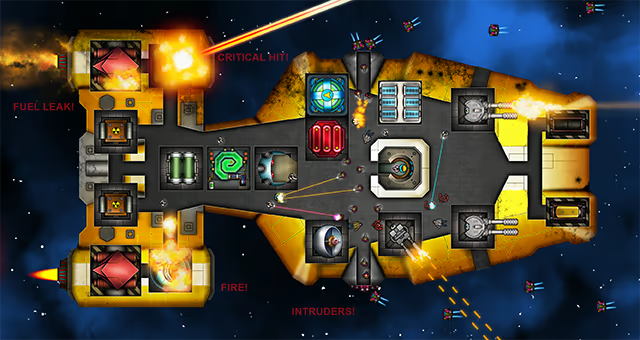
Shortest Trip to Earth is a roguelike spaceship simulator focused on exploration, ship management and tactical battles. Embark on a perilous journey across the universe with nuclear missiles, armed crew and a cat.
Modeled estimate, not a reported figure. How we estimate →
About


Genres
Stats
All-time low is the lowest price we've recorded for this game since we started tracking it.
Languages: English
Engagement
Hours played at review time, across 40 reviews with recorded playtime.
Reviews
Themes across 40 recent reviews and how positive each mention is. A keyword signal, not full sentiment analysis.
positive critical· bar length = how often the theme comes up
Reviews
It's so hard that it loose the "fun" that a game is supposed to be. Past the 5 or 6 system forget moving forward. Even if you have 8 weapons, 18 crew, 160hp and 100 shield you end up getting blown up. I regret getting this game.
Shortest Trip to Earth is a rich, deliberate, and often punishing spacefaring roguelike that prioritizes strategic thinking, resource stewardship, and narrative unpredictability over heroic power fantasy. Developed and published by Interactive Fate, the game places you in command of a vulnerable starship attempting to navigate a hostile, procedurally generated galaxy in hopes of reaching Earth. Rather than presenting space travel as sleek and romantic, it frames the journey as desperate, improvised, and profoundly uncertain. Every landing, battle, negotiation, and exploration decision carries real consequences, shaping not just the ship’s survival but the fate of the crew—people with personalities, fears, competencies, and sometimes heartbreaking vulnerabilities. The overarching structure resembles a road trip through cosmic disaster, where progress is measured not by dominance, but by resilience. The heart of the game lies in systems-driven decision-making. Players must balance fuel consumption, food supplies, ammunition reserves, morale, repair materials, and onboard facilities while navigating unpredictable star sectors. Random encounters—ranging from peaceful trade opportunities to moral dilemmas and sudden ambushes—force you to constantly reassess priorities. Combat is real-time with tactical pause, allowing careful positioning of weapons, crew assignments, reactor output adjustments, and subsystem management. Success depends on understanding the strengths and weaknesses of both your own ship and enemy vessels—not unlike managing a mechanical ecosystem in constant crisis. Losing a weapon mount, a shield generator, or a veteran crew member can turn what seemed like a manageable skirmish into a desperate fight for survival. The roguelike design ensures setbacks matter, but also encourages learning through failure rather than discouragement. Ship customization deepens that learning curve. Shortest Trip to Earth gives players significant control over ship layout, modules, weapons, drones, storage compartments, and defense systems. Each ship class offers different tactical identities—stealthy hit-and-run builds, tanky fortresses, drone carriers, glass cannons, or flexible generalists. Crew selection adds another layer, since traits determine combat performance, engineering efficiency, navigation effectiveness, and even event outcomes. Upgrading a ship is never just about accumulating better gear—it’s an expression of philosophy. Do you invest in powerful weapons at the expense of living space? Do you prioritize hyperdrives to avoid confrontation, or armor to endure it? These choices create long-term tension, especially given the ever-present threat of random catastrophe. Narratively, the game shines through its distinctive encounter writing and worldbuilding. Each region of space feels culturally and biologically unique, with factions ranging from bureaucratic aliens to aggressive raiders to existentially confused machines. Events are often humorous, unsettling, or morally challenging, presenting opportunities to barter, steal, negotiate, threaten, or cooperate. Choices rarely have obviously correct answers—helping strangers may earn future allies or drain resources you desperately need later. Many encounters carry personality, making the galaxy feel alive rather than procedurally flat. The writing embraces absurdity without ever becoming shallow, acknowledging that space is not just dangerous—it’s weird, unknowable, and often darkly funny. Visually and aurally, Shortest Trip to Earth is distinct rather than flashy. The art style features detailed top-down ship interiors, clean UI layouts, and expressive portraits that highlight both personality and urgency. Enemy ships, interstellar backgrounds, and alien structures have hand-crafted charm, helping environments feel tangible without overwhelming the player. Sound design contributes significantly—weapon impacts, alarm sirens, reactor hums, and atmospheric music emphasize isolation and looming threat. The soundtrack balances dread, melancholy, and wonder, reflecting the emotional rhythm of long-distance survival rather than constant action. The presentation reinforces the game’s identity: ominous, grounded, and filled with quiet, reflective moments between crises. Shortest Trip to Earth does not soften its difficulty curve, and that choice may divide players. Death is common, sometimes sudden, and occasionally tied to unfavorable RNG rather than clear player error. Progression unlocks persistent perks and new starting ships, but the game rarely offers comfort or momentum out of pity. Those seeking a more cinematic or forgiving space adventure may find the pacing demanding. The UI, while functional, can feel overwhelming to newcomers unfamiliar with subsystem-heavy management. Runs can last hours, making late-game losses emotionally difficult. But for players who enjoy unforgiving roguelikes—titles where every survival story feels earned rather than scripted—these challenges help give the game lasting depth. Ultimately, Shortest Trip to Earth succeeds because it understands the thematic weight of survival. It does not romanticize space—it exposes the fragility of life inside metal hulls surrounded by infinite emptiness. The game rewards curiosity, caution, adaptability, and strategic creativity, offering hundreds of small stories rather than one predetermined epic. Each run feels like a unique chronicle shaped by misfortune, clever improvisation, unexpected alliances, hard decisions, and narrow escapes. For fans of FTL-style roguelikes, system-driven storytelling, tactical combat, and resource-pressure worldbuilding, it stands as one of the most thought-provoking and replayable space survival games available—bleak at times, but emotionally compelling, mechanically robust, and full of unforgettable journeys. Rating: 7/10
like FTL, but more boring, frustrating, and less engaging overall
I have 100 hours and what must be 40 attempts in this game and I have come to terms with the fact that I will never see half of the content it has to offer. Of the 100+ hours I've played, roughly 1/3 of them have been immensely frustrating. There are 10 sectors, and on beginner difficulty I have never managed to get out of sector 5. The devs can't possibly believe that beginner difficulty is appropriately difficult. The difficulty spikes are utterly absurd and maddening. You can go from reasonably being able to handle each encounter in a sector to being completely clowned by a random encounter. Generally speaking, the first two sectors are fun. But once you start taking damage and trying to balance repairs, upgrades, and fuel/food, you realize that there is just never enough to get strong enough to advance. At first I thought I just needed to "get gud", but after three dozen tries and 100 hours I finally had to accept that the game is reguarded. If you can be happy considering sector 4 the final sector before the sector 5 end game, if you can be happy never unlocking the final ships, if you can enjoy getting absolutely destroyed by random encounters that spike the difficulty way beyond anything you should be reasonably expected to face, then maybe stock up on your favorite alcohol and buy this on sale. If not, stay away until they fix the difficulty (if they were going to do that, I'm sure they would have by now).
Not played much of this, but it's so stacked against the player. You have to go get resources but most of the time you get hit by bad events. This leads to attrition where you can't go anywhere. Plus most battles you are completely outgunned, can't run and can't do much, so much as I hate to do this, this is a NO review.
After beeing obsessed with the new(ish) "Void War", I love to see plans for a DLC :) and a major update for "Shortest Trip to Earth". Also the "trip" is not so "short" in my experience, especially compared to Void War. To be honest I have yet to complete, (basically beat), a single run after 117 hours. Might very well be a skill issue, :-)) granted, but the point beeing I really like this game. I got into this before FTL and it might not be the most informed take, but if you are into this genre: This game is absolutely worth giving a try :)
The game is incredibly micro heavy to play. Point defense attacks on a first-come-first-serve system, so you need to pause every second and reprioritize targets on incoming projectiles. You want to switch between load outs before combat so your shields are fully charged. You need to scan every enemy ship for weapons which can destroy your modules so you can focus them. After crewmates die you have to juggle your entire crew, and after a module dies you have to reformat one, perhaps two loadouts. The harder difficulties are insane, Challenging meaning that any shot that gets through your idiotic point defense because it could half the health of modules which could already be one-shot. The best you can do is hope for RNG that this shot won't be the one that ruins your only good weapon. Hardcore takes away your pause and halves your ship's HP. I've never beaten them, and frankly I don't want to try. Don't get me wrong, the core premise is fun, it's just the mechanics and interface that make it grind. Every time I come back I do a run, maybe two, then wonder why I'm fighting the game instead of playing FTL again. AND NOVEMBER 21th 2025 UPDATE HAS UTTERLY DEMOLISHED ME WITH BOARDERS. I HAVEN'T GOTTEN PAST SECTOR 6 A SINGLE TIME CAUSE EVERY TIME MY SHIP TURNS INTO VICERA CLEAN UP DETAIL. I buy every combat drone, pop every escape pod, hire as many mercenaries, and man the STUPID ♥♥♥♥♥♥♥ POINT DEFENSE and *STILL* die under a wave of bodies. I don't know, maybe it's balanced for the DLC, but no way am I getting that.
the gameplay unballanced and as mentioned before is extremely difficult! almost all the game events are dangerous for a player! this game is not a fun, it is hard work!
Fordernd, sehr gut durchdacht, mit liebe gepflegt und einfach nur gut! Spieltiefe, die man nicht erwartet, sehr hohe Motivation, es immer wieder neu zu spielen.
Ich mag komplexe spiele. Aber hier macht es kein spaß. Das meisten recourcen gehen für reperaturen drauf nicht für upgrades und die crew stirbt ständig.
Related
Related
Trends
Modeled estimate over time, reconstructed from Steam's monthly review histogram.
Momentum
Pace estimated from the game's recent review growth (our daily snapshots) at its own sales-per-review ratio — a momentum signal, not booked sales.
Audience
Estimated from the language of this game's reviews — a proxy for where players are, not official Steam demographics.
Related
| Wargroove | $949.3K | 5.3K | 83% | $7.99 |
| Tennis Elbow 4 | $948.7K | 1.1K | 96% | $23.99 |
| Bloodstained: Curse of the Moon | $948.6K | 4.5K | 94% | $9.99 |
| Amanda the Adventurer | $948.4K | 7.2K | 94% | $8.99 |
| Day of Defeat | $950.8K | 7.3K | 90% | $4.99 |
| DG2: Defense Grid 2 | $947.7K | 3.4K | 87% | $9.99 |