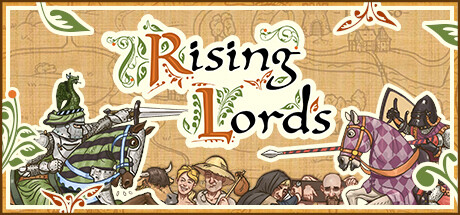
Rising Lords is a medieval turn-based strategy game with card and board game elements. Send your serfs to fight and die in your name... or let them prosper, and use them to your advantage!
Modeled estimate, not a reported figure. How we estimate →
About


Genres
Stats
All-time low is the lowest price we've recorded for this game since we started tracking it.
Languages: English*, French, German, Polish, Spanish - Latin America, Traditional Chinese, Simplified Chinese, Japanese, Korean, Italian, Spanish - Spain, Portuguese - Brazil +1 more
Engagement
Hours played at review time, across 41 reviews with recorded playtime.
Reviews
Themes across 41 recent reviews and how positive each mention is. A keyword signal, not full sentiment analysis.
positive critical· bar length = how often the theme comes up
Reviews
Rising Lords, developed by Argonwood and published by Deck13 and WhisperGames, is a strategy game that tries to merge several layers of gameplay into one cohesive experience—turn-based warfare, economic management, and even a touch of card-driven mechanics. Set in a stylized medieval world, it places you in the position of a feudal ruler who must think beyond the battlefield, balancing military ambitions with the realities of governing land and people. It’s a game built on strong ideas, though its execution can feel uneven depending on how well you adapt to its systems. The gameplay is split between managing your domain and engaging in tactical combat. On the management side, you oversee villages, assign workers, gather resources, and maintain a stable economy. Food production, taxation, and citizen happiness are all interconnected, creating a system where neglecting one aspect can quickly affect the others. This adds a sense of responsibility that goes beyond simply building an army. You are not just preparing for war—you are maintaining a society that must sustain itself over time, which gives the game a more grounded and strategic feel. Combat shifts to a grid-based, turn-based format where positioning and planning play a central role. Units have distinct roles and strengths, and terrain can influence the outcome of battles. What adds an extra layer to this system is the use of cards, which can modify actions or introduce temporary advantages. These cards allow for more flexible strategies, giving players tools to adapt to unexpected situations. However, they also introduce a level of unpredictability that may not appeal to everyone, as outcomes can sometimes feel influenced by factors outside of pure tactical planning. One of the more compelling aspects of Rising Lords is how these systems interact. Decisions made during the management phase directly affect your ability to wage war, and victories in battle can open up new opportunities for expansion. This interconnected design creates a sense of continuity, where every action contributes to a larger strategy. At the same time, it also means that mistakes can compound quickly, especially if resources are mismanaged or if military campaigns are poorly timed. Visually, the game stands out with its manuscript-inspired art style, resembling illustrations from medieval texts. This gives it a unique identity that sets it apart from more traditional strategy games. Characters and environments are stylized in a way that feels both historical and slightly playful, which helps balance the otherwise serious tone of managing a medieval domain. The audio complements this presentation, providing a subtle backdrop that supports the atmosphere without drawing too much attention. Despite its strengths, the game can be difficult to approach. The tutorial provides only a basic introduction, leaving many of the deeper mechanics for players to figure out on their own. This can make the early stages feel overwhelming, particularly for those unfamiliar with similar strategy games. The interface, while functional, does not always present information clearly, which can lead to confusion when trying to understand how different systems interact. These issues can create a barrier to entry that may discourage some players before they fully grasp the game’s depth. Difficulty is another area where the game can feel inconsistent. Early scenarios can be surprisingly challenging, requiring a solid understanding of mechanics that are not fully explained. While this can be rewarding for players who enjoy learning through trial and error, it can also make progression feel uneven. Success often depends on careful planning and a willingness to adapt, but the path to that understanding is not always smooth. The game offers a variety of modes beyond its main campaign, including skirmishes and multiplayer options, which help extend its replayability. These modes allow players to experiment with different strategies and settings, making it possible to approach the game in a more flexible way. This variety adds value, particularly for those who enjoy refining their approach over multiple sessions. In the end, Rising Lords is a strategy game that stands out for its ambition and its willingness to combine different systems into a single experience. It offers a depth that can be rewarding for players who are willing to invest time in understanding it, but it also demands patience due to its learning curve and occasional lack of clarity. While it doesn’t fully refine all of its ideas, it succeeds in creating something distinctive within the genre. Rating: 7/10
Related
Related
Trends
Modeled estimate over time, reconstructed from Steam's monthly review histogram.
Audience
Estimated from the language of this game's reviews — a proxy for where players are, not official Steam demographics.
Related
| Crown Wars: The Black Prince | $630.5K | 624 | 60% | $9.99 |
| Priest Simulator: Vampire Show | $630.8K | 913 | 95% | $19.99 |
| Dread Dawn | $631K | 2.2K | 72% | $12.99 |
| Frontier Pilot Simulator | $629.9K | 955 | 70% | $24.99 |
| TramSim Munich - The Tram Simulator | $629.9K | 682 | 67% | $17.49 |
| Manual Samuel - Last Tuesday Edition | $631.3K | 3.5K | 83% | $9.99 |