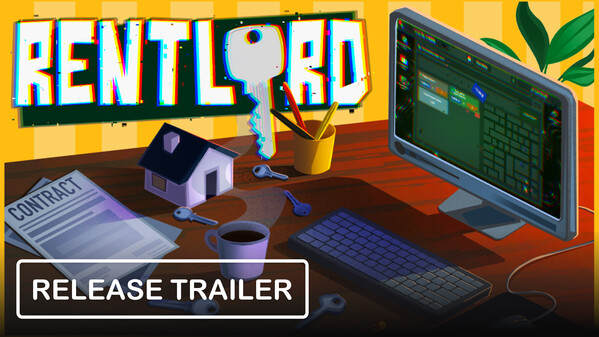
Rentlord is a combo-making roguelike real estate game where you buy properties, manage your income, and overcome unique weekly challenges. Strategic property upgrades and plugins with high combo potential, each run offers new opportunities to maximize rent, while avoiding taxes!
Modeled estimate, not a reported figure. How we estimate →
Media

About
Rentlord is a roguelike real estate management game where you build and expand your own property portfolio while overcoming challenging obstacles.
Browse a variety of properties available for purchase, each with unique benefits and strategic potential to expand your real estate empire.

Browse a variety of powerful plugins in the shop, each designed to enhance your strategy and maximize your income. Choose the ones that best suit your playstyle and expand your real estate empire with unique advantages and boosts.

See your strategic decisions pay off as you collect rent from your properties
Genres
Stats
All-time low is the lowest price we've recorded for this game since we started tracking it.
Languages: English, French*, German*, Spanish - Spain*, Japanese*, Korean*, Polish*, Portuguese - Brazil*, Russian*, Simplified Chinese*, Traditional Chinese*, Turkish**languages with full audio support
Engagement
Hours played at review time, across 40 reviews with recorded playtime.
Reviews
Themes across 40 recent reviews and how positive each mention is. A keyword signal, not full sentiment analysis.
positive critical· bar length = how often the theme comes up
Reviews
It looked interesting and I only dropped $3 on it, and it's fine, I guess. It just feels very... flat. I don't get that same sense of tension I do with Balatro, Bingle Bingle, etc. A lot of the time I'm just clicking the "collect rent" button because my upgrade modules are full or the two on offer are not helpful, and I don't have enough money to do anything else. There are definitely some combos, but honestly, "$500 every time a residential property collects rent" + "apartment building with a x10 multiplier" outperforms any other strategy. It's HARD to get multiplier up, but getting the base rent up is easy (all you have to do is wait out the current tenant's lease and evict them; at least one of the new options is going to be better). UI problems: 1) No way to see the current tenant's rent value. So if you have a good one, is it worth risking an evict? Probably but I feel like I should be able to see what they're currently worth. 2) Tenants add their rent and multiplier value to that of the property... but I've never seen a tenant with a multiplier other than 0. 3) No indication of how much revenue you actually made the prior week. You have to remember once Friday rolls over. Misc problems: 1) All properties of all types house exactly 1 tenant. Yes, even forests. Yes, that person might be a single mom. Game makes no explanation as to why. 2) Forests are still considered "vacant" even when they have a tenant because that's just a keyword like "shop" or "forest." 3) Castles and industrial are objectively bad. Their purchase cost is ridiculously high (industrial is like $400,000 compared to $15,000) and their base income value isn't all that much better ($8,000 vs. $400). 4) There are 3 kinds of residence, 2 kinds of vacant, two kinds of commercial, and one kind of industrial. No explanation. 5) Objectively no reason to ever sell a property, because shifting your focus just isn't worth it. Because of how tenant income rises over time, an established property is ALWAYS going to have a higher base rent than a newly purchased one (with rare exception). 6) Finishing a week early is bad. There's exactly one time you should ever take advantage of it: Week 1. Maybe week 2. After that, you're giving up tens or hundreds of thousands of dollars per day for "$5,000 - 35,000" Bottom line though. I spent $3 and for $3 its fine. I wish it was better, but I didn't spend that much.
Прикольная игрушка
The game is genuinely boring, short, uneventful and the "roguelike" feels more like a watered down "roguelite". Played it two hours and there's really nothing else to see or do other than playing in harder difficulty... There's way better games out there for 5 bucks...
Shallow gameplay, not worth it even if you got it for free
This game should be in early access. There's only 3 difficulties, only 3 portfolios(like decks in balatro), and relatively few plugins and properties. There's also a challenges button in the main menu with coming soon slapped on it and the gameplay is very simple, as many other reviews have pointed out. They have a decent post-release roadmap on the store page, but it's been several months since the first of 4 planned updates and it looks like the dev has completely moved on without thinking of the other 3 updates. I can't recommend until this game actually has enough content to call it a full release, which may be never. Edit: After 100%ing the game, most of the unique interactions are locked behind very rare plugins that you probably won't get until you already have a build capable of beating the game. If the common plugins were as interesting as the more rare ones, this game would be much more fun.
BEST GAME EVER
Rentlord is a compact yet surprisingly addictive indie strategy game developed by verty and published by Rogue Duck Interactive. Released on Steam in June 2025, the game presents an unusual twist on the management genre by turning real estate investment into a roguelike, combo-building puzzle. Instead of slowly constructing a massive property empire in a traditional tycoon simulation, the game focuses on short runs where players attempt to assemble profitable property combinations under escalating economic pressure. This approach results in a fast-paced strategic experience that feels closer to a deck-building roguelike than a conventional business simulator, combining careful planning with a strong element of randomness that keeps each playthrough feeling fresh. At the heart of Rentlord lies a simple but clever gameplay loop. Each run begins with a limited amount of starting money and a marketplace offering various properties for sale. Players purchase buildings—such as houses, apartment blocks, and other rentable locations—that generate income each in-game cycle. The objective is to reach increasingly demanding rent targets while managing expenses, taxes, and limited investment opportunities. Unlike traditional management games that emphasize long-term expansion, Rentlord pushes players to optimize efficiency in a compressed timeframe. Every purchase decision matters, because poorly chosen properties can stall income growth and make it difficult to meet the rising weekly goals that determine success or failure. What makes the game stand out is its emphasis on synergy and combo mechanics. Properties alone rarely generate enough income to win a run; the real depth comes from combining them with special modifiers called plugins. These upgrades function similarly to cards in a deck-builder, granting powerful bonuses that alter how properties behave or multiply their income. Some plugins boost rent from specific property types, while others trigger bonuses based on adjacency, ownership patterns, or economic conditions. Discovering these combinations is where the game becomes most satisfying. When a well-planned build comes together, a modest property portfolio can suddenly explode into a massive income engine capable of generating enormous profits in a single round. The roguelike structure ensures that each run presents a slightly different strategic puzzle. The available properties and plugins are randomized, meaning players must adapt their strategy to whatever options appear in the marketplace. Sometimes the game encourages focusing on a single powerful property supported by multiple bonuses, while other runs reward spreading investments across different building types to trigger diverse synergies. This randomness adds replay value and prevents the game from feeling overly predictable, although experienced players may eventually begin recognizing the most effective combinations that lead to consistent victories. Visually, Rentlord adopts a minimalist style that suits its design philosophy. The interface resembles a streamlined economic dashboard where properties, bonuses, and financial statistics are clearly displayed. Graphics are simple and functional rather than flashy, but the clean presentation helps players quickly understand the interactions between buildings and upgrades. The soundtrack and sound effects remain subtle and unobtrusive, allowing the focus to stay on the strategic puzzle of constructing an efficient economic engine rather than overwhelming the player with visual or audio distractions. Another appealing aspect of the game is its accessibility. Runs are relatively short, making it easy to jump in for a quick session and attempt another strategy without a large time commitment. The achievement system and unlockable upgrades provide additional incentives to keep playing, gradually introducing new plugins and bonuses that expand the range of possible strategies. As players complete objectives and experiment with new combinations, they gain access to more powerful tools that allow increasingly creative and explosive builds. This gradual progression gives the game a sense of growth even though each run is technically self-contained. However, the game’s streamlined design can also be a limitation. Because the number of property types and plugins is relatively small compared to larger roguelike strategy games, the available strategies may begin to feel repetitive after extended play. Some builds clearly outperform others, which can reduce the incentive to experiment once optimal combinations are discovered. The overall scope of the game is also fairly modest, meaning players looking for a deep simulation or long-term economic management experience may find the content somewhat limited. Even with these drawbacks, Rentlord succeeds at delivering a charming and engaging twist on the management genre. Its engine-building mechanics are easy to understand but rewarding to master, and the roguelike structure ensures that every session presents a new challenge. Watching a carefully constructed network of properties and plugins transform into a wildly profitable income machine is immensely satisfying, and the game’s short run structure encourages the addictive “one more attempt” mentality that defines many successful roguelikes. In the end, Rentlord is a small but clever strategy game that stands out thanks to its unique concept and efficient design. By transforming property investment into a combo-driven puzzle, it offers a fresh take on both roguelike and management mechanics. While it may not have the long-term complexity of larger strategy titles, its quick sessions, satisfying synergies, and creative premise make it a memorable experience for players who enjoy experimenting with strategic builds and economic systems. Rating: 8/10
没想到炒房也能跟肉鸽联系在一起,构筑成型以后数值膨胀的很高,玩起来很爽快,也算是体验了一把包租公的乐趣
game is very easy, has little to do beyond hit "collect rent" and is very buggy. i dont know how i got half the achievements i have because i most certainly did NOT achieve many of those requirements
Demosunu da çok oynamıştım. Tam olarak ekranda ne olup bitiyor bilmiyorum ama eğlenceli bir deneyim.
Related
Related
Trends
Concurrent players on Steam, sampled daily since tracking started.
Audience
Estimated from the language of this game's reviews — a proxy for where players are, not official Steam demographics.
Related
| The Case Book of Arne | $64.7K | 368 | 88% | $9.99 |
| Lavender Quartz 境界秤動 | $64.7K | 302 | 95% | $11.99 |
| Time Warpers | $64.7K | 547 | 83% | $4.99 |
| TinyKeep | $64.6K | 256 | 66% | $9.99 |
| Godrop | $64.6K | 312 | 95% | $8.99 |
| ANIWARS: Call of the Void | $64.6K | 179 | 94% | $12.99 |