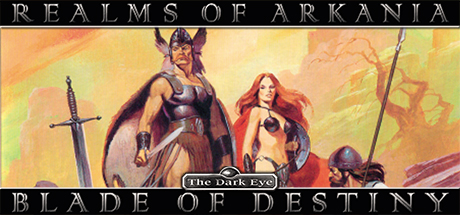
Blade of Destiny (1992) is the first part of the glorious Realms of Arkania Trilogy...An Orc army stands ready to attack Arkania's villages and towns. The only hope of saving the land lies in the legendary Blade of Destiny. Can you find this magical weapon in time to stop the siege?
Modeled estimate, not a reported figure. How we estimate →
Media
About
Genres
Stats
All-time low is the lowest price we've recorded for this game since we started tracking it.
Languages: English, German
Engagement
Hours played at review time, across 41 reviews with recorded playtime.
Reviews
Themes across 41 recent reviews and how positive each mention is. A keyword signal, not full sentiment analysis.
positive critical· bar length = how often the theme comes up
Reviews
Ist super Geeeeeiiiiilllllll!!!!!!!!!!!!!!!
Awful music! No way to turn it off! No Tutorial! Terrible pixilations Overlong, boring intro!
Kult
《阿卡尼亚王国:命运之刃》...没想到能在steam上玩到这么老的游戏,但是内容一点不少,涉及到从战斗到生存的全方位管理。六人小队的角色管理设计得相当好,要考虑的事情很多,他们的技能也相当多,战斗挺多样的。这部游戏完全超出了我的想象,能感受到上世纪对电子游戏的热爱和野望呢
[h1][b]Not Recommended[/b][/h1]
Realms of Arkania 1 – Blade of Destiny Classic, developed by Attic Entertainment Software GmbH and published by United Independent Entertainment, stands as a defining relic from the early 1990s era of role-playing games. Originally released in 1992, it was one of the first digital adaptations of the German tabletop RPG system Das Schwarze Auge (known internationally as The Dark Eye), a franchise that rivaled Dungeons & Dragons in its home country for depth and world-building. The “Classic” edition available on Steam preserves this original version almost exactly as it was, complete with its intricate mechanics, rigid systems, and interface limitations. To play it today is to step into a time capsule of early PC role-playing—a world where patience, strategy, and imagination were as vital as reflexes or graphics, and where a player’s endurance was often tested as much as their characters’. The premise of Blade of Destiny revolves around a familiar fantasy scenario: the orc tribes of the north are gathering for war, threatening to sweep across the lands of Thorwal, and the only hope lies in recovering the legendary sword known as Grimring, the Blade of Destiny. The player takes command of a party of six adventurers tasked with assembling fragments of an ancient map that leads to this mythical weapon. While the plot might appear straightforward, the game’s execution is anything but. Instead of guiding players through a linear narrative, it offers a sprawling, semi-open world with dozens of towns, dungeons, and regions to explore. Each location is navigated through a hybrid of 2D travel maps and 3D first-person exploration, reminiscent of titles like Eye of the Beholder or Might and Magic. But what sets Blade of Destiny apart is its devotion to simulation: it not only tracks combat and quests but also hunger, fatigue, weather, encumbrance, and morale. Every decision—from choosing rations to selecting travel routes—has consequences, making it as much a survival experience as a heroic one. Character creation is one of the most elaborate processes in the game, borrowing heavily from its tabletop roots. Players select races and classes—humans, elves, dwarves, magicians, warriors, rogues—and then assign dozens of attributes and skills, ranging from combat proficiency to wilderness lore, healing, and even etiquette. These statistics directly affect in-game outcomes, as nearly every situation, from foraging in the wilderness to bartering with merchants, is resolved through dice-roll checks under the hood. This gives the game an unpredictable charm that feels closer to a living role-playing session than a scripted adventure. Yet it also means that failure is frequent, and new players can easily find their party starving, poisoned, or lost after a few misjudged days of travel. The depth is rewarding but also merciless—a reflection of the era’s belief that mastery should be earned through trial and error rather than convenience. Combat plays out on a tactical, turn-based grid viewed from an isometric perspective. Each fight unfolds like a miniature strategy game, requiring positioning, careful management of spells, and attention to stamina and injuries. On paper, the system offers impressive variety: characters can use melee weapons, ranged attacks, and magic, while environmental factors influence outcomes. However, combat’s slow pace and the cumbersome interface make battles lengthy affairs. Even minor skirmishes can stretch on for several minutes as each party member’s turn is manually executed through menus. While this level of micromanagement adds authenticity to its tabletop inspiration, it can also disrupt momentum and make grinding or random encounters feel tedious. Still, when approached with patience, these battles showcase a kind of tactical precision that many modern RPGs have lost—every hit and miss carries real weight, and victory feels genuinely earned. Visually, Blade of Destiny shows its age, but there is an undeniable charm in its simplicity. The 3D environments are composed of flat textures and static walls, creating mazelike dungeons and labyrinthine cities that rely on imagination as much as depiction. Monster encounters transition to hand-drawn battle screens that, while primitive, evoke a nostalgic sense of tabletop illustration. The interface is dense, relying on nested menus and small text, with little visual feedback for actions—a stark contrast to the intuitive designs of later generations. The game demands that the player read the manual, take notes, and even draw maps, which feels archaic yet strangely satisfying. The atmospheric music, sparse though it is, provides moments of tension and wonder that enrich the sense of exploration. For players accustomed to modern automation, the lack of hand-holding may feel punishing, but for enthusiasts of classic CRPGs, this very difficulty is part of its immersive charm. Narratively, Blade of Destiny does not aim for cinematic storytelling but rather the feeling of an epic journey shaped by the player’s will. The main story—the search for the Blade of Destiny—is a loose thread that ties together a vast number of side quests, random encounters, and emergent events. You might find yourself rescuing a caravan, treating a disease outbreak, or fending off bandits in the wilderness before ever touching the main quest. This freedom gives the world a texture that feels alive, though it also contributes to a lack of pacing or clear direction. There is a time limit, however—the orc invasion looms as a constant reminder that you cannot wander forever. Fail to recover Grimring in time, and the world falls to ruin. This ticking clock adds a subtle layer of urgency rarely seen in RPGs of its time, compelling players to balance exploration with efficiency. Realms of Arkania’s difficulty and archaic design can be daunting, but beneath those rough edges lies an experience of surprising depth and authenticity. It remains one of the few RPGs to treat adventuring as both a strategic and logistical challenge rather than pure combat. The satisfaction of finally mastering its systems—managing your party’s hunger, surviving a brutal snowstorm, or emerging victorious from a deadly dungeon—is unmatched. For many players, the game’s punishing nature only enhances its sense of accomplishment. Yet it is undeniably a product of its era: newcomers without nostalgia for early ‘90s CRPG design may find it unintuitive and slow. The lack of modern conveniences such as quest tracking, auto-mapping, or tutorial guidance ensures that Blade of Destiny is best suited for veterans who appreciate historical depth and are willing to adapt to its demands. Ultimately, Realms of Arkania 1 – Blade of Destiny Classic endures as both a foundational milestone and a niche curiosity in RPG history. It represents a time when computer role-playing sought to emulate tabletop complexity rather than cinematic storytelling, and it succeeds in doing so with uncompromising authenticity. Its world feels vast, its systems intricate, and its challenges brutally fair. While the experience is far from accessible by modern standards, it offers a rewarding, methodical adventure for those patient enough to learn its language. To play it today is to step into the mindset of early RPG design—where imagination, perseverance, and curiosity were the greatest weapons a player could wield. Rating: 7/10
Amiga 500 classic Spiel sehr gut
My first game ever. Loved it.
Sternstunde des deutschen RPGs.
Old-School-RPG, spiele es immer wieder mal aus Nostalgiegründen :) Stammt noch aus Zeiten als Fantasie noch in deinem Kopf statt fand und nicht auf dem Bildschrim.
Related
Related
Trends
Modeled estimate over time, reconstructed from Steam's monthly review histogram.
Momentum
Pace estimated from the game's recent review growth (our daily snapshots) at its own sales-per-review ratio — a momentum signal, not booked sales.
Audience
Estimated from the language of this game's reviews — a proxy for where players are, not official Steam demographics.
Related
| Kitten Love Emulator | $3.4K | 57 | 89% | $1.99 |
| Casina: The Forgotten Comedy | $3.4K | 78 | 85% | $3.49 |
| Walter Walnut | $3.4K | 50 | 94% | $2.99 |
| Kiara And My Ara Ara Adventure | $3.4K | 91 | 91% | $2.99 |
| Cions of Vega | $3.4K | 91 | 75% | $2.99 |
| Pursuing My Uncle | $3.4K | 101 | 89% | $1.99 |