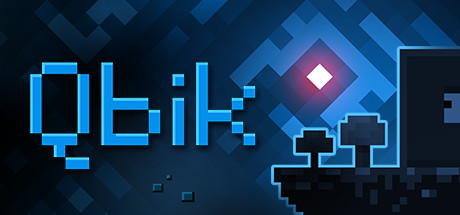
Qbik, developed by Norbert Palacz and published by Forever Entertainment S.A., is a minimalist puzzle-platform game that embraces simplicity while offering a surprisingly complex and methodical challenge beneath its retro exterior. The premise is immediately charming yet straightforward: players control a small, one-eyed square creature tasked with consuming every yellow block in each level. Set within an underground world of pixelated caverns, the player must carefully navigate tight spaces, avoid traps, and plan every move in order to clear the board without getting stuck. It’s a concept that harkens back to the golden age of puzzle design, where clarity of rules and logical depth mattered far more than flashy presentation or cinematic storytelling. Qbik’s deceptively cute aesthetic hides a game that can be as tough and cerebral as any modern logic puzzle, rewarding patience, foresight, and precision.
From the moment it begins, Qbik establishes a distinct identity through its nostalgic pixel art and restrained visual design. Each level is built from simple geometric structures that communicate function through color and shape: yellow squares represent food, gray walls define boundaries, and spikes or other hazards signal instant failure. The backgrounds are muted, and the music is subdued, ensuring that the player’s attention is drawn entirely to the mechanics at play. The protagonist, a perpetually hungry cube with a single blinking eye, provides an odd touch of personality, its simplistic expression occasionally hinting at a mischievous sentience. The overall aesthetic feels deliberate and cohesive, reflecting the game’s mechanical purity. Rather than distracting the player with excess detail, it invites total focus on the puzzles themselves, which grow more elaborate and cunning with every passing level.
Mechanically, Qbik operates on an elegant foundation: players move the cube across a grid-based stage, consuming yellow blocks to clear the level. The challenge lies in the sequence of moves—each eaten block can alter the layout of the stage, and taking the wrong one at the wrong time can lead to an unsolvable configuration. There’s an inherent tension between movement and consumption, as every decision has lasting consequences. The game eases players in with simple layouts before gradually introducing new elements such as movable platforms, switches, and teleporters that add complexity to the equation. The difficulty curve is inconsistent at times but undeniably stimulating, demanding both spatial reasoning and an understanding of cause and effect. Thankfully, the inclusion of an “undo” feature allows for experimentation without severe punishment, letting players rewind mistakes instead of restarting entire levels. This small design choice maintains the challenge while reducing unnecessary frustration, a welcome touch that keeps the game’s pacing smooth and engaging.
Beyond its built-in campaign, Qbik includes 63 handcrafted levels that grow progressively intricate, testing the limits of the player’s logical planning skills. Once the official stages are completed, the built-in level editor opens the door to limitless creativity. Players can design their own challenges and share them via the Steam Workshop, effectively extending the game’s lifespan indefinitely. This editor is simple to use but surprisingly robust, offering the same set of tools the developers employed to create the core puzzles. The ability to play and rate community creations adds replayability, transforming Qbik from a compact single-player experience into a living puzzle ecosystem. The low system requirements and small file size also make it an accessible title for virtually any PC, allowing players to jump in and experiment freely without technical barriers.
The game’s biggest strength is its design clarity, but that same strength can also be its limitation. Qbik is a pure puzzle game in the traditional sense—there is no story to follow, no elaborate progression system, and no flashy presentation to distract from the logic at hand. For some players, this focus may feel refreshing, while for others it may come across as overly bare. The soundtrack, while functional, loops quickly and lacks variation, which can make long play sessions feel monotonous. The pixel art, though clean and charming, doesn’t evolve significantly as the player progresses. Additionally, the later puzzles introduce difficulty spikes that can frustrate those expecting a gentler curve. The lack of hint systems or in-depth tutorials means that progress is entirely dependent on persistence and observation. Yet for players who appreciate puzzle design that demands deliberate thinking, these challenges become part of the reward—each level conquered feels like an accomplishment earned through genuine reasoning rather than trial and error.
What keeps Qbik compelling despite its simplicity is the purity of its design philosophy. Every element, from the sparse visuals to the clean user interface, serves the core experience of problem-solving. The game never resorts to artificial gimmicks or filler content, focusing instead on a steady escalation of mechanical interplay. Its minimalist presentation makes it timeless rather than dated; it could have existed twenty years ago or twenty years in the future, and it would still function on the same fundamental principles. The inclusion of the level editor ensures that Qbik’s potential extends beyond its modest initial offering, allowing dedicated players to expand upon its foundation indefinitely. It’s the kind of game that rewards creativity, logic, and patience—the hallmarks of classic puzzle craftsmanship.
In the end, Qbik stands as a small but admirable entry in the world of indie puzzle games. It does not try to reinvent the genre, but instead refines it to its essentials, stripping away anything that might distract from the mental challenge at its core. The result is a game that feels timeless in its simplicity yet demanding in its depth. For players who love methodical problem-solving, pixel art aesthetics, and the satisfaction of mastering cleverly designed levels, Qbik delivers a focused and rewarding experience. It may not appeal to those looking for spectacle or narrative, but for those who find beauty in logical design and minimalism, Qbik offers an elegant, brain-teasing adventure that lingers far longer than its humble appearance suggests.
Rating: 8/10