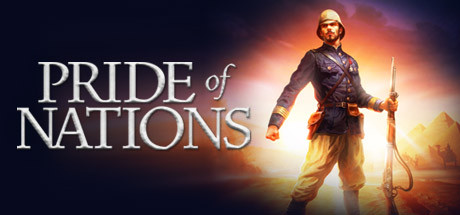
Pride of Nations is a turn-based historical strategy game set in the colonial era of the 19th century, where the player takes control of a country and guides it through industrialization, military conquest, and colonization.
Modeled estimate, not a reported figure. How we estimate →
Media

About
Genres
Stats
All-time low is the lowest price we've recorded for this game since we started tracking it.
Languages: English, French, German, Spanish - Spain
Engagement
Hours played at review time, across 40 reviews with recorded playtime.
Reviews
Themes across 40 recent reviews and how positive each mention is. A keyword signal, not full sentiment analysis.
positive critical· bar length = how often the theme comes up
Reviews
it's great
If you're thinking about buying Pride of Nations, just be aware that it is not for the casual strategy gamer. Pride of Nations is complex, with a steep learning curve, and requires a lot of patience. Sure, turns can take a while to process and the map scrolls a bit slowly if you're running high resolutions. But for those who stick with it, no other game comes close to matching its scope, detail, and historical accuracy. I own a large collection of grand strategy games, but Pride of Nations is easily my all-time favorite.
superbe jeu, mais qui a un tres tres gros defaut, le temps tres long qui passe entre chaque tour. c'est dommage. il est quand meme meilleur que victoria 2. IL EST TOUJOURS MEILLEUR QUE V3 A L HEURE ACTUELLE
Pride of Nations is a flawed game, but also a good game that is deserving of a sequel. Most gamers' will draw comparisons to Victoria 2. Pride of Nations always does something amazing then it feels unfinished or not fully tested. For example, the level of military unit detail is incredible. You have land and naval commanders that have specific traits and command limits. The amount of units you can build in both Corps, Divisions, and Brigades is truly impressive. Your army feels real. However, moving it is brutal and punishing, far more than it needs to be. Attrition is a major factor every time you move somewhere. And while attrition is a real thing, you are taking on the role of a King, President, or Emperor. It can reasonably be assumed that you have Generals and staff that supply the army so you can actually use it without losing half your men moving in a turn. Economic development with provinces is some of the best I've ever seen in a game of this type. You can see the tremendous benefits that railroads bring a country. As an economic simulation of 19th century Europe, this is a lot more fun than say, Victoria 3. However, you don't exist within in a vacuum and this is where the game breaks down again. Politics are lackluster. There are supposed to be "hot spot" events, but you never seem to generate them and interactions with neighboring countries is generic. Worse, the scripted events don't work. I was playing as Russia and the Crimean War triggered without any build up or decisions to it, one turn France, England, and Turkey simply declared war on me. Alright, fine, I fight an exceedingly good campaign getting France to bow out early and turning the Black Sea into a Russian lake. I eliminate the entire British BEF, and am making slow but steady inroads into the Ottoman Empire when another scripted event takes place saying the war is over. I get no territorial concessions and had two armies destroyed because they were on Ottoman territory and couldn't be supplied once control of zones reverted back to the Ottomans. I had no chance to even negotiate a peace nor would I have agreed to one at that time without compensation because I was winning! After 30 hours of game play, I feel that's decent value for the game when you get it on sale. There are fun elements, but the lack of finish shows up and makes it difficult to imagine someone completing all the turns in a grand campaign. The AI moves between turns takes a while so 30 hours into the game I was in 1854 (start in 1850) and the game goes through 1918. I might try the game again at some point as the United States and see how it functions simulating up to the Civil War. However, I'm hesitant to put in the time because of the scripted nature of the Crimean War an unsatisfactory feeling I got without having any input into the peace conference terms. Maybe I'm just used to a Hearts of Iron type of peace. Worth playing? Yes. Not a hidden gem, but certainly a game that had some potential.
A highly complex and flawed gem of a grand strategy game. It being an AGEOD game it almost plays like a boardgame, with the computer taking care of all of the under the hood computations. Do I recommend this? Yes, but... - You really need to have a lot of patience. - You need to be interested in history. - Be ready to figure out everything by yourself. - Be prepared to sink your teeth in a hardcore, complex game. Just by reading the above, most people will have decided not to play this game. Yet you're still reading this, so congratulations and let me explain why this is such a good game. In the grand campaign you get to play through seventy years of world history split up into two week turns (15 actually), which amounts to 1680 turns! Colonialism, industrialisation, the forming of nation states, the birth of modern armies and much more is present in this game. There is simply no game with this broad of a scope and timeframe that somehow goes into all of these 'details'. The game gives you a lot of options and freedom to build up your nation. You could focus on gaining colonies and remaining mostly neutral in the messy wars in Europe. You could also bolster the economy of your homeland, export your comodities and become an economic juggernaut. You can also go the diplomatic way and navigate the precarious web of treaties. Or you can wield your armies and invade friend and foe. Ultimately you'll probably mix it up and do a bit of everything, but depending on your nations' situation some of the above might not be advisable or even possible. Though maybe a bit dated looking by todays standards I find the map appealing, the UI apropriately styled and the army and unit counters are nice to look at. The different units give a lot of character to the game, as each unit has a picture showing their distinctive uniforms or military material. Every nation has its own unitforms and depending on what parts of the world you control you get different units. You have your standard units, but specific units like the Gurka's, French Foreign Legion, Cossacks, and many more are also present. And to top it off, all these units' appearance and performance change throughout the years. Now one thing that almost kills this game: the loading times... my god the loading times. I bought the game just about when it came out ten years ago. Back then it actually took multiple minutes of waiting in between turns, as the computer calculates basically every decision of every nation and every move of every unit acros all of the world. This would only become worse once you progressed through the game, as so many things started happening at once and these all needed to be computed. It led me to give up on the game and it lay dormant for many years in my library. I always knew this game had potential, so recently I gave it another shot. By now the load times are manageable, but still kind of long. Sometimes up to a minute in between turns. Lastly the game is difficult and the UI, though I like the aesthetic, doesn't help. It being an old niche game means the community is almost none existant, so getting questions answered in forums is not going to be easy. To the manual then, which is decent, but also left me with some unanswered questions. So basically you've got to learn the game by yourself, by playing it and really sinking your teeth in it. Luckily there are just about 1680 turns to get it right! In the end Pride of Nations is a game that must be played like the way you would savour a good whiskey. Take your time, let all of its different aspects slowly seep in and enjoy the moment.
I would love to play this game. But: Keeps crashing. To long turn time. Unplayable
Great concept, sadly a less than optimal implemention. If only the ai would calculate while the player takes his turn, it would be soo much better. As it stands it is a nice strategy game while listening to podcasts.
I'd recommend this game only to a certain rare type of gamer--the kind with a great deal of patience and a love of history (especially this period of history). This is not a game to just pick up and play casually. It requires study (beginning with a close reading of the manual, but not ending there, since not everything is in the manual). It also requires a big time commitment (say a couple years to complete the full campaign). And then it requires attentive, methodical play. There are shorter scenarios that could be enjoyed with less effort, but the game system shines in campaign mode, playing on the world map. Frankly, I bit off more than I could chew when I bought this game. I'm impressed with it; it's a real gem. But I may never play it again. I'm just not the right kind of gamer for it and don't have enough time. I'd still heartily recommend it, though, with the above caveats, even though it has some flaws and was never developed to its full potential.
Demasiado complicado de jugar y comprender.Estás más tiempo esperando tu turno que jugando,Y no lo puedo poner en español. Lo tengo ya muchos años y no he conseguido ni terminar una sola partida porque se cuelga cuando le da la gana y todo lo que has jugado no te vale para nada porque ya no puedes seguir. Una porqueria de juego esperaba mucho más.
As with the rest of this series from AGEOD, the learning curve for this game is rather steep, particularly as this is a detailed economic as well as military simulation, but it is well worth the time investment. The simulation of the time period is well-done and evocative, the AI is a credible opponent, and I particularly like the lovely board game-like unit cards and artwork. The UI definitely takes some getting used to, but I already understood the military, logistical, and events systems from playing To End All Wars, so for me it was really just a matter of learning the economic and political aspects. This is a deep and complex game and isn't for everyone, but if you're looking for a deep simulation of the 1850-1920 period, this is a very solid title, and one which I believe deserves an eventual sequel on AGEOD's new engine.
Related
Related
Trends
Modeled estimate over time, reconstructed from Steam's monthly review histogram.
Momentum
Pace estimated from the game's recent review growth (our daily snapshots) at its own sales-per-review ratio — a momentum signal, not booked sales.
Audience
Estimated from the language of this game's reviews — a proxy for where players are, not official Steam demographics.
Related
| Bullets And More VR - BAM VR | $115.4K | 514 | 88% | $9.99 |
| AKIBA'S TRIP: Hellbound & Debriefed | $115.4K | 328 | 80% | $19.99 |
| Sakura Santa | $115.3K | 648 | 85% | $9.99 |
| Charming Hearts | $115.4K | 593 | 88% | $9.99 |
| Summa Expeditionis | $115.4K | 312 | 71% | $9.59 |
| Touhou Seirensen ~ Undefined Fantastic Object. | $115.3K | 437 | 96% | $14.99 |