[h1] Played with Quest 3 + Virtual Desktop [100% completed] [/h1]
Final Score: 8/10
Imagine if you could go back to the 90s and relive classics from that era like Super Nintendo, Mega Drive, Nintendo 64, or arcade classics like Streets of Rage. Pixel Ripped 1995 brings back those nostalgic moments you experienced, or at least shows you what it would have been like if you had been born in that time. I lived through that era, and I can say with certainty that if the game tried to recreate that feeling, it succeeded excellently.
I played this game right after finishing Pixel Ripped 1978 (Yes, I started with the third game in the series, because I bought it on sale thinking it was the first one due to the title)
Before going further, I need to say that [b]this review only compares Pixel Ripped 1995 with Pixel Ripped 1978[/b]. The reason is simple: [b]the first game in the series, Pixel Ripped 1989, did not work at all on my PC or my wife’s PC[/b]. In both cases the game [b]crashed immediately on startup with an access violation error[/b]. I tried a bunch of fixes and troubleshooting steps, but nothing worked, so [b]I could not actually play it[/b] and therefore cannot include it in this comparison.
[h2] Story [/h2]
The story of Pixel Ripped 1995 is basically the same as 1978. Cyblin Lord, the villain, takes over as the protagonist, corrupting Dot’s world and forcing her to connect with someone from the real world. In this case, David, the silent protagonist we control.
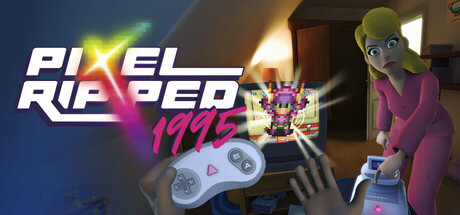
The game is divided into chapters, each with an introduction, the main level, and a boss fight. Unlike 1978, we do not have two different gameplay styles. Here, we only play in front of the console, controlling Dot like a regular video game character.
The few moments where we step into Dot’s perspective only happen during the chapter introductions, where we mostly just watch with little or almost no interaction.
[h2] Gameplay & VR [/h2]
As mentioned before, we spend most of the time playing as David, controlling Dot. Unlike 1978 where everything revolves around Atari, here we go through a variety of consoles and genres.
Each chapter features one or sometimes two consoles. We see 16-bit consoles like Super Nintendo and Mega Drive, and also 32-bit ones like the PlayStation 1.
In them, we play several games inspired by classics like Sonic, Metroid, Castlevania, Road Rash, Streets of Rage, Mortal Kombat, and even something like Crash Bandicoot with a Silent Hill vibe. The nostalgia here is really strong.
There are also interactions with the environment, a bit more limited than in 1978, but more impactful.
You use motion controls to grab NERF guns, shoot around you, switch controllers, turn off the TV, throw banana peels, and other actions that are required to progress.
Controls work well overall, but the default layout for jumping, shooting, and recentering the camera is pretty weird. Probably because the game was made with older controllers in mind. It is not a big issue though. I played most of the game like that without major problems, just takes some getting used to. Later I remapped everything through Steam, which fixed it, except tutorials still showing the wrong buttons.
[h2] Graphics & Performance [/h2]
Just like in 1978, there are two visual styles. A 2D look when inside the game, which is honestly amazing, mixing 2D and 3D. But since most of the time is spent outside, I will focus on the 3D visuals.
Unlike 1978’s more cartoon style, this one looks more rustic, with simpler and honestly less appealing characters.
It does not really hurt the experience since most of the time you are looking at the 2D games anyway.
Performance is very good overall. Just like 1978, environments are small and models are simple. With good optimization, even weaker PCs can run it at 120 FPS.
The only issue I had was during the chapter 2 boss fight, where the game crashed a few times mid-combat. It seems like a specific bug and it did get a bit frustrating, especially for achievements.
[h2] Difficulty and Achievements [/h2]
This is the biggest difference compared to 1978. The game is noticeably harder. Each chapter has two difficulty modes, Normal and Hardcore.
Normal is already challenging at first, but it gets easier once you get used to it. Checkpoints and extra lives help a lot.
Hardcore is where things get serious. You have fewer lives, cannot recover lost pixels after taking damage, and boss fights do not give extra lives.
There are also two achievements that almost made me give up on 100%.
One for finishing the game in a single session. Not that hard, but the crashes during boss fights made it annoying.
The other for finishing the game without dying or failing as David. This is already very hard because of insta-kill moments, and the crashes just made it worse.
Aside from those, the rest of the achievements are pretty reasonable. There is also a chapter select, so you can replay specific parts or go straight to boss fights. You can also complete chapters individually on Hardcore, so no need to replay the whole game.
If you do not care about achievements, the difficulty feels fair overall, and there is good replay value with Normal and Hardcore. This also makes it longer than 1978.
[h2] Final thoughts [/h2]
Pixel Ripped 1995 feels like a really strong idea that is not fully refined yet. The nostalgia is excellent, especially if you lived through the 90s, and the variety of games is easily its biggest strength. Each chapter feels like a tribute to a different genre, which keeps things fresh.
Compared to 1978, it is more ambitious and creative, but less consistent. The lack of a proper dual gameplay structure makes things feel more segmented, and most of the time you are just playing in front of a screen.
At the same time, this allows for more direct and impactful interactions with the environment. Using VR to interfere with the game world is simple, but often feels more meaningful than in 1978.
Gameplay is solid but a bit rough. Controls can feel weird without remapping, and some parts show the game’s age. The higher difficulty, especially on Hardcore, can be fun but also frustrating when combined with crashes.
Visually, it is a step below 1978 in consistency and polish, mainly in the 3D parts, but the 2D sections more than make up for it with strong style and nostalgia.
In the end, Pixel Ripped 1995 is a very creative and memorable VR experience, even if it lacks the refinement of its successor. It is more experimental, more challenging, and sometimes more frustrating, but also more daring.
If 1978 feels like a polished and complete version, 1995 feels like the foundation where those ideas were tested and proven.
FInal score: 8/10 ⭐