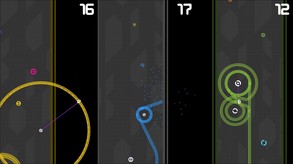
ONE MORE LINE is a highly addictive, one button, space disco, skill timing game! Steam edition features 2-4 player local multi-player and no advertising. All for a very low price! Can you put a price on fun though?
Modeled estimate, not a reported figure. How we estimate →
Prices
The United States storefront in every case, so this compares stores and not countries.
About
Genres
Stats
All-time low is the lowest price we've recorded for this game since we started tracking it.
Sums Steam only; App Store publishes no volume signal, so the true total is higher by an unknown amount.
| Store | Price | Audience | Score | Chart | Est. revenue |
|---|---|---|---|---|---|
SteamYou are here | $2.99 | 292reviews | 73% | — | $18.7K |
| Free | 889ratings | 89% | — | not modelled |
Matched by title — a reused name can pair the wrong games. * is a critic aggregate. Prices and positions are each store's United States storefront; Epic charts worldwide. Audience and Score too, except Steam's, which is worldwide.
Engagement
Reviews
Themes across 44 recent reviews and how positive each mention is. A keyword signal, not full sentiment analysis.
Reviews
One More Line, developed and published by SMG Studio, is a minimalist yet intensely addictive arcade experience that strips gaming down to its purest form: rhythm, timing, and precision. It’s one of those rare titles that takes a single mechanic and polishes it until it becomes hypnotic. On the surface, it seems almost too simple—you guide a small, endlessly moving object through a narrow corridor filled with spinning anchor points by pressing a single button. But that simplicity is deceptive. Beneath its neon aesthetic and pulsing soundtrack lies a finely tuned game of reflexes and momentum where every second feels like a test of control and nerve. It’s a game that challenges you not just to survive, but to master flow itself. The premise of One More Line couldn’t be easier to grasp, but it takes seconds to learn and hours to truly understand. Your small ship continuously moves upward through a corridor lined with circular nodes. By holding a button, you attach to one of these nodes and begin orbiting around it. Releasing the button flings you off at whatever angle your rotation carries, sending you hurtling forward through the void. The goal is to travel as far as possible without crashing into the corridor walls or colliding with the very nodes that serve as your lifelines. There’s no scoring system beyond distance—your entire purpose is to push your run a little farther than before. This barebones design gives the game its purity. There’s no story, no upgrades, no unlockable gimmicks—only your skill, your rhythm, and your ability to make split-second decisions under pressure. The genius of the game lies in its physics and pacing. Every orbit feels different depending on the angle, speed, and proximity of the next anchor point. The key is to find the perfect rhythm of attaching, circling, and releasing. Too early and you’ll slam into the wall; too late and you’ll spin out of control or collide with another node. This constant tension between restraint and risk is what gives One More Line its addictive quality. Each movement requires intuition as much as precision, and the longer you last, the faster your reflexes must become. There’s a meditative rhythm to it once you get in sync with the game’s flow—your eyes trace paths ahead of your movement, your brain begins to anticipate angles, and your hands move almost subconsciously in response. Failure comes suddenly and brutally, but restarting is instantaneous, making it dangerously easy to fall into the “just one more try” loop that defines all great arcade games. A huge part of the game’s identity comes from its visual and auditory presentation. One More Line is a feast of color and motion, its stark black background providing contrast for the bright, pulsing trails that mark your journey. Each run leaves behind a streak of vibrant lines, painting an abstract pattern of your success and failure. These trails give every attempt a sense of permanence—like a signature left behind in neon light. The color palette shifts dynamically as you progress, flashing through blues, pinks, greens, and purples that create a kind of visual rhythm to match the gameplay’s tempo. The accompanying soundtrack reinforces this energy, combining electronic beats and pulsating basslines that perfectly complement the game’s kinetic style. The sound of each successful swing, each moment of release, contributes to the hypnotic atmosphere. It’s not just about playing the game—it’s about entering a kind of flow state where music, color, and motion all blur together. The game’s appeal also comes from its unforgiving difficulty. There’s no margin for error; even the slightest miscalculation will end your run instantly. This makes every small victory feel earned. Progressing just a few more meters beyond your previous best feels monumental, and the desire to improve becomes its own motivator. Yet this also means the game can be frustrating for newcomers, particularly in its early stages when the physics feel counterintuitive. It takes time to internalize how much momentum you carry when swinging and how to use centrifugal force to navigate tight spaces. The learning curve can be steep, and players who expect gradual progression or leniency will find none here. One More Line demands precision and punishes hesitation, but its responsiveness and consistency ensure that when you fail, it feels like your fault—not the game’s. SMG Studio’s minimalist design philosophy extends to every aspect of the experience. There are no lengthy menus, tutorials, or visual distractions. You start instantly, fail instantly, and restart instantly. The Steam version adds a few small extras—local multiplayer, optional visual customization, and cosmetic trails—but these additions don’t dilute the core concept. The multiplayer mode, in particular, turns the already chaotic gameplay into a gleeful mess of intersecting lines and near misses, amplifying both the tension and the laughter. It’s a testament to how versatile the basic mechanic is: even when shared between players, it maintains its addictive charm and intensity. The game’s small scope works in its favor, focusing entirely on execution rather than expansion. However, One More Line’s simplicity can also be its limitation. There’s no progression system, no evolving challenges, and no real sense of long-term advancement. What you see in the first few minutes is essentially what you get for the entire experience. Some players may find this repetition meditative and endlessly replayable, while others might grow weary once they’ve reached a personal plateau. The lack of variation in mechanics means that the thrill depends entirely on your own improvement and endurance. For players who thrive on pure skill-based challenge, this is precisely the point; for those seeking new stimuli or variety, it can feel like hitting a wall after the initial rush fades. Still, even at its most repetitive, the game’s rhythm and immediacy keep it engaging in short bursts. What sets One More Line apart from other reflex-based games is how it transforms frustration into motivation. The combination of elegant physics, striking visuals, and pulsing music creates an experience that feels both minimalist and artistic. Each playthrough becomes an abstract performance, your failures and successes recorded in streaks of color and motion. The more you play, the more you tune into its frequency—until you’re not just reacting to the game but anticipating its flow. It’s a perfect example of how simplicity can be powerful when executed with precision and style. SMG Studio has managed to craft a game that demands little but gives a lot, a digital playground where mastery is its own reward. In the end, One More Line is a brilliant distillation of what makes arcade gaming timeless. It’s fast, punishing, beautiful, and endlessly replayable. Its design encourages obsession, challenging players to chase perfection one run at a time. For those who crave pure mechanical satisfaction and can lose themselves in repetition and rhythm, it offers an experience that borders on transcendence. It’s not a game that evolves or expands—it doesn’t need to. Like the glowing trails it leaves behind, One More Line is about the fleeting beauty of motion, the satisfaction of precision, and the irresistible urge to try again, just one more time. Rating: 7/10
Media

Related
Related
Price dynamics, follower growth, revenue and sales trajectories with interactive tooltips
This and every other Pro feature is free until October 20, 2026. A free account is all it takes.
Languages: English**languages with full audio support
Hours played at review time, across 44 reviews with recorded playtime.
positive critical· bar length = how often the theme comes up
The gameplay loop is interesting but the novelty wears off very quickly, while getting all the achievements takes a lot longer. And I'm not the person to usually nitpick hypercasual games like this one, but when a game presents skill-based achievements within a game where the player's skill can be undermined by the randomness of the game mechanic, it defeats the purpose of being an achievement, since it becomes luck-based rather than skill-based. This game lacks a consistent method of playing, since the circle to which your pointer gets tethered is determined randomly, which can sometimes benefit you, but most of the times, just ends your run prematurely. Also, the background music is cool, but becomes very annoying being the only one available, even more considering the amount of time you might spend if you're looking to get the 300pt achievement.
This is such a low effort piece of shovelware junk that the developers couldn't be bothered to include any sort of tutorial or even basic explanation of how to play. Instead they try to link to a video tutorial. But they never actually bothered to upload a video anywhere. Clicking the link in game for the video tutorial does absolutely nothing.
is this what feeling high is the soundtrack and gameplay feels like those scenes in movies when they high cause i dont smoke
Неплохой таймкилер, но я бы сделал его немного подешевле.
This is a Gem - One session in I can see this will be addictive - solo and multiplayer options - love this in my library.
I bought this like 7 years ago and it's fun but it's also just a stupid and FREE mobile game that you can get no ads on for under $2 on Google Play. Fun but not worth the money.
hard good game
Det är ju inte som att det är världens bästa spel men... one more line!
Maybe it's good on your phone, but in this incarnation it just doesn't work. No ability to slow things down while you learn what you're doing, no motivation given to put any time into it.
Selling now
See how fast this game is selling right now — estimated copies and revenue per day from recent review growth.
Players by region
Where this game's players are, estimated from review languages.
Related
| Game | Estimated lifetime revenue | Reviews | Review score | Price |
|---|---|---|---|---|
| $57.8K | 493 | 96% | $4.99 | |
| $17.1K | 908 | 97% | $0.99 | |
| $1.3K | 14 | 100% | $3.99 | |
| $1.2K | 22 | 86% | $2.99 | |
| $390 | 7 | 71% | $2.99 | |
| — | 0 | — | — |
Related
| Game | Estimated lifetime revenue | Reviews | Review score | Price |
|---|---|---|---|---|
| $18.7K | 95 | 85% | $4.99 | |
| $18.7K | 86 | 78% | $14.99 | |
| $18.7K | 84 | 71% | $15.19 | |
| $18.7K | 644 | 80% | $1.49 | |
| $18.7K | 64 | 88% | $7.49 | |
| $18.7K | 102 | 100% | $14.99 |