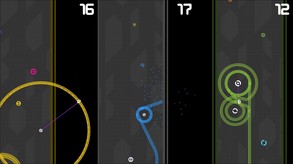
ONE MORE LINE is a highly addictive, one button, space disco, skill timing game! Steam edition features 2-4 player local multi-player and no advertising. All for a very low price! Can you put a price on fun though?
Modeled estimate, not a reported figure. How we estimate →
Media
About
Stats
All-time low is the lowest price we've recorded for this game since we started tracking it.
Languages: English**languages with full audio support
Engagement
Hours played at review time, across 40 reviews with recorded playtime.
Reviews
Themes across 40 recent reviews and how positive each mention is. A keyword signal, not full sentiment analysis.
positive critical· bar length = how often the theme comes up
Reviews
One more line of snow plz!
This game is mostly positive because nobody has patients for a challenge. it takes a while to get used to the controls and to be able to control it.
[h2][b]便宜,但是別買[/b][/h2] 遊戲玩法很簡單,飛行船飛愈遠分數愈高,途中必須想辦法透過牽引繩索躲避軌道上的節點與軌道兩側的牆壁。看起來是個隨時可以打開來輕鬆玩的小遊戲,不過實際玩下來有諸多問題。 首先,第一次進入遊戲會跳出「要不要顯示 How To Play」的視窗,按了按鈕完全無反應。接著進入單人模式,不管是不是第一次遊玩都會跳出 How To Play 演示影片,這設計有點懶惰。 再來問題就比較大了,How To Play 影片中說明玩家須透過 SPACE 鍵進行牽引,然而 SPACE 鍵根本沒有作用,實際上要按的是滑鼠左鍵! 最後一點,也是這遊戲最大的問題,飛行船牽引的節點選擇是系統決定的,然而這部分的演算法有問題,有時候牽引的對象是距離最近的節點,有時候牽引到的是與飛行船水平並列且最近的節點,最糟糕的是有時候會牽引到前方兩個節點中較靠後的第二個節點!我自己也是寫程式維生的人,說真的這種判斷完全沒有難度,是開發者不想修而已。 [h2][b]總結[/b][/h2] 便宜的大便,終究還是大便。2015 年的遊戲,過了 9 年了也不期待開發者會修復。雖然玩了半個鐘頭 Steam 成就也解了50%,但個人還是決定退款,完全不建議購買。 個人入手價格:NT$ 13 (-80% off)
"One More Line" é a prova de que a simplicidade extrema pode ser terrivelmente viciante. O foco aqui é puramente no tempo de reação e na física de momentum, ao contrário de outros jogos de corrida infinita que poluem a tela com power-ups e moedas. Apesar do seu visual minimalista e psicodélico, creio que os entusiastas de jogos de "um toque" (como Flappy Bird ou Super Hexagon) também irão apreciar a precisão matemática necessária para não explodir contra as paredes de cores vibrantes. Eu disse que o jogo foca no momentum, e é aqui que a estratégia tática entra em jogo. Você controla uma pequena partícula que se move para cima, e sua única forma de mudar de direção é lançar uma linha de conexão em pontos fixos para orbitá-los. O jogador precisa decidir exatamente quando segurar o toque para girar e, mais importante, quando soltar para ser arremessado na direção certa. Escolher o momento de soltar não é apenas uma decisão de curto prazo; é preciso visualizar a trajetória futura para não acabar em um ângulo sem saída, então quem jogar vai sentir que cada manobra é uma mistura de instinto e geometria básica. A jogabilidade é hipnótica e, na minha opinião, um dos seus pontos mais fortes é o feedback visual: cada vez que você orbita um ponto, o jogo desenha uma linha colorida, transformando sua partida em uma obra de arte abstrata e caótica ao final. É mostrado o rastro da sua trajetória; quando você consegue encadear várias órbitas perfeitas em sequência, a sensação de fluidez e velocidade é indescritível. No entanto, é preciso ser cauteloso; a velocidade aumenta e os obstáculos tornam-se mais frequentes, o que ensina que o excesso de confiança é o caminho mais rápido para o fracasso. Ainda sobre a experiência, aqui há um conceito muito importante que é o moral do jogador frente ao erro. Como as partidas duram segundos, o moral se mantém alto pela facilidade de tentar "só mais uma vez". Por exemplo: se você bate logo no primeiro ponto, a reinicialização é instantânea, o que remove a frustração do tempo de carregamento. O moral aumenta ao bater seu recorde pessoal por apenas alguns milímetros. O mais importante é manter a calma rítmica; se você entrar em pânico e começar a clicar freneticamente, perderá o controle da física centrífuga — e isso faz parte da mecânica de aprendizado que o jogo propõe. Para finalizar, outra coisa que eu gostei: a trilha sonora eletrônica que complementa perfeitamente as cores neon e o rastro de "tinta" que você deixa para trás. Na subida infinita, não fique focado apenas no ponto mais próximo; tente olhar para o topo da tela para antecipar sua próxima curva. Você não precisará de muitos botões, mas antes é preciso ter um tempo de resposta milimétrico para dominar a arte de girar. Enfim, recomendo.
I am 32 years old. My ex-wife and I have a daughter together, and we adopted our son together. Both are now 4 years old. When we were going through our separation, I felt lost and unhappy. I was self-destructive. One day, I was so angry with everything spiraling out of control that I punched a concrete wall in a moment of overwhelming emotion. This resulted in breaking my fifth metacarpal in my right hand—the hand I worked with, played games with, and used to carry my children to bed—the hand I desperately needed to ensure I could continue providing. Upon learning the severity of the self-inflicted damage, I became almost suicidal. Keep in mind that just a few months before this, I was the happiest man, with no history of depression or anxiety. I had never experienced anger outbursts, nor was I the type to break down and cry, but I was in a tough situation that truly prevented me from seeing the light on the other side. With nothing better to do, I looked for a game I could play WITH ONE HAND while recovering. Somehow, I stumbled upon this game and read some of the comments. I decided it was worth a try... I must admit I didn't beat the game, nor did I play as much as some of you. In fact, I may have played this game for only a day or two. That being said, after doing so, I had a new joy and hope for life. I managed to leave behind the pain and suffering that had been thrust upon me. I could experience the joy and happiness of other people. I relaxed for 5 ♥♥♥♥ minutes listening to this music, long enough to realize that I would be okay. After realizing this, I turned off the game and went back to work. My hand hurt a lot, but I was motivated. I stopped feeling so sorry for myself and became the father I needed to be at that moment, not the weak boy I was behaving like. Today, I am close friends with the mother of my children. We don't fight, argue, or say hurtful things to each other. We are parents and friends. Now I have 3 children. My third child is, wait, ALSO 4 YEARS OLD. The woman I am with was going through a very similar situation at the time of my separation, and we just unexpectedly stumbled into each other's lives. We have been dating for a year and are very happy together. Moral of the story: you never know what life has in store for you, and if I had given up when all odds were against me, I wouldn't be where I am today. This silly little game helped me realize that. Thank you.
For a one-button arcade game, imo this one lacks the most important component: a very polished and satisfying main mechanic. It feels sluggish and unpredictable, so I'm not interested in pushing my highscore any further.
For the price it is okay. I wouldn't say it is addicting, but you get the want to beat it. Haven't tried local co-op but it would be fun for a short amount of time.
One More Line, developed and published by SMG Studio, is a minimalist yet intensely addictive arcade experience that strips gaming down to its purest form: rhythm, timing, and precision. It’s one of those rare titles that takes a single mechanic and polishes it until it becomes hypnotic. On the surface, it seems almost too simple—you guide a small, endlessly moving object through a narrow corridor filled with spinning anchor points by pressing a single button. But that simplicity is deceptive. Beneath its neon aesthetic and pulsing soundtrack lies a finely tuned game of reflexes and momentum where every second feels like a test of control and nerve. It’s a game that challenges you not just to survive, but to master flow itself. The premise of One More Line couldn’t be easier to grasp, but it takes seconds to learn and hours to truly understand. Your small ship continuously moves upward through a corridor lined with circular nodes. By holding a button, you attach to one of these nodes and begin orbiting around it. Releasing the button flings you off at whatever angle your rotation carries, sending you hurtling forward through the void. The goal is to travel as far as possible without crashing into the corridor walls or colliding with the very nodes that serve as your lifelines. There’s no scoring system beyond distance—your entire purpose is to push your run a little farther than before. This barebones design gives the game its purity. There’s no story, no upgrades, no unlockable gimmicks—only your skill, your rhythm, and your ability to make split-second decisions under pressure. The genius of the game lies in its physics and pacing. Every orbit feels different depending on the angle, speed, and proximity of the next anchor point. The key is to find the perfect rhythm of attaching, circling, and releasing. Too early and you’ll slam into the wall; too late and you’ll spin out of control or collide with another node. This constant tension between restraint and risk is what gives One More Line its addictive quality. Each movement requires intuition as much as precision, and the longer you last, the faster your reflexes must become. There’s a meditative rhythm to it once you get in sync with the game’s flow—your eyes trace paths ahead of your movement, your brain begins to anticipate angles, and your hands move almost subconsciously in response. Failure comes suddenly and brutally, but restarting is instantaneous, making it dangerously easy to fall into the “just one more try” loop that defines all great arcade games. A huge part of the game’s identity comes from its visual and auditory presentation. One More Line is a feast of color and motion, its stark black background providing contrast for the bright, pulsing trails that mark your journey. Each run leaves behind a streak of vibrant lines, painting an abstract pattern of your success and failure. These trails give every attempt a sense of permanence—like a signature left behind in neon light. The color palette shifts dynamically as you progress, flashing through blues, pinks, greens, and purples that create a kind of visual rhythm to match the gameplay’s tempo. The accompanying soundtrack reinforces this energy, combining electronic beats and pulsating basslines that perfectly complement the game’s kinetic style. The sound of each successful swing, each moment of release, contributes to the hypnotic atmosphere. It’s not just about playing the game—it’s about entering a kind of flow state where music, color, and motion all blur together. The game’s appeal also comes from its unforgiving difficulty. There’s no margin for error; even the slightest miscalculation will end your run instantly. This makes every small victory feel earned. Progressing just a few more meters beyond your previous best feels monumental, and the desire to improve becomes its own motivator. Yet this also means the game can be frustrating for newcomers, particularly in its early stages when the physics feel counterintuitive. It takes time to internalize how much momentum you carry when swinging and how to use centrifugal force to navigate tight spaces. The learning curve can be steep, and players who expect gradual progression or leniency will find none here. One More Line demands precision and punishes hesitation, but its responsiveness and consistency ensure that when you fail, it feels like your fault—not the game’s. SMG Studio’s minimalist design philosophy extends to every aspect of the experience. There are no lengthy menus, tutorials, or visual distractions. You start instantly, fail instantly, and restart instantly. The Steam version adds a few small extras—local multiplayer, optional visual customization, and cosmetic trails—but these additions don’t dilute the core concept. The multiplayer mode, in particular, turns the already chaotic gameplay into a gleeful mess of intersecting lines and near misses, amplifying both the tension and the laughter. It’s a testament to how versatile the basic mechanic is: even when shared between players, it maintains its addictive charm and intensity. The game’s small scope works in its favor, focusing entirely on execution rather than expansion. However, One More Line’s simplicity can also be its limitation. There’s no progression system, no evolving challenges, and no real sense of long-term advancement. What you see in the first few minutes is essentially what you get for the entire experience. Some players may find this repetition meditative and endlessly replayable, while others might grow weary once they’ve reached a personal plateau. The lack of variation in mechanics means that the thrill depends entirely on your own improvement and endurance. For players who thrive on pure skill-based challenge, this is precisely the point; for those seeking new stimuli or variety, it can feel like hitting a wall after the initial rush fades. Still, even at its most repetitive, the game’s rhythm and immediacy keep it engaging in short bursts. What sets One More Line apart from other reflex-based games is how it transforms frustration into motivation. The combination of elegant physics, striking visuals, and pulsing music creates an experience that feels both minimalist and artistic. Each playthrough becomes an abstract performance, your failures and successes recorded in streaks of color and motion. The more you play, the more you tune into its frequency—until you’re not just reacting to the game but anticipating its flow. It’s a perfect example of how simplicity can be powerful when executed with precision and style. SMG Studio has managed to craft a game that demands little but gives a lot, a digital playground where mastery is its own reward. In the end, One More Line is a brilliant distillation of what makes arcade gaming timeless. It’s fast, punishing, beautiful, and endlessly replayable. Its design encourages obsession, challenging players to chase perfection one run at a time. For those who crave pure mechanical satisfaction and can lose themselves in repetition and rhythm, it offers an experience that borders on transcendence. It’s not a game that evolves or expands—it doesn’t need to. Like the glowing trails it leaves behind, One More Line is about the fleeting beauty of motion, the satisfaction of precision, and the irresistible urge to try again, just one more time. Rating: 7/10
The gameplay loop is interesting but the novelty wears off very quickly, while getting all the achievements takes a lot longer. And I'm not the person to usually nitpick hypercasual games like this one, but when a game presents skill-based achievements within a game where the player's skill can be undermined by the randomness of the game mechanic, it defeats the purpose of being an achievement, since it becomes luck-based rather than skill-based. This game lacks a consistent method of playing, since the circle to which your pointer gets tethered is determined randomly, which can sometimes benefit you, but most of the times, just ends your run prematurely. Also, the background music is cool, but becomes very annoying being the only one available, even more considering the amount of time you might spend if you're looking to get the 300pt achievement.
This is such a low effort piece of shovelware junk that the developers couldn't be bothered to include any sort of tutorial or even basic explanation of how to play. Instead they try to link to a video tutorial. But they never actually bothered to upload a video anywhere. Clicking the link in game for the video tutorial does absolutely nothing.
Related
Related
Trends
Concurrent players on Steam, sampled daily since tracking started.
Momentum
Pace estimated from the game's recent review growth (our daily snapshots) at its own sales-per-review ratio — a momentum signal, not booked sales.
Audience
Estimated from the language of this game's reviews — a proxy for where players are, not official Steam demographics.
Related
| Shard Games | $19.6K | 97 | 37% | $7.99 |
| Jetstream | $19.6K | 135 | 90% | $9.99 |
| Serious Fun Football | $19.6K | 63 | 48% | $9.99 |
| MEMOLOGY 2: OLD TIMES | $19.6K | 580 | 96% | $0.99 |
| Mark Out! The Wrestling Card Game | $19.6K | 54 | 94% | $14.99 |
| Goblin Gangbang 🧟🍆👩 | $19.6K | 253 | 69% | $2.49 |
Related
| Garry's Mod | $228.7M | 1.3M | 97% | $9.99 |
| Human Fall Flat | $109.3M | 225.6K | 95% | $19.99 |
| DAVE THE DIVER | $90.8M | 139.6K | 97% | $19.99 |
| Slime Rancher | $73.8M | 155.4K | 98% | $19.99 |
| House Flipper | $65.8M | 110.8K | 94% | $24.99 |
| People Playground | $62.2M | 315.3K | 98% | $9.99 |