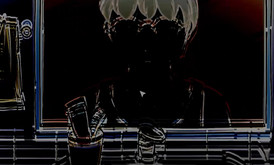
Nether Gallery, also known as 彼岸画廊, developed and published by HongShou Studio, is a dark, atmospheric 2D horror adventure that delves into the blurred boundaries between dream and reality, life and death, memory and oblivion. The game follows Wu Bai, a weary office worker whose mundane existence is suddenly interrupted by an inexplicable descent into a surreal world known as the “gallery.” Within this eerie realm, fragments of his memories, regrets, and anxieties take physical form, transforming familiar places into twisted representations of his psyche. What begins as a story about an ordinary man struggling with the pressures of modern life slowly unfolds into a nightmarish journey through guilt, disconnection, and the fragile line separating the living from the dead. It’s a quiet, introspective kind of horror—one that creeps under your skin not through jump scares, but through its uncanny atmosphere and emotional resonance.
At its core, Nether Gallery uses its horror elements not simply to frighten, but to comment on the suffocating monotony of working life and the emotional decay that can come from it. Wu Bai’s story is steeped in the culture of overwork and alienation; his existence as a faceless employee in a gray corporate world becomes the foundation for the game’s descent into madness. The gallery itself serves as a metaphorical mirror, reflecting his memories and inner turmoil. As he wanders through corridors filled with distorted art, strange creatures, and forgotten relics of his life, the player begins to piece together fragments of a life slowly eroded by exhaustion and detachment. Each puzzle solved and each discovery made feels like peeling away another layer of his repressed emotion. The horror in Nether Gallery is deeply psychological, built on the fear of losing oneself amid the repetitive grind of existence and the haunting realization that some parts of the soul may never return once lost.
The game’s visual presentation plays a central role in delivering its sense of unease. HongShou Studio has crafted a world that feels both hauntingly familiar and disturbingly alien. The hand-drawn art style evokes the atmosphere of a decaying painting—dim colors, muted lighting, and unsettling compositions that distort everyday objects into grotesque shapes. The environments transition seamlessly from realistic office spaces and suburban apartments to otherworldly galleries, where perspectives bend and objects defy logic. The use of light and shadow is particularly effective, making even small rooms feel oppressive and disorienting. The subtle animations and fine details in the background—the flicker of fluorescent lights, the echo of footsteps, the faint hum of machines—enhance the suffocating tension. Combined with the subdued, ambient sound design, the result is an immersive experience that keeps the player on edge even during moments of stillness.
Gameplay in Nether Gallery follows the familiar framework of side-scrolling horror adventures, with an emphasis on exploration and puzzle-solving. Players guide Wu Bai through interconnected environments, collecting key items, deciphering cryptic clues, and interacting with strange objects that trigger fragments of his lost memories. The puzzles are mostly logic-based and intuitive, relying on environmental storytelling rather than arbitrary difficulty. Progress is measured less by conquering obstacles and more by uncovering pieces of a fractured narrative. Each success feels like reclaiming a portion of Wu Bai’s humanity, even as the world around him grows increasingly distorted. However, the pacing is deliberately slow, encouraging reflection over adrenaline. Those expecting high-tension chases or quick scares may find the gameplay subdued, but the slower rhythm fits the tone of the story—one that builds dread through quiet revelations rather than loud confrontations.
The narrative structure of Nether Gallery is intentionally fragmented, forcing players to reconstruct meaning from scattered hints and visual cues. Dialogue is sparse, and much of the story is conveyed through symbolism: a family photograph, a broken clock, a painting that seems to move when unobserved. The game’s title itself, “Gallery,” captures its narrative approach—each room, each puzzle, and each vision functions like a painting that tells part of a larger story. The imagery evokes Buddhist and existential ideas of the afterlife and reincarnation, especially in the depiction of the “Sanzu River,” a boundary between the world of the living and the dead. Wu Bai’s journey becomes less about survival and more about self-realization, as he confronts not just external horrors but the ghosts of his own life. By the time the player reaches one of the game’s multiple endings, the sense of closure—or lack thereof—feels deeply personal, reflecting how much of the gallery’s truth they managed to uncover.
Despite its conceptual and artistic strengths, Nether Gallery does show the limitations of its indie production. The animation can feel stiff at times, and certain puzzles may rely on pixel-perfect exploration that disrupts the otherwise smooth pacing. The game’s length, averaging around four to five hours, might leave some players wanting more, especially as its narrative world feels large enough to support further exploration. Yet within that brief runtime, it achieves a cohesive emotional and thematic impact. The technical simplicity often works in its favor, emphasizing atmosphere and story over spectacle. Its restraint—both in narrative delivery and gameplay mechanics—gives it an understated power that lingers after the credits roll.
Nether Gallery succeeds as both a work of horror and a work of art. It is less about scaring the player and more about confronting them with the quiet horrors of the everyday—the fatigue of living, the alienation of modernity, the ache of forgotten dreams. Through its surreal imagery and contemplative pacing, it invites players to interpret its meaning in their own way, much like studying a haunting piece of art that refuses to explain itself. For those who appreciate psychological storytelling, layered symbolism, and reflective atmosphere, it stands as a gem of indie horror—an experience that demands patience, but rewards it with emotion and insight. Nether Gallery may not shout its message, but it whispers it hauntingly through the halls of memory, where every painting tells the story of a soul caught between the world of the living and the one that lies just beyond.
Rating: 8/10