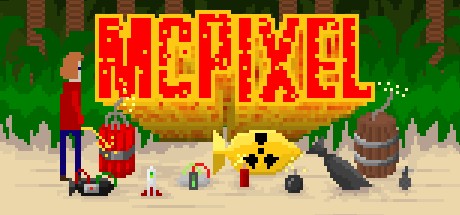
McPixel is a save-the-day guy that you guide through 100 short challenges to prevent stuff from blowing up. You have only 20 seconds to save the day! Think quick!
Modeled estimate, not a reported figure. How we estimate →
Media

About
Genres
Stats
All-time low is the lowest price we've recorded for this game since we started tracking it.
Engagement
Reviews
Themes across 42 recent reviews and how positive each mention is. A keyword signal, not full sentiment analysis.
Reviews
就是到处点触发动画,至于动画的趣味性完全看电波能不能和作者对上。
ТУПАЯ ИГРА ДЛЯ ДЕБИЛОВ (я тупой дебил так что крутая игра)
un juego que en principio parece divertido pero que al no tener ningún sentido ni lógica, rápidamente se vuelve frustante y repetitivo.
Related
Related
Trends
Modeled estimate over time, reconstructed from Steam's monthly review histogram.
Languages: English
Hours played at review time, across 42 reviews with recorded playtime.
positive critical· bar length = how often the theme comes up
да
👍
Really intense game, full of mini-puzzles and hilarious moments. McPixel does remind me a bit of the Henry Stickmin games, where the failiures are as rewarding as successes, but does stand on it's own thanks to the rapid pace and unique brand of humor.
McPixel is a deliberately chaotic and irreverent point-and-click adventure that turns the traditional logic of puzzle games on its head in favor of absurd comedy, rapid experimentation, and gleeful nonsense. Developed and published by Sos Sosowski, the game embraces the idea that failure can be just as entertaining as success, transforming every mistake into a punchline rather than a punishment. From the very first moments, it becomes clear that McPixel is less interested in teaching players how to solve puzzles “correctly” and more interested in surprising them at every possible turn. Instead of presenting a continuous narrative, McPixel is structured as a collection of short, self-contained scenarios, each centered on preventing some form of imminent disaster—usually a bomb explosion—within a strict time limit. These scenarios are intentionally brief, often lasting only a few seconds, and are packed with clickable objects that react in unpredictable ways. The game encourages players to click on everything they can see, not because the solution will be obvious, but because the results are frequently hilarious, grotesque, or completely illogical. Saving the day might involve kicking an object, eating it, destroying it, or triggering a bizarre chain reaction that somehow neutralizes the threat. The defining feature of McPixel’s design is its embrace of trial and error as the core mechanic. There is no tutorial explaining how the game’s logic works, because its logic is intentionally inconsistent. What works in one scenario may fail spectacularly in another, and even repeating the same action can sometimes produce different outcomes. This design philosophy creates a frenetic rhythm where players are constantly testing ideas under pressure, often failing repeatedly before stumbling upon the correct—or at least effective—solution. Crucially, these failures are framed as part of the entertainment, with exaggerated animations and sudden, explosive endings that reinforce the game’s slapstick tone. Visually, McPixel adopts a crude, retro pixel art style that feels intentionally low-fidelity. Characters are blocky and exaggerated, environments are simple, and animations are deliberately stiff or abrupt. Rather than feeling cheap, this aesthetic enhances the humor by evoking the look of early computer games while subverting their seriousness. The visual simplicity ensures that reactions and gags land instantly, without visual clutter or excessive detail distracting from the joke. Sound effects and music follow the same philosophy, relying on exaggerated cues and playful timing rather than polish, reinforcing the sense that the entire experience is one long comedic sketch. The humor itself is unapologetically absurd and often juvenile, drawing heavily from slapstick, parody, and surrealism. McPixel frequently mocks video game conventions, pop culture, and action movie tropes, presenting a pixelated hero who is anything but competent. The protagonist’s actions are rarely heroic in a traditional sense; instead, he blunders, flails, and occasionally succeeds by accident. This self-aware silliness gives the game a strong identity, though it also means that enjoyment hinges heavily on whether the player connects with its comedic style. While the game’s fast pace and constant surprises keep it engaging in short bursts, its design can feel repetitive over longer sessions. Because progression often requires discovering every possible outcome in a scenario, players may find themselves clicking through the same sequence multiple times just to uncover a missing solution. For some, this repetition becomes part of the fun, as each variation offers a new gag or animation. For others, the lack of meaningful progression or deeper structure can make the experience feel shallow once the novelty wears off. Despite these limitations, McPixel’s originality and confidence in its absurd design set it apart from more conventional puzzle and adventure games. It does not attempt to tell a grand story or offer a refined challenge curve, instead prioritizing spontaneity and surprise. Its bite-sized structure makes it especially well suited for short play sessions or shared viewing, where unexpected outcomes can be enjoyed as much by spectators as by the player. Ultimately, McPixel is a game that thrives on breaking expectations. It asks players to abandon logical thinking, embrace chaos, and find joy in failure as much as success. While its humor and mechanics may not appeal to everyone, particularly those seeking thoughtful puzzles or narrative depth, it stands as a memorable example of indie experimentation. For players who enjoy rapid-fire comedy, unpredictable interactions, and a complete disregard for conventional game logic, McPixel remains a uniquely entertaining and unapologetically strange experience on Steam. Rating: 8/10
支援鍵鼠 不含中文
The most absurd game to ever exist. To the point that the sequel to this game is... threequel? Give it a try and you won't regret it, it's hilarious.
Don't pay $5 for it.
Audience
Estimated from the language of this game's reviews — a proxy for where players are, not official Steam demographics.
Related
| Boneraiser Minions | $467.4K | 5.3K | 96% | $4.99 |
| Card-en-Ciel | $467.1K | 865 | 91% | $24.99 |
| WindStop Strategy | $467K | 1.6K | 79% | $9.99 |
| Denizen | $467K | 902 | 73% | $15.99 |
| Fruit Ninja VR | $467.9K | 876 | 81% | $14.99 |
| JUMP KING QUEST | $466.9K | 1.2K | 88% | $14.99 |
Related
| Half Minute Hero: Super Mega Neo Climax Ultimate Boy | $391.3K | 1.5K | 86% | $9.99 |
| Evoland | $1.6M | 6K | 83% | $9.99 |
| There Is No Game: Wrong Dimension | $8.8M | 25.7K | 98% | $12.99 |
| Little Inferno | $4.1M | 13.7K | 95% | $14.99 |
| Broken Age | $2.2M | 8.2K | 84% | $14.99 |
| Minit | $605.4K | 2.9K | 89% | $9.99 |