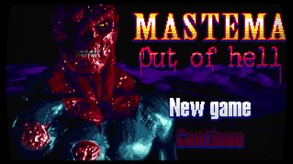
You don't know who you are, where you are and why you are here, you know just thing, you want to survive and get out of HELL!
Modeled estimate, not a reported figure. How we estimate →
Media

About
Stats
All-time low is the lowest price we've recorded for this game since we started tracking it.
Languages: English**languages with full audio support
Engagement
Hours played at review time, across 41 reviews with recorded playtime.
Reviews
Themes across 41 recent reviews and how positive each mention is. A keyword signal, not full sentiment analysis.
positive critical· bar length = how often the theme comes up
Reviews
Flop of a platformer, trying to be retro, old school cool makes it more cringe. This game is just frustrating, period.
"Mastema: Out of Hell" is a fantastic looking platformer that suffers from problematic controls and some questionable game design choices, which makes the game more difficult than it needed to be. However, it is still very fun and playable and can be beaten if you are determined enough. I beat the game after sinking several hours into it. [b]GRAPHICS & SOUND[/b] - The game looks beautiful. It's got some excellent 1990s era SNES-like pixel graphics. The background art, tilesets and sprites (especially the boss sprites) are gorgeous to look at. -The game's music is fantastic and moody and goes well with the art and the overall theme of the game. -The graphics and music make the game feel like it was actually made in the '90s, and not just another modern retro indie pixel art game. [b]GAMEPLAY[/b] - The opening cutscene sold me the idea that the game is all about fighting demons with a fancy sword. But once the first level started, I felt a bit let down. It turned out that the game is a rather simple platformer where you basically jump across platforms, collect stuff and avoid dangers and enemies. It's still fun for the most part though! [b]WEAPON & COMBAT[/b] - Remember that fancy sword I was talking about earlier? Well, you don't carry it by default. Rather, the sword is a temporary power-up that appears once every few levels. If you collect it, you get the ability to shoot swords like bullets! And even then, the "sword-bullet" doesn't travel very far and sometimes pressing the shoot button doesn't always spawn the "sword-bullet" thingy. - If you lose a life, your sword is gone. And if the level you died in does not have a sword power-up, good luck to you because you'll need to resort to plan B: just jump over enemies and hope not to run into the big enemies, because you can't jump over them without getting hurt. - Every now and then you'll find a power-up that lets you perform a special fiery attack, which destroys all enemies it comes into contact with. There are 5 types of special attacks: a tornade, a giant fireball that spins around you, a large monster from beneath and a bull that moves horizontally across the screen. I thought these were pretty cool! [b]COLLECTIBLES[/b] - Shiny stones (collecting 100 of them grants you an extra life) - Special attacks - Health and lives [b]CONTROLS[/b] - As for the controls, it's not the smoothest but believe me, it's not that bad. - The controls are manageable for the most part. However, they feel inadequate whenever you're required to perform perfect jumps at the edge of platforms. This happened to me over and over. - This, combined with the issues pertaining to the sword mentioned earlier makes the player feel incompetent and weak and may discourage them from playing further. - Upon getting hit by an enemy, you aren't knocked back, which feels odd. But in hindsight, it might actually be a good thing because you don't have to worry about getting knocked off ledges in this game that already suffers from awkward controls. [b]LEVEL DESIGN[/b] - There are 20 worlds, each broken up into three stages. - Each stage is very short and can be beaten in a few minutes, which IMO is a good thing as it makes it easier to practice a stage and it. - Dying mid stage takes you back to the start of the stage. A "game over" sends you back to the home screen where you can choose to continue where you left off. - The level artworks (such as the tiles and background art) are nicely done and create a dark and other-worldly atmosphere. - Each world has it's own unique visual theme to it - skeletons, insects, ice, fire, forest, dungeon etc which adds visual variety. - Some levels have some very nice set pieces in the levels. [b]ENEMIES & BOSSES[/b] - The enemies in the game are visually impressive and nicely animated. Unfortunately, they're also very dumb because enemy AI is non-existent. Most enemies simply patrol their areas and are completely indifferent to you even if you are standing close to them. - The Bosses are large demons and monsters - an alien looking rhino, a demonic gorilla, a sphynx statue, a a giant demon head, to name a few. Bosses do pose a challenge, but they all have just 1 to 3 attacks and fairly small HPs and can be beaten once you figure out their patterns. One issue is that they don't have a health bar so you won't be able to keep track of their health status. [b]CONCLUSION[/b] While the controls could be vastly improved, it still offers hours of entertainment. If you have a fondness for retro pixel art and the patience to master each level, then get this game!
Finally finished this frustration simulator. The ending scene justifies why the controls are awful and the reason you shouldn't be able to escape hell. It has no replay value but cool pixel art and trading cards. 4/10 could be 7/10 with better jumping or edge climbing. Recommended only for those with high losing tolerance.
☀️
Очень рекомендую. Графика Дельта-С. Музыка в стиле Toccata and Fugue in D Minor. Боссы очень красиво нарисованы. Очень оригинальные уровни.
The controls can be really frustrating at first, definitely takes some practice to master. Has several questionable level design choices and the bosses are laughably easy. But the music and graphics will hit that sweet spot and satisfy your retro cravings.
Mastema: Out of Hell is a retro-inspired action platformer developed by Oscar Celestini and published by Forever Entertainment S. A., and it positions itself firmly as a love letter to the unforgiving 16-bit era of side-scrolling games. From its opening moments, the game establishes a bleak and oppressive atmosphere, casting the player into the depths of Hell with no exposition-heavy introduction or guiding hand. You awaken nameless and disoriented, driven only by survival and the instinct to push forward through hostile environments packed with demonic enemies, deadly traps, and relentless platforming challenges. This minimalist narrative approach works in the game’s favor, letting the environment and moment-to-moment gameplay communicate its themes of isolation, punishment, and perseverance. Visually, Mastema: Out of Hell embraces classic pixel art aesthetics with bold colors, chunky sprites, and a visual language reminiscent of early console action titles. While the graphical fidelity is intentionally modest, the art direction succeeds in creating a consistent and memorable vision of Hell that feels more stylized than realistic. Lava-filled caverns, crumbling stone platforms, infernal machinery, and grotesque demonic foes populate over fifty levels, each designed to test reflexes and spatial awareness. The environments rarely feel decorative; instead, every screen is constructed as a mechanical challenge, with hazards and enemy placements designed to punish hesitation and reward precision. Gameplay revolves around straightforward platforming fundamentals: running, jumping, attacking, and reacting quickly to environmental threats. The simplicity of the controls reflects the game’s retro inspirations, but this also places a heavy burden on level design to maintain engagement. Throughout the campaign, players gain access to different weapons that alter attack patterns and provide brief moments of variety, though the core mechanics remain consistent from start to finish. Combat is functional rather than elaborate, serving primarily as another obstacle layered onto the already demanding platforming. Encounters often require careful timing and positioning rather than brute force, especially when multiple enemies and environmental hazards overlap. Difficulty is one of the defining traits of Mastema: Out of Hell, and it is unafraid to frustrate players in pursuit of its old-school identity. Instant-death traps, narrow jumps, and tightly spaced hazards are common, demanding patience and repetition. Progress frequently comes through trial and error, and while checkpoints help reduce excessive backtracking, the game still expects players to learn from failure and adapt. For fans of punishing platformers, this can be deeply satisfying, turning each cleared section into a small victory. For others, the difficulty can feel uneven, especially when compounded by occasionally stiff movement or imprecise collision detection, which can make certain deaths feel unfair rather than instructive. Boss encounters provide a welcome change of pace, emphasizing pattern recognition and endurance over raw reflexes. These fights are visually distinct and mechanically more focused, often requiring players to learn attack sequences and exploit brief openings. While not overly complex, they serve as effective milestones that break up the linear progression and reinforce the game’s themes of persistence against overwhelming odds. The sense of accomplishment after defeating a boss is one of the game’s strongest emotional payoffs, particularly given the hostile nature of the levels leading up to them. Audio design complements the visual and mechanical choices well, with music that channels retro chip-style compositions and darker melodic tones. The soundtrack reinforces the oppressive atmosphere without becoming monotonous, providing just enough energy to keep tension high during extended platforming segments. Sound effects are simple but effective, clearly communicating danger, enemy attacks, and player actions, which is crucial in a game where reaction time often determines success or failure. Overall, Mastema: Out of Hell is a focused and unapologetic indie platformer that knows its audience. It does not attempt to modernize its design philosophy or soften its difficulty, instead leaning fully into the conventions of classic action platformers. This commitment gives the game a clear identity, even if it limits its broader appeal. For players who appreciate pixel art, demanding level design, and a stripped-down approach to gameplay, it offers a challenging descent through a stylized vision of Hell that rewards persistence and mastery. While its rough edges and rigid mechanics may alienate some, those willing to embrace its retro sensibilities will find a compact but intense experience that reflects both the passion and limitations of its indie roots. Rating: 6/10

да
Grande jogo ao estilo retro 8-Bits, recomendo demais para quem curte um bom jogo de plataforma retro.
is a pretty neat retro game with cool pixel graphics music and gameplay defently Oscar Celestini nail it in the "retro style departament"
Related
Related
Trends
Modeled estimate over time, reconstructed from Steam's monthly review histogram.
Audience
Estimated from the language of this game's reviews — a proxy for where players are, not official Steam demographics.
Related
| Expand & Exterminate: Terrytorial Disputes - Endless Base Defense | $2.5K | 58 | 81% | $1.99 |
| The Campaign Series: Fall Weiss | $2.5K | 123 | 46% | $0.77 |
| LUNAR LICH/月球巫妖 | $2.5K | 91 | 98% | $1.64 |
| Cat Needs | $2.5K | 54 | 98% | $2.99 |
| Eye of Saccharine | $2.5K | 60 | 80% | $2.99 |
| Hatup | $2.5K | 57 | 91% | $1.99 |