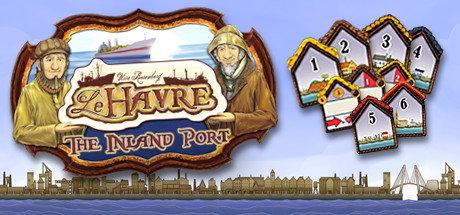
Le Havre: The Inland Port, developed by DIGIDICED and published by Twin Sails Interactive, is a digital adaptation of Uwe Rosenberg’s acclaimed two-player board game. It distills the essence of resource management and economic planning into a tight, strategic duel between two rivals striving to build the most prosperous harbor. The experience is smaller and more focused than many of its digital board game contemporaries, but within that focus lies a refined system of decision-making that rewards patience, foresight, and efficiency. The game plays out over twelve rounds, each representing a “day,” where players take turns constructing buildings, managing resources, and timing their moves to maximize profit. By the final round, whoever has accumulated the most wealth is declared the victor, but the path to that outcome is paved with a dozen subtle choices that can easily spell success or failure.
At its core, Le Havre: The Inland Port revolves around timing and optimization. Each turn, you can either take resources or activate one of the buildings you’ve acquired to convert those resources into something more valuable. The challenge comes from the way the game’s resource system is designed: instead of manually counting tokens, resources are tracked on a rotating wheel, where their position determines both quantity and accessibility. Each round, unused resources grow in number as the wheel turns, meaning that sometimes restraint is more rewarding than immediacy. Knowing when to wait and when to act becomes the essence of the game’s strategy. Every building you construct expands your possibilities, yet your choices must remain efficient, as both space and time are limited. This creates a constant tension between expansion and consolidation, forcing players to weigh long-term planning against short-term gains.
The digital adaptation captures this interplay faithfully, preserving the delicate balance that made the tabletop version so engaging. The interface presents information clearly, and the automated management of resources removes much of the bookkeeping that can slow down physical play. The AI provides a competent challenge, and the inclusion of online multiplayer, cross-platform functionality, and hot-seat options makes it easy to engage with human opponents when possible. The design embraces the board game’s minimalist nature, emphasizing clean visuals and smooth animations that reflect the simplicity of the setting—a quiet harbor bustling with potential rather than noise. The music and sound effects are subdued but pleasant, complementing the deliberate pace of gameplay rather than distracting from it.
However, the game’s focus on precision and minimalism can also be a limitation. Because it is an adaptation of a two-player board game, its scope is necessarily narrow. There are no large campaigns, evolving storylines, or multiple opponents to contend with. It is, in essence, a duel—intimate, strategic, and self-contained. This focus makes it excellent for players seeking short, concentrated sessions, but those looking for broader or more varied gameplay may find the experience limited. The AI, while serviceable, can feel predictable after several matches, and online multiplayer, though included, has suffered from a lack of an active community over time. Without consistent human opponents, the longevity of the game depends largely on your appreciation for mastering its systems through repeated solo play.
The user interface, though functional, is not without flaws. Some players have reported awkward navigation when managing buildings or resources, and the lack of certain quality-of-life features, such as an undo button or streamlined controls, can make errors feel unnecessarily punishing. Translation and text clarity issues also occasionally break immersion, small reminders that this adaptation was built with mobile platforms in mind. Yet despite these imperfections, the underlying design remains sound. The game’s core loop—managing growth, building synergy, and outmaneuvering your opponent—retains its elegance, and the satisfaction of executing a perfectly timed move remains intact. For strategy enthusiasts who appreciate tight systems over visual spectacle, these technical blemishes are minor compared to the satisfaction of deep planning.
Where Le Havre: The Inland Port excels is in how it turns simplicity into complexity. With only a handful of actions each turn, the game forces players to think several moves ahead, anticipating their opponent’s decisions and optimizing their own economic engine. Every choice feels deliberate, and small mistakes can ripple forward in ways that define the outcome. The rotating resource wheel adds an elegant layer of tension, where waiting can often be as powerful as acting—a design philosophy reminiscent of Rosenberg’s other works like Patchwork and Agricola, but distilled into something brisk and competitive. It’s a game that rewards patience, learning, and experimentation, and each new match feels like an opportunity to refine one’s understanding of its mechanics.
Ultimately, Le Havre: The Inland Port is a thoughtful, quiet, and intellectually engaging experience that captures the spirit of its tabletop counterpart. It’s not a flashy or expansive game, but rather a meticulous exercise in economic strategy. For players who enjoy games that reward efficiency and clever planning over luck, it offers hours of quiet satisfaction. While the digital version suffers from minor technical issues and limited multiplayer activity, it remains a faithful and well-crafted adaptation of a modern board game classic. It’s a title best enjoyed in measured sessions—an elegant duel of wits that mirrors the ebb and flow of the harbor it portrays, where success depends not on haste, but on the patient mastery of timing and opportunity.
Rating: 5/10