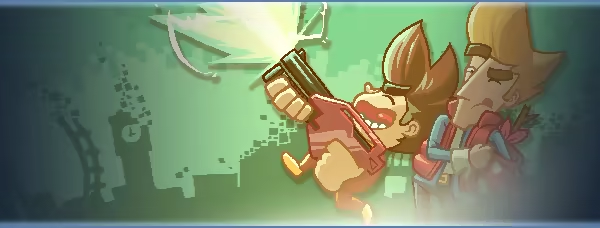
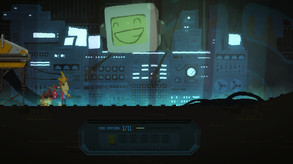
A fast-paced Point-and-Click adventure AND an indie platfomer in one! Join adventurer Ben and wannabe indie darling Dan in a race against time to stop all the Apocalypses happening at the same time.
Modeled estimate, not a reported figure. How we estimate →
About

WHY PLAY ONLY ONE GENRE OF GAME when you could be playing two slightly different ones at the exact same time?
He has one foot stuck in the 90s, his feet never leave the floor, and he’s happiest collecting any old junk he can lay his hands on, in the hopes of combining it all together to solve a satisfying puzzle.
...has aspirations to be the next big hit indie platform character. He's got everything he needs: he's hip, he's sensitive, and his nose is a different colour to the rest of his face.
LAIR OF THE CLOCKWORK GOD sees you switching between both characters and using their unique abilities together in a race-against-time effort to stop all the Apocalypses happening simultaneously, by teaching an old computer about feelings.
Solve classic point-and-click style puzzles as Ben to create unique upgrade items for Dan, so he can jump higher, run faster and blast away at everything with a shiny new gun. Then, run and jump as Dan to unlock new areas and exciting new puzzles for Ben!

If you haven't played the old Dan and Ben games (you should), or you have but can't remember what happened, there's NO NEED TO WORRY! Lair of the Clockwork God is a STANDALONE Dan and Ben Adventure, which means you need to know absolutely nothing about Ben There, Dan That! or Time Gentlemen, Please! whatsoever. None of the original plot is referenced, the characters are re-introduced expertly, etc etc. It's all good.
Stats
All-time low is the lowest price we've recorded for this game since we started tracking it.
Languages: English**languages with full audio support
Engagement
Hours played at review time, across 40 reviews with recorded playtime.
Reviews
Themes across 40 recent reviews and how positive each mention is. A keyword signal, not full sentiment analysis.
positive critical· bar length = how often the theme comes up
Reviews
Lair of the Clockwork God is a rare kind of indie game that feels both lovingly nostalgic and sharply contemporary, blending two traditionally separate genres into a single experience that constantly reinvents itself. Developed and published by Size Five Games, the title stars long-running series characters Ben and Dan, who embody two opposing philosophies of game design. Ben represents the slow, methodical logic of classic point-and-click adventures, while Dan is a fast-moving, jump-happy platformer hero obsessed with modern action tropes. Rather than choosing between these styles, the game commits fully to both, building its entire structure around the friction, cooperation, and comedy that emerge when they collide. The narrative premise is as absurd as it is clever, revolving around a looming, multi-layered apocalypse orchestrated by a literal ancient machine that must be taught what it means to be human. This setup becomes an excuse for relentless satire, poking fun at video game conventions, genre evolution, and cultural anxieties surrounding technology and progress. The writing is dense with jokes, meta commentary, and unexpected emotional beats, often shifting from sharp parody to sincere reflection without warning. Dialogue is consistently witty and self-aware, making even mundane interactions entertaining, while the overarching story cleverly escalates into something far more thoughtful than its silly exterior initially suggests. Gameplay is where Lair of the Clockwork God truly distinguishes itself. Players switch freely between Ben and Dan, each of whom interacts with the world in fundamentally different ways. Ben’s gameplay revolves around talking to characters, collecting items, and solving logic puzzles through dialogue and inventory combinations. Dan, by contrast, tackles physical challenges using jumps, wall climbs, switches, and timing-based platforming. The brilliance lies in how these systems are intertwined; progress often requires solving both types of problems in tandem, forcing players to think about spaces and solutions from two perspectives at once. A locked door might require Ben’s conversational skills to obtain an item, while Dan must physically reach an otherwise inaccessible area to make that solution possible. The pacing benefits greatly from this dual-structure design. When puzzles slow down, platforming picks up the momentum, and when reflex-heavy sections risk becoming repetitive, the game shifts back to clever dialogue or absurd logic puzzles. This constant alternation keeps the experience fresh across its runtime, ensuring that neither genre overstays its welcome. Even players who are typically uninterested in one of the two styles are likely to remain engaged, as the game rarely demands deep mastery of either. Instead, it focuses on accessibility, creativity, and humor-driven problem solving. Visually, the game embraces clean, expressive pixel art that supports both gameplay styles effectively. Environments are colorful and varied, filled with visual jokes, interactive elements, and subtle details that reward curiosity. Character animations convey personality more than realism, reinforcing the comedic tone and making even simple movements feel expressive. The soundtrack complements this aesthetic with playful, energetic tracks that adapt well to both puzzle-solving and platforming moments, while sound effects and voice delivery further enhance the game’s comedic timing. One of the game’s greatest strengths is how deeply its humor is integrated into its mechanics. Jokes are not limited to dialogue or cutscenes; they frequently become part of puzzle solutions, gameplay rules, or player expectations. The game is unafraid to subvert its own logic, occasionally using absurd reasoning as a valid solution or deliberately misleading players for comedic payoff. At the same time, beneath the jokes lies a surprisingly sincere commentary on creativity, obsolescence, and the value of human imperfection in a world increasingly driven by systems and algorithms. While the platforming is intentionally forgiving and not especially demanding compared to dedicated platformers, this design choice aligns with the game’s broader philosophy. Precision and difficulty are secondary to flow, experimentation, and humor. The point-and-click elements similarly avoid frustration by keeping inventory management streamlined and logic intuitive, even when the solutions are playful or unexpected. This balance makes the game welcoming to a wide audience without sacrificing cleverness. Ultimately, Lair of the Clockwork God succeeds because it understands exactly what it wants to say and how it wants to say it. It is a game about genres, about collaboration, and about the absurdity of progress, all wrapped in a package that is consistently funny, inventive, and heartfelt. By refusing to choose between old and new design philosophies, it creates something uniquely its own—an experience that feels like both a celebration and a critique of gaming history. For players who enjoy smart writing, genre-blending mechanics, and games that aren’t afraid to be silly while still meaningful, Lair of the Clockwork God stands as one of the most memorable and original indie titles of its generation. Rating: 9/10
Увлекательная игра..напоминает ДЕНДИ)) рекомендую ..мне понравилась,может и вам зайдет) всем пока)
It was not engaging enough for me
If you have any soft spot at all for point and click adventures, this is fantastic.
I would really like to love this game. I am fond of both platformers and classic point and click adventures, but I found myself more frustrated with how the design elements of those games were implemented here more than charmed by the cross-pollination of genres. The platforming controls are abysmal and frustrating more often than not. The adventure game puzzles are well implemented, but the contextual interface is unintuitive and adds frustrations on top. If the controls were just somewhat more streamlined, such as allowing me to use mouse 1 to click through dialog instead of having it default to "." or having to be keybound to another key that isn't used for anything else, or if some of the interactables like portals defaulted to "use" on a basic key click instead of having to open the context menu and use the mouse to ensure I don't select 'look at' for the umpteenth time, I would have enjoyed the overall experience much more. There is a lot to enjoy here, but it is mired down in frustrating game-feel and a death by a thousand cuts of minor grievances.
I had a love hate relationship with this game but I did manage to complete it and had a few laughs along the way so I recommend it. I found some of the puzzles and platforming difficult so I had to sometimes refer to the very good text guide, no shame in that, some of the puzzles were a bit obtuse. In one of the more difficult platforming sections the little character, Dan, was swearing and cursing at the difficulty, very funny since I was doing exactly the same thing. A few tries and I did get through it and I don't consider myself to be a very good platformer. The game is quite meta and once you understand that you start to understand that some odd things that might look a bit like glitches to you earlier in the game are actually game play elements and used to solve puzzles later, very clever. Who would have thought turning down the in game volume level would help the characters in a noisy environment. The game was very chatty and texty so although essential to the story and the game it did slow down the gameplay a bit. In summary an interesting mixup of old school point and click adventure, platforming and edgy meta / break the fourth wall type dialogue. Obviously made with a lot of love and as far as I can tell quite original and well worthwhile while on sale. However not something I would want to play again.
As well as being very funny, this game features two puzzles that mess with the whole gaming medium in really innovative ways. The platforming can get frustrating though.
I wanted to like it so bad! I loved the first two games. I disliked the platforming and found it either way too easy or way too difficult. The adventure game portions couldn't make up for it :(
HILLARIOUS AND WELL-THOUGH ADVENTURE Nice piece of inventive gamedev right here :) I REGRET NOTHING!
What do I get for buying a game based on the creators' pedigree and my love of their previous games? A buggy disappointment, apparently. Ignoring the acknowledged-yet-unaddressed issue where you can fall through the ground, I ran into one where the context menu failed to respond, and another where the dialogue window failed mid-conversation and necessitated a restart. Honestly, the bugs were more entertaining than the gameplay. The premise is entertaining, but the clunky context menu was very uncomfortable to use on the Steam Deck, leading to sub-par adventuring. They sought to take the piss out of platforming, but this resulted in it being piss poor. At least the opening logos are funny, and there are plenty of accessibility options.
Related
Related
Trends
Modeled estimate over time, reconstructed from Steam's monthly review histogram.
Momentum
Pace estimated from the game's recent review growth (our daily snapshots) at its own sales-per-review ratio — a momentum signal, not booked sales.
Audience
Estimated from the language of this game's reviews — a proxy for where players are, not official Steam demographics.
Related
| Vtuber Hack | $282.4K | 121 | 84% | $54.99 |
| Fallen Priestess: My Sister's Demonic Bloodline | $282.3K | 624 | 73% | $18.99 |
| INDUSTRIA 2 | $282.8K | 443 | 52% | $19.99 |
| Embark | $282.2K | 389 | 60% | $24.99 |
| The Black Masses | $282.2K | 1.2K | 58% | $9.99 |
| Age of Barbarian Extended Cut | $282K | 914 | 78% | $12.99 |