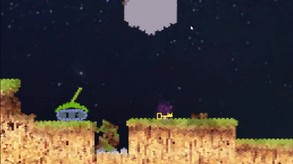
Experimental approach to 2d artillery genre: everything is realistically destructible, because the game world is a physics simulation. There are no sprites in the game. All you see is made of dynamically simulated matter, and thus can be destroyed. This innovative approach opens the new layer of physics based gameplay features.
Modeled estimate, not a reported figure. How we estimate →
Media

About
Genres
Stats
All-time low is the lowest price we've recorded for this game since we started tracking it.
Languages: English, Russian
Engagement
Hours played at review time, across 48 reviews with recorded playtime.
Reviews
Themes across 48 recent reviews and how positive each mention is. A keyword signal, not full sentiment analysis.
positive critical· bar length = how often the theme comes up
Reviews
Веселая игра!
Jelly in the Sky is a small but strikingly experimental title that approaches the 2D artillery and destruction genre from an angle few games dare to explore. Instead of relying on traditional tile-based terrain or fixed environmental rules, it builds its entire world from fully simulated, malleable particles. Every wall, every platform, every chunk of ground is made of matter that reacts dynamically to explosions, collisions, and weapon impacts. This gives the game an immediately distinctive identity: battles play out not on a static map but on a battlefield that constantly reshapes itself, collapsing and contorting as players fire their weapons. The premise is simple, but the execution opens the door to chaotic, unpredictable sequences that make each match feel different. The greatest strength of Jelly in the Sky lies in the sense of physicality at the heart of its design. Explosions don’t just chip away at preset destructible spots—they carve through terrain in jagged, irregular ways, sending debris tumbling through the air or triggering chain reactions that alter the flow of combat. Players can create makeshift tunnels, topple structures, or blast entire sections of the level into drifting dust. The physics may not always behave perfectly, but that unpredictability gives the game a certain raw charm. It feels less like a traditional competitive shooter and more like a sandbox playground where explosions are tools as much as weapons. This focus on emergent behavior helps distinguish the game from its genre peers, suggesting that the developer’s goal was less about precision and more about embracing chaos as part of the fun. Jelly in the Sky’s visual presentation is minimal by design. Instead of intricate art, detailed animations, or lush textures, the game opts for a rough, blocky style that emphasizes its physics-first approach. Objects resemble floating masses rather than structured buildings, and environments look more like abstract simulations than crafted landscapes. While this can occasionally hinder readability—especially during busy moments when particles fill the screen—it also reinforces the game’s identity as a physics-driven experiment rather than a traditional action game. The stripped-down style allows the simulation to take center stage, ensuring the focus remains on the visceral spectacle of destruction rather than aesthetic polish. Gameplay itself is straightforward. You select weapons, angle your shots, and attempt to destroy opponents or the terrain supporting them. The controls are accessible enough for newcomers, and the inclusion of single-player modes, local PvP, and basic co-op provides different ways to engage with the game. Yet it becomes apparent early on that Jelly in the Sky leans heavily on novelty rather than long-term depth. The physics, while fun and surprising, do not evolve into more complex systems or long-term progression. There is no campaign, no competitive structure, no meaningful unlocks—just freeform destruction and quick rounds of artillery-style combat. This makes the game enjoyable in short bursts but leaves limited incentive to return once you’ve seen the extent of what the physics engine can do. The game’s experimental nature also leads to occasional frustrations. The chaotic physics can sometimes behave inconsistently, resulting in moments where attacks misfire or debris behaves unpredictably. Depending on your tolerance for jank and volatility, these moments may either enhance the anarchic fun or break immersion. Similarly, the minimalistic visuals, while thematically fitting, can make it difficult to track projectiles or enemy positions amidst the turmoil. These issues do not break the experience, but they give the game an unpolished quality that reinforces the impression of a physics testbed more than a fully realized commercial title. Despite these limitations, Jelly in the Sky succeeds in offering something genuinely different. It stands as a reminder that even small indie titles can push boundaries by experimenting with foundational mechanics instead of traditional game structure. The satisfaction of watching terrain collapse realistically, of carving unexpected paths through a map, or of simply testing the extremes of the physics system provides a kind of joy that well-polished shooters cannot replicate. For players who enjoy unorthodox, physics-driven gameplay, or who appreciate indie projects that prioritize experimentation over refinement, Jelly in the Sky offers an amusing and occasionally fascinating dose of creative destruction. In the end, the game is best viewed as a physics sandbox with artillery mechanics attached rather than a conventional shooter. Its strengths—emergent gameplay, unpredictable destruction, and a distinctive simulation-driven approach—make it memorable, while its weaknesses—limited content, minimal visual clarity, and inconsistent physics—prevent it from becoming a long-term staple. But for what it aims to be, Jelly in the Sky delivers a refreshingly unconventional experience, one that embraces the messy joy of blowing things apart and letting the pieces fall where they may. Rating: 5/10
Jeg
Хорошая игра.
"Your videocard performance is: 5.8 - weaker than optimal" -GTX 1080 *2021 UPDATE* "Your videocard performance is: 7 - weaker than optimal" -RTX 2080 Ti *2023 UPDATE* "Your videocard performance is: 3.4 - good enough" -RTX 3090 Ti *2026 UPDATE" "Your videocard performance is: 7.2 - weaker than optimal" -RTX 5090
Now I see why the Reviews are Mixed...
Со времен Gravity Defied не ненавидел разработчиков до такой степени) Игра причиняющая боль и напоминающая о временах, когда не было кнопки X to Win. 10 закончившихся боеприпасов из 10
Когда Prey2017 идет в 28-30 фпс с редкими просадками до 26, а эта игра идет в 19-22 :/ Но в целом, задумка очень интересная, правда может стоит снизить обсчитывание частиц с нескольких сотен раз в секунду до 100-150? или эффект уже иной? в любом случае, игра довольно интересная, жаль мой ноут ее не тянет
Related
Related
Trends
Modeled estimate over time, reconstructed from Steam's monthly review histogram.
Momentum
Pace estimated from the game's recent review growth (our daily snapshots) at its own sales-per-review ratio — a momentum signal, not booked sales.
Audience
Estimated from the language of this game's reviews — a proxy for where players are, not official Steam demographics.
Related
| SEX Room 2 [18+] | $27.8K | 265 | 71% | $3.99 |
| Explorers of the Abyss | $27.8K | 186 | 63% | $7.99 |
| Hunting Unlimited™ 2008 | $27.8K | 85 | 88% | $9.99 |
| 貢がせろ!女苑ちゃん!! | $27.8K | 128 | 93% | $6.99 |
| Lust Theory Season 3 | $27.8K | 156 | 64% | $14.99 |
| Containment: The Zombie Puzzler | $27.8K | 294 | 78% | $4.99 |