I doesn't exist - a modern text adventure is an unusual and deliberately introspective indie title that takes the foundations of classic text adventures and reshapes them into something far more self-aware, unsettling, and philosophically driven. Developed by LUAL Games KIG and published by DreadXP, the game initially presents itself as a nostalgic throwback—inviting players to type commands, examine environments, and solve small logic problems—but it quickly becomes clear that its true focus lies not in puzzles or progression, but in questioning the relationship between player, character, and control itself.
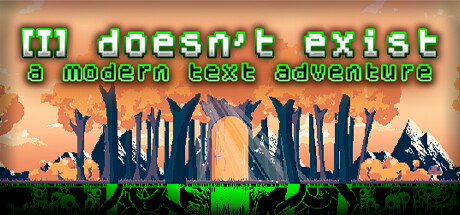
The opening segment eases players into familiar territory. You interact with the world through typed commands, navigating a moody forest setting rendered in minimalist pixel art. Objects can be examined, manipulated, and combined through natural language input, evoking the feel of early computer adventures while benefiting from a more forgiving modern parser. This early section functions almost like a traditional escape-room puzzle, grounding the experience and establishing expectations around problem-solving and exploration. The presentation is restrained but atmospheric, using text and sparse visuals to encourage imagination rather than overwhelm it.
Once the initial objective is completed, the game undergoes a striking tonal and structural shift. What begins as a straightforward text adventure becomes increasingly abstract and introspective, with the protagonist—or perhaps the interface itself—starting to challenge your commands. The game begins to blur the line between player agency and character autonomy, asking unsettling questions about who is really in control. Your typed instructions, once treated as absolute, are now interpreted, resisted, or questioned, creating a growing sense of unease that defines the rest of the experience.
Narratively, I doesn’t exist thrives on ambiguity. Rather than explaining its themes outright, it allows meaning to emerge through fragmented dialogue, reactive text responses, and subtle changes in tone. Identity, existence, and free will are recurring motifs, explored through the act of interaction itself rather than through exposition. The game often feels less like a story being told and more like a conversation unfolding between player and system, with moments that can feel intimate, confrontational, or quietly disturbing depending on how you engage.
The text input system is central to both the game’s strengths and its frustrations. When it works well, it fosters a strong sense of immersion, encouraging players to think carefully about wording and intention. The parser generally understands a wide range of commands, but like many text-based systems, it can occasionally fail to interpret reasonable inputs. These moments can break immersion, especially in a game where interaction is the entire experience. That said, these limitations also reinforce the game’s themes, as misunderstandings between player intent and system response become part of the broader conversation about communication and control.
Visually and sonically, the game maintains a subdued but effective aesthetic. Pixel art scenes are simple yet evocative, providing just enough context to anchor the text without distracting from it. Sound design is sparse, often relying on ambient tones and silence to heighten tension and introspection. This restraint complements the narrative focus, ensuring that nothing pulls attention away from the words on screen and the implications behind them.
The overall runtime is relatively short, but the game encourages multiple playthroughs through its branching conclusions and subtle variations in how scenes unfold. Different choices, tones of interaction, and levels of compliance or resistance can lead to distinct endings, some more conclusive than others. However, replaying the game requires revisiting early sections in full, which can feel repetitive for players primarily interested in seeing every outcome rather than re-engaging with the experience holistically.
I doesn’t exist is not a game that aims to entertain in a conventional sense. It offers little in the way of traditional challenge or reward, and players looking for clear goals or mechanical depth may find it unsatisfying. Instead, its value lies in how it uses interactivity to provoke thought and discomfort, turning the simple act of typing commands into a reflection on agency and existence. It is a game that invites interpretation rather than explanation and rewards curiosity more than efficiency.
Ultimately, I doesn’t exist – a modern text adventure stands as a thoughtful and experimental piece that reimagines an old genre through a modern, existential lens. It is best approached not as a puzzle game or narrative epic, but as an interactive meditation—one that may resonate deeply with players who enjoy introspective storytelling and meta-commentary on games themselves. For those willing to embrace its ambiguity and unconventional structure, it offers a compact but memorable experience that lingers long after the final line of text appears.
Rating: 6/10