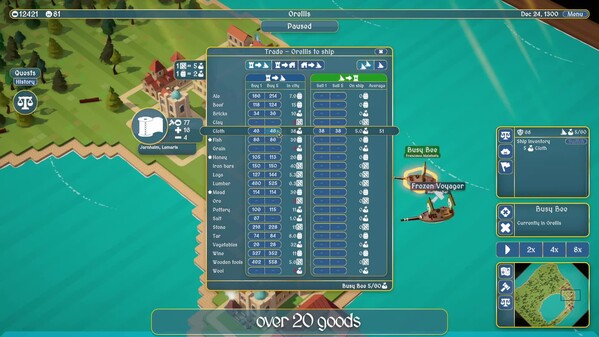
Live your medieval trader life! Buy low, sell high and explore the world! Buy ships, build businesses, find or train captains. Deal with pirates, manipulate mayors and challenge traders. React to hundreds of events that shape your very own procedurally-generated world!
Modeled estimate, not a reported figure. How we estimate →
Media

About
Welcome to High Seas, High Profits! A game about putting on the dusty pants of a medieval capitalist, entrusting drunk sailors with trading your beer and enforcing the almost random desires of whimsy mayors who think famine is kinda bad, but throwing a harvest celebration is crucial!
You're busy, let's get down to business:
discover the cities on your map and the bonuses that they offer
trade between cities and build wealth
buy old dusty ships or build your very own new and shiny ones
learn about prices and set up trading routes
build production businesses or enter auctions for city owned shops
find new captains with awesome traits, or train the ones you have into... sucking less
engage with the other traders, race them through the cities, help them out or work towards bankrupting them and taking over their business
fight pirates, run away or just.. befriend them, for a chance at treasure and rare ship improvements
enjoy chill, turn based gameplay or fast pace RTS and switch between the 2 at any time!
Genres
Stats
All-time low is the lowest price we've recorded for this game since we started tracking it.
Languages: English, French, German, Spanish - Spain, Russian, Italian, Polish
Engagement
Hours played at review time, across 42 reviews with recorded playtime.
Reviews
Themes across 42 recent reviews and how positive each mention is. A keyword signal, not full sentiment analysis.
positive critical· bar length = how often the theme comes up
Reviews
Short version: As someone who loves the trading sim genre, this game is pretty much THE spiritual successor to the classic Patrician series. It scratches a very unique itch: optimizing production and logistics in an economic sandbox driven by supply and demand. If you're an excessive planner like me, half of the game is played in Google Sheets, while the game serve as a manifestation of your trade empire in graphical form. It's an utterly satisfying experience to see your grand designs play out exactly how you planned it. The indie dev is also very responsive, actively engages with the player base in Discord. With continued development, I can definitely see the game fill a void in this genre. ------------------------------------------------------------------------------------------------------------- Long version What I liked about the game: 1. Economic complexity - there are 21 goods in the game with almost half being processed goods, Each business cost different building materials, which would varies the amount of time it takes to break even. Combined all that with a RNG that assigns different pricing and maintenance values every game, players have plenty of factors to consider when deciding which industries to develop. 2. Tribute to the classics - besides the procedural generated maps, the dev specifically put in 3 custom maps: the Hansa, Caribbeans, and the Mediterranean. It allows players like me to recreate the nostalgia of playing Patricians, Port Royale, and Rise and Venice. 3. Progression done really well - similar to Patricians, you gain reputation by trading more with a city and can accelerate its gain by doing missions for the mayor. Each level gets requires progressively more points to level up, which encourages players to develop multiple cities after reaching a specific threshold, since reputation is tied to the # of businesses you can build in a city. Overall, pacing is a lot slower than Patricians, which rewards a more methodical approach to expansion. Mechanics that need polish/rework: 1. Town management - while this is a matter of personal preference, I really don't like how I can't directly place dwellings or buyout AI industries. Since building space is limited, it always pisses me off when the mayor wastes a perfect 3 x 3 building slot by placing a 2 x 2 building on it. You also can't build housing for your population indefinitely, and can only influence the mayor to do it. Given how housing affects town satisfaction, it's punishing to not be able to control it in a more direct manner. 2. Population management - this is probably my biggest gripe with the game, in that population control is gradual and not instant. Players can control population by providing goods, housing and employment, which effects town satisfaction. Depending on the satisfaction level, the game uses a multiplier that increase/decrease the chance of population change. Satisfaction updates every month, so the change is gradual. Given the randomness of how population is calculated, you can never control how big a town grows. It also leads to cycles, which the town will grow up to the point which it becomes unsustainable causing goods shortages, then gradually decline back to a sustainable level. But if you've built industry in the city, it causes worker shortages. And since you can't move population around with ships like in Patricians, you just have to wait for an entire year in game sometimes for the population to stabilize. It also makes planning for consumption an impossible challenge, cause population swings wildly. I hope the dev gives us more tools to manage population, either let us move population around or cap the growth thru dwellings and/or employment. Another option is for the consumption to be tied to employed populations, as opposed to total population. In short, give players more tools to alter the sandbox. Afterall, people that play this type of niche are all control freaks. I mean, what normal person plans the entire game out in excel before even starting the game? On a separate note, it does make my wife think I'm working though... while in fact, I'm planning my trade empire, muhahaha!
This game has some deep systems and offers plenty of space for micromanagement. There are a few handy automation and quality of life features and it's quite enjoyable to go through the motions of buying low and selling high. The blocky art style is cute and clean (reminds me of Kingdoms and Castles). Music is nice too. Some flows through the UI can be a bit rough. For example, selecting ships. If I want to select a ship, I need to click on the quick access button, click to go to the ship, then I have to click the ship in the water of the dock of the city that the screen just jumped to. Could I not just click the ship in a collapsible outliner, or click a button next to the city that the ship is in to select the ship. The worlds are procedurally generated, but always circular and quite small. Every map tends to feel much the same as a result. I noticed a few other areas where systems turned out to be quite shallow, such as ship variety, upgrades, world customisation, building management. I would continue to play this game if navigating its menus didn't feel like a chore. At the moment, it does. As a result, I'm actually not going to recommend this game. I started out typing this thinking it was a thumbs up, because this is a cozy and clearly well put together game. The developer clearly has put their passion into building out this beautiful trading sim. However, if I can't bring myself to play it because the UI is that cumbersome, I really couldn't recommend it to others.
The good - Finally a trade sim game! - You can disable pirates in the set up - Maps for the Hanse, Caribean and Mediterranean (although it is weird trading the goods we know from Patrician in the Caribean) - Turn based or 'real time' (real time is turn based, but you dont have to manually press 'next turn') The bad The UI and trade interface are a mess. - You cannot see which buildings in a city are yours. - When I click my warehouse, I want to see what is in there and how full it is. It does not show me. I need to click the market... Traders hall also does not show this info. - Warehouse does not seem to have a manager like in Patrician and Port Royale, so I guess everything is managed via the trade routes, making them very micromanagement heavy. - Setting up trade routes is very confusing at first. -- You need to select the goods you want on the trade route. In other games they were all visible. This leads to extra clicks. -- Each good has multiple icons below it for buy,sell,load,unload. You can only do 1 action per stop per good. In Port Royale 3 we had 4 tabs and you had 4 actions per stop. I assume we need to add multiple stops per city to the route if we want to have more actions per good... -- You can set the prices for buying and selling, and amounts to load and unload in generic settings, but if you go to the world map, click a city, there is a "detailed setup for stop" where you can twiddle and tweak each city. Very useful, but hidden. It wants to be Patrician, but is severely lacking in QoL. Wait for now, unless you want to micromanage in Excel. Dev: copy what we had in Port Royale 3 or Rise and Venice and this game will be amazing
Patrician III on steroids. Needs a lot of stuff yet but it's clearly it's spiritual successor
It's just a modern take on the Patrician franchise.
Als alter Veteran von Patrizier, Rise of Venice und Port Royale warte ich schon länger auf einen fesselnden Titel in dem Genre. Mein Eindruck nach 10 Stunden Spiel ist allerdings eher enttäuscht. Vieles wirkt unfertig oder nicht ausgereift: - Was soll der Vorteil der zwei Spielmodi (rundenbasiert und Echtzeit) sein? Ja, rundenbasiert bietet die Möglichkeit ohne Zeitdruck in Ruhe zu planen; das bietet aber auch eine Pause-Taste! Egal in welchem Modus kritzeln Schiffe/ Konvois ihren Kurs in Form von "in 4 Runden bin ich an der Stelle"; ich frage mich, was soll ich mit dieser Information? Gesamtheitlich betrachtet stört es meiner Meinung nach einfach den Spielfluss. - Das Konzept, dass in jeder Stadt alle Waren produziert werden können und nur jeweils drei mit einem 20% Bonus erschließt sich mir nicht. In der realen (mittelalterlichen) Welt konnte man nun einmal nicht überall Holz schlagen, Erze schürfen oder Getreide anbauen. Nicht nur "nicht gut", sondern gar nicht. Warum dann überhaupt Transport via Schiffe? Dann kann ich auch in den Städten Betriebe für die fehlenden Waren bauen und den Kram direkt an die Stadt verticken - Nachfrage ist ja da! Nach etlichen "Würfel-Versuchen" ist mir auch kein Random-Setting begegnet, in dem man Städte erhält, wo sich Bonus-Produktionen ergänzen (bspw. Salz und Fisch oder Honig, Wein, Met), sodass sich der "Wow, hier bau ich mein Imperium"-Effekt einstellen würde. Zudem sind Produktionen ohne Boni sind so dermaßen unprofitabel, dass selbst wenn man diese als reine "Versorgungsgrundlage" für weiterverarbeitende Betriebe nutzt, nicht wirklich eine effiziente Produktion damit aufbaut. - Kapitäne und Crew... hätte man sich bei der aktuellen Version sparen können. Es wird irgendein Depp ausgewürfelt; man muss einige Runden warten, bis man den durch einen anderen (Depp) tauschen kann. Wenn man wenigstens zwischen ein paar auswählen könnte, oder irgendwie (meinetwegen durch einen "Headhunter" mit Geldeinwurf) Einfluss auf das Ergebnis nehmen könnte, wäre das noch verschmerzbar. So ist es nur einfach extrem lästig und vor Allem ein Hindernis beim Aufbau seiner Flotte. Apropos Flotte: Die Idee mit den Upgrades ist gut. Zusammen mit dem Kapitänsproblem artet das Ganze sehr schnell in nerviges und unnötiges Micromanagement aus. - Besonders hinderlich ist das rufbedingte Bau-Cap von Betrieben. Einfache Frage: Warum??? Sich in der Stadt einen Namen machen, damit der Stadtrat erlaubt, dass man sich da niederlassen darf - okay. Aber "Hey Du reicher Sack.... Du baust bei uns in der Stadt aber höchstens zwei Betriebe.... sonst verdienen wir noch zu viel Gewerbesteuer...."? Es bremst den Skalierungs-Ansatz extrem aus. Grad solche Spiele bieten in der Skalierung und anschließenden Optimierung ihren Reiz. Ansonsten können auch gleich eine Handvoll Schiffe autohandeln (was im Übrigen auch ein Micromanagement-Klick-Monster ist) und ich das Betriebe bauen gleich sein lassen kann. - Es fehlen Elemente und Möglichkeiten mehr Einfluss auf die Welt und Städte zu nehmen. Weder kann ich mit meinen Konkurrenten interagieren, noch mit vorhandenen Gebäuden und Betrieben (brenn es nieder, kauf es, sabotiere es, etc - Fehlanzeige). Wo ist mein Vorteil (außer dem Umstand, dass ich ein paar Betriebe mehr bauen darf), wenn ich mir in der Stadt einen Namen mache? - Der negativste Aspekt zum Schluss: Ich bin bei allen Spielen nach einigen Jahren Spielzeit immer wieder in das gleiche Problem gelaufen: Bevölkerungsrückgang in allen Städten durch Mangel an Waren und Zufriedenheit. Die NPC-KI-Händler schaffen es nicht die Versorgung einer Grundbevölkerung x in den Städten aufrecht zu halten. Wenn der Spieler nicht selbst durch drölfzehn Auto-Handelsrouten (viel Spaß bei ständigen Piraten-Angriffen, trotz dickem Schiff, T3 Kanonen, Rumpf, Ruder und Segeln, nach denen dann dein Trader trotzdem erstmal in die Werft muss...) interveniert, zieht dann die Abwärtskaskade mit sich > zu wenig Arbeiter für Betriebe > Produktion viel zu teuer > null Profit. Die rufbedingte Limitierung der Betriebe die ich bauen darf, verhindern hier meines Erachtens besonders ein Entgegenwirken! Darüber hinaus ist der Soundtrack des Spiels wirklich großartig! Das Spiel hat auch Potenzial und ich wollte es wirklich lieben, aber wenn man hier nicht mehr Anreize schafft sich zum händereibenden Kapitalisten, der groß skaliert entwickeln zu können, bleibt man sehr lange Zeit ein kleiner Krämer, der mit seinen Schiffchen ein bisschen auf der Karte rumgurkt, bis der Versorgungsnotstand kickt und man das Spiel frustriert beendet. Wenn es Early Access wäre - okay.... für eine "fertige" Vollversion halte ich das Spiel für zu unausgereift, um es zu empfehlen.
I've tried over 5 or 6 games in this genre in the last few years and none of them come close to this one. After many attempts, this is finally a merchant game that works. And it doesn't just work, it scales well when you stop being a merchant and become a large-scale entrepreneur. The economy is well simulated, it feels organic. Prices fluctuate, you have to follow the market. Here I always have some price to adjust, accumulated material to get rid of because world production increased and I'm just now realizing it. Optimizing routes, prices, adjusting imports/exports, within its simplicity, there are quite a few variables you need to control, all to watch your empire grow. If you're looking for a trading game, literally buying and selling stuff, this is it. It's basically a spreadsheet simulator. If you like THAT type of management game, take some time off work because you're going to get hooked. Obviously it has things to improve, difficulty curve is unbalanced, some systems need polish. But the core works.
面白い。無心で貿易に打ち込める良作。UIもよくできていて特に悪い部分は見当たらない。 丁寧かつ世界観に沿ったチュートリアルもあり隙が無い。
The game could be interesting, but its too heavy in text so I hope the developers can provide support for the Chinese language.
I enjoy economy games but this is just awful. The Buy/Sell screen is baffling and not at all user friendly. When you do think you have worked it out, making money is painfully slow and seems to get slower as the AI races away. I restarted several times but simply got frustrated, it is just slow, repetitive and simply zero fun. I rarely post negative reviews but this game is such a let down, sorry.
Related
Related
Trends
Modeled estimate over time, reconstructed from Steam's monthly review histogram.
Momentum
Pace estimated from the game's recent review growth (our daily snapshots) at its own sales-per-review ratio — a momentum signal, not booked sales.
Audience
Estimated from the language of this game's reviews — a proxy for where players are, not official Steam demographics.
Related
| Fortissimo FA | $53.6K | 339 | 82% | $9.99 |
| Light and Shadow - Doppelganger | $53.7K | 145 | 79% | $9.49 |
| Cursed | $53.6K | 670 | 80% | $4.99 |
| 9th Sentinel Sisters | $53.7K | 282 | 70% | $7.99 |
| Anima Flux | $53.7K | 124 | 85% | $19.99 |
| Galaxy Trucker: Extended Edition | $53.7K | 238 | 89% | $9.99 |