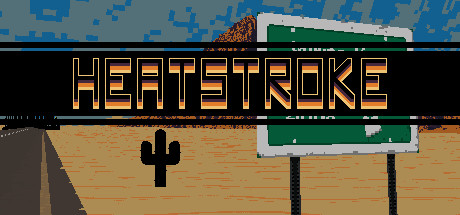
HeatStroke is a simulation game tasking you to transcribe an unhinged short story while driving down a seemingly endless desert road.
Modeled estimate, not a reported figure. How we estimate →
Media

About
Genres
Stats
All-time low is the lowest price we've recorded for this game since we started tracking it.
Languages: English
Engagement
Hours played at review time, across 42 reviews with recorded playtime.
Reviews
Themes across 42 recent reviews and how positive each mention is. A keyword signal, not full sentiment analysis.
positive critical· bar length = how often the theme comes up
Reviews
Talia Bob Mair has ♥♥♥♥♥♥ me like a pig.
im truly impressed that this game, where you spend the majority of it typing and the rest making sure you dont swerve towards your untimely death, was able to captivate me as much as it did. originally struggling to engage with the concept to finally understanding why HeatStroke was made to be like this was an incredibly satisfying and well worth it endeavor. i spent all my pause time on making a smoothie. it didnt taste good and it was probably the reason why i missed out on the under 3 hour little tree. so truthfully im left with a bitter aftertaste but whatever, good story
drinking while driving < writing while driving
An interesting and unforgettable experience.
If a game consists of a short story, the short story had better be well-written. I wasn't particularly impressed by this one. The few characters seem to rotate between just three emotional states: aggrieved anger in which they lash out, whimpering depression in which they seek forgiveness, and vague existential malaise. Very little else ever happens, and they spend a lot of time self-narrating these same three moods. It is occasionally punctuated by self-aggrandizing boasting in which they say "heh." The exception is the love interest, who instead shows little emotion at all, but calls the protagonist an intelligent man, forgives him for belittling her field of study, describes the premise, and then spends the rest of her time trying to comfort him whenever he's sad. Her perspective is vague but her skin is described three times. It's not clear how much the tacked-on feeling of the later chapters is deliberate and how much might be because they were largely ideated after the first chapters were already written. The philosophy itself is somewhat insipid, skipping over most of its own major questions and then doing a much more pathetic version of one of the subplots of God-Emperor of Dune. Maybe I'm annoyed because the game lies to you about how much longer you'll need to keep going, while telling you that you'll lose all your progress if you stop. Personally I don't think that's a particularly clever implementation of narrative deception. Fascinating way of playing with the concept of a game, though. Splitting attention in this way is cool. And I love the move of having exactly one achievement: completion. The framework is good, I was just disappointed by the writing. ------- Edit: Half the negative reviews have replies from the developer saying they didn't understand the game, so here's a little theoretical FAQ: Q: Did you not understand that lying to the player about how long they have to keep going is an intentional part of the narrative experience A: No, I get that, I just didn't think it was done well enough Q: Did you not understand the philosophy A: No, it was pretty clear, and I recognized the thought experiments it was referencing, I was just disappointed that there were only a couple of sentences in which anyone deeply engaged with talking about its assumptions Q: Did you not understand that looping through the same three emotional states and overexplaining them every time is an intentional part of the narrative experience A: If that's true I still don't think it's good. If there are people who think that's a cool experience, they're welcome to leave positive reviews reflecting that. I thought it wasn't, so this is my review.
Heatstroke is an incredible existential story told in a hostile way. While unsure at first, I do believe that the medium in which it's told being an exhausting and grueling marathon hones in on what the story is trying to tell and forces the player to digest every thought and aspect of it, no matter how uncomfortable. I do however, feel like the 'horror' elements are underwhelming, and have their hand revealed far too soon in comparison with the rest of the game, becoming more of a dull expectation than a feature that you continue to be invested with its development throughout playing. Ultimately I would recommend heatstroke to anyone who loves reading stories, and is willing to invest several hours of focus for doing such.
i tried to play this while high out of my mind but my typing speed was so messed up I couldn't finish it LOLLLL
If you like typing. I mean really... REALLY like typing. Like ... you like typing for three hours straight. Then you'll love this silly "marathon" of a short story.
♥♥♥♥♥♥♥
HeatStroke is an experimental indie experience developed by Talia bob Mair, Matt Garnett, and Braden Banning, and published by ItsTheTalia. It resists easy categorization, blending elements of driving simulation, typing challenge, endurance test, and surreal interactive storytelling into a single, cohesive concept. Rather than presenting players with traditional objectives, levels, or progression systems, the game asks for something far more demanding: sustained focus. It transforms what could have been a simple novelty into a meditative yet punishing exercise in multitasking and concentration, creating an experience that feels closer to performance art than conventional game design. The core premise is deceptively straightforward. Players find themselves driving along an endless desert highway while simultaneously transcribing a long, unfolding piece of text that appears on screen. The car does not drive itself in a perfectly straight line; the road curves and drifts, requiring constant steering adjustments. At the same time, the text demands accurate typing, letter by letter, word by word. The challenge lies in balancing these two tasks. Losing control of the car or making critical errors disrupts progress, often forcing the player to start over. There are no frequent checkpoints or forgiving systems that cushion failure. Instead, HeatStroke emphasizes endurance, turning sustained attention into the primary skill being tested. This dual-task structure creates a unique cognitive tension. The player’s eyes must constantly shift between the road and the text. The act of typing—normally automatic for many—becomes surprisingly stressful when combined with the need to keep the vehicle steady. Over time, the experience becomes physically and mentally taxing. Fingers begin to ache, attention starts to waver, and small mistakes can have outsized consequences. Yet this strain is intentional. The game derives its identity from this friction, pushing players into a state where immersion and fatigue coexist. Visually, HeatStroke adopts a minimalist pixel-art style that complements its focused design. The desert landscape stretches endlessly under a wide sky, dotted with cacti and occasional environmental changes that subtly alter the tone as the journey continues. The simplicity of the visuals ensures that the player’s attention remains anchored to the core tasks of driving and typing. As the narrative text grows stranger and more surreal, the environment begins to mirror this shift in tone through subtle distortions and color changes. The aesthetic may not be technically elaborate, but it effectively reinforces the game’s hypnotic atmosphere. The narrative itself is delivered entirely through the text the player must transcribe. Rather than presenting the story in digestible segments, the game forces players to engage with it directly and continuously. This approach transforms the player from passive reader into active participant. Typing each word creates a sense of ownership over the unfolding narrative. The story often veers into absurd or philosophical territory, adding an additional layer of intrigue. Because the player must concentrate on reproducing the text accurately, the act of storytelling becomes intertwined with the physical experience of play. One of the most polarizing aspects of HeatStroke is its uncompromising structure. The lack of save points and the potential for significant setbacks after mistakes can be frustrating. For some players, this design fosters a powerful sense of accomplishment when progress is maintained. For others, it may feel punishing or overly rigid. The game demands a level of patience and commitment that exceeds most modern titles. It does not cater to short play sessions or incremental progression. Instead, it challenges players to commit fully to the journey, accepting the risk of failure as part of the experience. Despite its minimal mechanics, HeatStroke generates a surprisingly strong emotional response. The long stretches of desert highway combined with the introspective or surreal narrative text create a mood that oscillates between meditative calm and mounting tension. The repetitive hum of the road and the rhythm of typing produce a trance-like state. Yet the constant threat of losing control prevents full relaxation. This interplay between calm and stress becomes the defining emotional arc of the game. Ultimately, HeatStroke stands out as a bold and unconventional experiment in interactive design. It reimagines typing—a mundane, everyday action—as a central gameplay mechanic, and pairs it with driving to create a unique multitasking challenge. Its endurance-based structure, minimalist presentation, and surreal storytelling combine to form an experience that is as much about mental resilience as it is about gameplay. While it will not appeal to everyone, particularly those seeking traditional progression systems or forgiving mechanics, it offers something rare: a focused, singular vision executed with deliberate intensity. For players willing to embrace its demands, HeatStroke delivers a strangely compelling and unforgettable ride down an endless digital highway. Rating: 8/10
Related
Related
Trends
Modeled estimate over time, reconstructed from Steam's monthly review histogram.
Momentum
Pace estimated from the game's recent review growth (our daily snapshots) at its own sales-per-review ratio — a momentum signal, not booked sales.
Audience
Estimated from the language of this game's reviews — a proxy for where players are, not official Steam demographics.
Related
| ULTRATAP | $12.8K | 74 | 89% | $4.99 |
| Asa-Chan Wants to Go Home! | $12.8K | 79 | 91% | $9.99 |
| Edge of Book | $12.8K | 113 | 52% | $4.49 |
| Gazing from beyond | $12.8K | 567 | 70% | $1.19 |
| 1917 - The Alien Invasion DX | $12.8K | 113 | 72% | $4.99 |
| Majestic Nights | $12.8K | 113 | 55% | $4.99 |