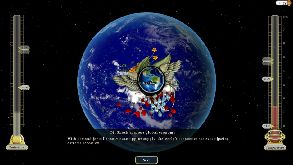
Fate of the World is a dramatic global strategy game that puts all our futures in your hands. The game features a dramatic set of scenarios based on the latest science covering the next two centuries. You must manage a balancing act of protecting the Earth’s resources and climate versus the needs of an ever-growing world population, who...
Modeled estimate, not a reported figure. How we estimate →
Media

About
Genres
Stats
All-time low is the lowest price we've recorded for this game since we started tracking it.
Languages: English, Dutch, German
Engagement
Hours played at review time, across 38 reviews with recorded playtime.
Reviews
Anti nuclear power misinformation:3 There's some cool parts of this game that makes you think. But the devs seem a bit too biased for many of their options that makes it somewhat immersion breaking.
The idea is very good at its core, but the game systems are sufficiently buggy and opaque that it takes a lot of the fun out of the game, even if you know the (extremely specific!) strategy necessary to beat it. And learning how to play the game is mostly just "learning the extremely specific strategy", which is needlessly difficult precisely because of the opaqueness of the game's systems. It's possible to get to 2160 or so, have the entire world on clean energy and net negative emissions, and *still* have to spam out sulfur aerosols to stop warming from going further. Why? Unclear: the game doesn't tell you. Is there a bug? Is it methane clathrate release? Who knows! Guess you just gotta spam those aerosols until the end of the game, since it doesn't provide any other late-game mechanisms for geoengineering. Overall, beating Fate of the World doesn't actually feel like "yes, I saved the Earth", it feels like "yes, I found how to game the systems the game presented to me". And to me, that feels like a failure of game design, and undermines the core intent of the game.
This game is both too detailed and too vague to be playable. The game gives you tons of economic data, but a handful only a handful of cards without detailed description of what they do. You have to 'buy' for tens of dollars? the abstraction makes no sense. (if you are a world government, you should have more power) Parts of the world have to buy technology you paid to develop from each other, makes no sense. (south america buys 'deep sea drilling technology' from north america) Why give me this amount of detail, but so little control? if it's big picture, give me big picture overviews. Its politics is also questionable as far as climate policy goes, as it is a firm believer in the power of managed capitalism to buy our way out of global warming. It is also stuck on a strict 'developed world', 'developing', 'underdeveloped' framing. The end goal of human existence is the united states, not living in harmony with nature or something. p.s. Consider playing the free 'Half-earth socialism' for a flawed, but better designed game.
[h1]So close and yet so far[/h1] [hr][/hr][i]It is one of those games which can be very entertaining to play, but it just keeps on disappointing you. It almost gets to that bliss of 'just one more turn', but severe design issues pull game right back to the ground and leave a sour taste in your mouth.[/i][hr][/hr] [h1]☠️Flawed Execution☠️[/h1] The fundamental problem of this game is that it possesses deep systems and gives you a lot of information. However, it doesn't give you tools to judge what is actually important and leaves your decision making to cards. Cards are very general and very large scale options for player to use. So, you have a system with a lot of parameters, but you only end up hammering the problem with sledge hammers. It's difficult to observe what you need exactly to do, a lot of options are not even available and any change requires massive amounts of investment. This leaves game into micomanaging hell where you have to over-invest into region for it to become productive and then constantly rotate massive policies to exploit the region or to add and remove same positive benefits constantly. https://steamcommunity.com/sharedfiles/filedetails/?id=3428653836 Game then is equally arbitrary in regards to failure states. You can lose regions or even a game out of a blue. You get a warning before a turn and there is often nothing you can do at that point. You might not have funds, cards to change course or they might not even be enough. It is bizarre how turns are split into 5 years. You can reverse all undesirable policies and give freebies to a region and it will still reach a failure state. Game is flawed, because it seemingly calculates negative effects before positive ones and you can lose region outright if it has low life (hearts). Even if not, it can fail you due to extreme randomness in events. You can out of the blue lose several hearts, unexpectadly losing you a region in hours long game. This is incredibly bad design choice as it combines grand strategy with pure RNG mechanics which mesh with each other abysmally. https://steamcommunity.com/sharedfiles/filedetails/?id=3428652891 [h1]🏰The World Building🏰[/h1] Game is quite immersive. You do feel like you are doing something important. Constant news report helps to establish a living world. Protests and state of being of regions helps you to paint how it is to live there. This is sadly is another area where games fails. It is politically bias as hell. Take an example of GMO (genetically modified food). It is supposed to be a great short to mid term solution to food shortages. However, while it is easy to implement it, it costs insane amounts of money to renew it. It also costs a massive amount of money to cancel it. Tech is absolutely garbage and in most illogical ways too. There are plenty of techs which are absolutely unviable in this game. All of these techs and solutions tend to be around solutions which are not liked by greens. GMO, non-renewable energy sources, conservative policies, etc. So, developers not only were incompetent as game developers, they were bad people too when it came to politics. Rot all around! [h1]🌈What this game needed🌈[/h1] It was a great game for its time when indie games were non existent and small titles like that were original, unique and high quality. Now environment is completely different and it looks like a joke by comparison. What it needed and needs is a sequel which addresses those balance and GUI issues. Mainly, game needs a system which would track what your policies are influencing. It would be like in Democracy or Orbi Universo where you could see how card will interact with all the variables. This will allow you to know precisely what you are doing without obtuse texts and high learning curve. Then a game needs to have a tracking screen for main parameters in how well a nation is doing. No more random failure states. Failure should be systematic and long coming. This way player could know that things were bad for a long time and it would be more of his fault for allowing or choosing to fail. Game also needs to either simplify its statistics or to make each of them relevant. As of today, most of the statistics are irrelevant as game doesn't interact with them in any meaningful way. Another half are statistics which works, but are irrelevant for most cases like free land for agricultural use. Game really needs to hide statistics which are irrelevant and give them as 'base' while hiding unimportant statistics deeper in game menus. Only highlighting them as an issue when they are close to becoming relevant. As for cards themselves. They need to have another system in place. You get few slots which you have to unlock. However, cards vary from essential and low investment like education to outright insane like space programs. Something like education, land protection programs are essential for this game and they cost little to do. So, they end up just polluting available space. They should be removed as cards and be given as sliders. How much you want to invest into education and healthcare? This would give player far more meaningful options as it would allow to keep those cards permanently on with 100% slider while allowing to adjust budgets by increasing or decreasing sliders with trade offs. Developers rarely get card systems right and this game is no exception. They just end up adding simple buttons and sliders into cards and instead of 'diplomacy button' you have a card which gives you diplomacy options. It is like this in this game and it is just as bad. Cards are supposed to be for large, expensive, strategic decisions. You should think about how do you want to approach the problem rather than solving it. Do you want to energy crisis in investing to renewables or nuclear power? So, you add a card which abstracts investment into those sources. A strategic level depth here being how much nuclear fuel is available and a player could potentially invest a lot of resources into energy production which in long term shall become useless. To add further depth, make a random seed of how much hidden uranium there is and cards to explore for new fuel sources which are revealed with varying levels of cost for exploitation. BAM! Instant strategic masterpiece! [h1]Frustrating & Outdated[/h1] [hr][/hr][i]The game was fine for its time, but we had come a long way since then. Its mechanics are fundamentally flawed. Its artwork is primitive. It speaks about experience and resources of developers who made them. It would had been fine for their first project which they later would massively improve upon in the sequel. Sadly, we are not living in such a world and nothing came out of this studio and we are left with thoroughly outaded game which time has rightfully forgotten.[/i][hr][/hr] [url=https://steamcommunity.com/groups/Calicifer/discussions/0/599651305036743039/][i]Calicifer's Reviews[/i][/url] [quote]If you are interested reading full review or want to discuss something with me, please follow the provided link. I don't allow endless discussions under my reviews. You will be warned and then your comment will be deleted with my final say on the matter.[/quote]
I like what the game wants to be, and it gets close to what it wants to be. The scenarios are fun and seemingly realistic with what we see through the past. Where the game falls for me though, and just tanks it overall is that you are seemingly guessing / hoping for positive outcomes with your actions. The actions you take don't really provide much detail on pros / cons, let alone any real explanation on what a card will do in the long term. If you look on the forums, it is generally recommend to download an unofficial mod to clean up this lack of information. This is great, and helps fix the issues; but you shouldn't need an unofficial mod to fix some core issues.
fun, satisfied my specific itch on social/economic/scientific reform. And it has fully convinced me that managed capitalism can't save the world, That it will require significant radical change. Every level requires super specific strategies to win, you suffer from being unable to insert more policy's, being unable to insert more direct or more drastic action. With the only direct/drastic being the immoral gene bombs killing billions, or the global banning of fuel sources most economy's can't or won't manage without your micromanaging. All actions require several decades to install. Which is another issue, the people of this world only exist to consume, there is no local action as a result of local awareness. Which feels like the people are't really bothered to help which climate change, even as Eco-fanatics. Only you will bother and you, even with global backing can only do so much. The best you can do with your gradual change polices is only barely enough to win, so you'll need to min max as much as possible. As the people wait for you to fix the world for them, as they constantly whine about how you are not fast enough.
I picked it up on sale, but even then, I wouldnt recommend this game to others. Mostly because its so disappointing. It has interesting systems underneath. You have to battle through a bad UI to get there, but there are a lot of statistics behind the hood that all affect each other. They would be amazing to watch in a better game. Its so disappointing in fact, that it made me write my first ever review. Now, I dont have hundreds of hours here, so I dont claim to be an expert. But there very much seems to be a "correct" way to play the game. You have to make the same moves, at the same turn, in each playthrough to achieve success. Even if you ignore the preachiness of it, that's not a strategy game. That's a puzzle game. There is slight variety here and there, in what exactly you prioritize depending on random events, but you do the same moves each time. The second issue is the card system. Now its not bad on its own, but it seems weirdly balanced. First of all, it's very inflexible. If I have 49 bucks left at the end of turn, and the campaign to encourage renewable energy costs 50, I cant buy it. I mean I get it from a board game perspective, but can I really not just make a slightly less extensive campaign? I mean come on. Hell, Im pretty sure IRL Europe has grown its rate of renewable energy much faster than possible in this game. And we dont have a world government pumping billions of dollars into it. On top of that, the costs are balanced very strangely. Building continent wide water management systems costs the same in Japan, North Africa, and the Middle East. I feel like covering just Japan should be a little cheaper than the others. And here we have the preachiness again. You can encourage nuclear energy for decades and barely make a blip on the stats, but you can cover continents in these complex environmental programs for a fraction of the cost. I feel like it should be way cheaper to just build tons of power plants (not just encourage them) for the same amount of money. Then, the cards really obfuscate things. I get that you dont want to show exact projections, or the game would be too easy, but half the time I dont even know what my choices do. Like encouraging vegeterianism. I cant see how many people decide to switch. I dont know how many switch on their own, and how many because of my program, and I dont know, whether they will all switch to meat as soon as I stop funding it. Same with things like Forest Protection. How much forest will I be protecting exactly? Will I be converting farmland to woods as well? Lastly, the game is very limited by these cards. There are tons of ideas that the game doesnt represent, either to avoid bloat, or again because of the preachiness. I cannot invest into rail travel instead of cars. I cannot encourage building hydroponics or aquaponics inside of cities. I cannot move population centers to safer areas, or onto deserts, to leave more arable land for agriculture. I also cannot do things partially. I have to spend as much money as the card demands. Overall, its just a very disappointing experience. You see all these complex statistics, and all you can do is imagine how interesting they would be in a better game. I know it may seem hard to avoid preachiness in sims of this nature, but Ive seen it done excellently in Suzerain. Just make sure that there are many viable paths to victory - as long as you play rationally and your choices have synergy, of course.
Complex game that is not offer sufficient explination on its concepts. UI does not help me. Sound design is like a blade in my ears. The fate of this game is the recycling bin.
A somewhat dated educational game, but a good one. It's incredibly difficult, but I think that's the point. It shows just how hard it is to properly fight climate change. Especially when you have countries fighting against change. It reflects a lot of the real world difficulties and politics of resolving issues. But it also shows what needs to be done to progress. I guarantee you'll lose more games than you win, but it's worth playing. I would highly recommend adding the Unofficial Patch, which fixes some balancing issues. Honestly, I wish we could see a new version of this game, since a lot has changed in terms of progress and research into green technology, even in just the past 10 years.
Amazing mechanics, challenge and balancing. I was obsessed with this game and even modded it.
Related
Related
Trends
Modeled estimate over time, reconstructed from Steam's monthly review histogram.
Momentum
Pace estimated from the game's recent review growth (our daily snapshots) at its own sales-per-review ratio — a momentum signal, not booked sales.
Audience
Estimated from the language of this game's reviews — a proxy for where players are, not official Steam demographics.
Related
| Evil Genome 光明重影 | $177.1K | 526 | 68% | $14.99 |
| Farm for your Life | $177.3K | 498 | 82% | $9.99 |
| The Black Watchmen | $177.3K | 747 | 88% | $9.99 |
| Adore | $177.3K | 455 | 88% | $19.99 |
| Samurai Vandalism | $177.3K | 455 | 79% | $19.99 |
| The Married Woman Nextdoor - Creampie SEX Beside Her Husband | $177.1K | 919 | 87% | $9.99 |
Related
| Factorio | $140.6M | 232.2K | 98% | $35.00 |
| House Flipper | $65.8M | 110.8K | 94% | $24.99 |
| Prison Architect | $63.1M | 73.6K | 89% | $29.99 |
| Dyson Sphere Program | $56M | 83K | 97% | $15.99 |
| The Scroll of Taiwu : Beyond The Dome | $51M | 56K | 66% | $29.99 |
| Tabletop Simulator | $42.2M | 73.8K | 96% | $19.99 |