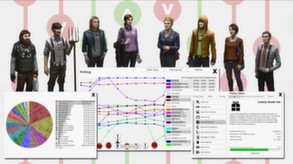
Have you ever wanted to be president? or prime-minister? Convinced you could do a better job of running the country? Let's face it, you could hardly do a worse job than our current political leaders.
Modeled estimate, not a reported figure. How we estimate →
About

Democracy 3 is the work of a single developer, Cliff Harris from the UK, an indie games veteran who has been making games since 1997 and programming since he was 11 years old. Cliff gets some 'help' from his cats, but frankly not much...Genres
Stats
All-time low is the lowest price we've recorded for this game since we started tracking it.
Languages: English, German, French, Italian, Spanish - Spain, Polish, Portuguese - Portugal, Russian, Simplified Chinese
Updates
Build ids and update times come straight from Steam's PICS — the same source SteamDB reads. Patch history grows as we record new builds.
Engagement
Hours played at review time, across 40 reviews with recorded playtime.
Reviews
Themes across 40 recent reviews and how positive each mention is. A keyword signal, not full sentiment analysis.
positive critical· bar length = how often the theme comes up
Reviews
I love this game, straight up. But its broken and won't show text, making it unplayable. Apparently this is a very common bug from at least 2018 that has never been fixed, and I can't even roll back the update to play an earlier version. Please fix and I'll buy Democracy 4?
Game is unbalanced and broken.
Half-assed slop
A good balance between depth and fun. As someone born in Hungary I miss propaganda, total media control and throwing dirt on the opposition party. Or maybe I just miss democracy in Hungary...
The game is nice, but it feels counterintuitive at times. For example the blue icons shouldn't be blue. Usually, blue indicates something good, so you tend to neglect that in favor of areas that need more attention such as the red icons. However, that's not what it means. Blue icons can be either good or bad, it can indicate poverty and unemployment or gdp. Imo, the colors should indicate how good or bad that specific icon is doing (good gdp is blue, bad gdp is red, neutral is white) while the different types of icons should be represented by different geometrical shapes such as squares or triangles, instead of all circles. Also, when implementing new policies, if you use the slider and then click on one of the affected groups to learn more about it, you implement the policy without clicking the "implement" button. There should be a pop up window to check the groups, instead of confirming changes and then moving to the group. Anyways, the game is fine, but it could be better
Honestly, what a hot piece of garbage. And it's expensive too. There are only two real playstyles: 1. Roleplay an irl party and lose the first re-election, making your progress go down the drain. 2. Raise taxes, pay off ALL of national debt, fund education and healthcare. Good job, you just solved half of the problems a country has and you have a large surplus to solve the remaining problems. The game also isn't exactly easy to read, feels like it's from an a lense of the American political scene and what I hated the most, EU members are somehow allowed to enact tariffs. That's basegame ♥♥♥♥♥♥♥ content, France and UK, what the ♥♥♥♥?
Good game for those who want to train their brain but only have low PC specs
It is fun but wildly leftist biased. Its to the point where this game is pretty much liberal propaganda. Raise taxes in the US to 55 percent? Optimal strategy. Protect the president (you) with added security? EVERYONE HATES THAT. Throw billions more to EBT and cutdown the work week to 32 hours, everyone loves it and somehow doesnt really negatively effect GDP. The craziest one, allowing just random passport checks. Yes, that is right, dont even check everyones passport, just random checks. Somehow that doesnt negatively effect crime. WHAT THE ACTUAL HELL?!??!
The game is fine, it's lacking a bit in depth and everything seems to be tied too much to GDP. It also desperately lacks a multi party system. Basically it feels like you play the USA with small changes, no matter which country you play as. But it's still fun every now and then for a nice evening. And compared to the successor, this game runs on MacOS, which was the reason for buying it over the successor. I can recommend it, if you like economic simulations, but I'd recommend buying it on sale, not at it's full price of about 53€ with all DLCs. The game is too old and empty for that price today.
Democracy 3 is a political simulation that takes an unconventional approach to strategy by putting players in the position of a democratically elected national leader rather than a military commander or city planner. Instead of focusing on warfare or territorial expansion, the game revolves around governing a modern nation through policy decisions that affect every aspect of society. Players are responsible for balancing economic growth, public services, taxation, national security, environmental protection, healthcare, education, immigration, and countless other issues while maintaining enough public support to remain in office. The result is an experience that feels intellectually engaging, offering a realistic glimpse into the complexities of leadership where every decision carries meaningful consequences. What makes the game particularly compelling is its intricate simulation of interconnected systems. Every law, budget adjustment, or reform influences multiple areas of society, often producing both intended and unintended outcomes. Raising taxes may improve public finances but discourage business investment, while cutting welfare spending could strengthen the budget at the expense of social stability. These interconnected relationships encourage long-term planning instead of quick fixes, rewarding players who can identify how one policy affects numerous aspects of the country. The game constantly reminds players that governing is rarely about finding perfect solutions, but rather choosing the most practical compromises. One of Democracy 3's strongest features is its sophisticated representation of the electorate. Citizens are not grouped into simplistic categories but instead possess overlapping beliefs, occupations, lifestyles, and values that shape their political opinions. A voter may simultaneously belong to several demographic groups, causing their support to shift based on a wide variety of policy decisions. Over time, government actions can even reshape the population itself by influencing education levels, religious beliefs, environmental awareness, wealth distribution, and social attitudes. This dynamic political landscape makes every election feel earned, as success depends on understanding diverse voter priorities instead of simply maximizing a popularity score. Despite the enormous complexity beneath the surface, the interface presents information in a surprisingly accessible way. Visual diagrams illustrate the relationships between policies and national statistics, allowing players to trace how one decision influences crime, employment, productivity, public health, or other important indicators. Instead of forcing players to sift through endless spreadsheets, the game provides intuitive graphical connections that make even complicated economic and social systems easier to understand. While newcomers may initially need time to grasp the depth of these mechanics, the learning curve feels rewarding rather than frustrating because the game consistently explains why changes occur. Replayability is another major strength. No two administrations unfold in exactly the same way because different policy priorities create entirely different political landscapes. Players can pursue free-market capitalism, extensive welfare systems, environmentally focused governments, socially conservative agendas, or numerous other governing philosophies, each presenting unique opportunities and challenges. Extensive Steam Workshop support and accessible modding tools further expand the experience by allowing players to introduce new countries, policies, scenarios, and gameplay adjustments. This active customization potential significantly extends the game's longevity for players who enjoy experimenting with alternative political systems. The presentation is functional rather than visually spectacular, and that design choice may divide audiences. Democracy 3 emphasizes information and decision-making over cinematic storytelling or flashy graphics. Most of the gameplay consists of reviewing reports, adjusting policies, studying economic indicators, and preparing for the next election cycle. Players looking for action-oriented strategy or dramatic political narratives may find the pacing relatively slow, but those who appreciate thoughtful management simulations will likely consider its analytical nature one of its greatest strengths. The clean interface serves its purpose effectively, keeping attention focused on the consequences of governance instead of visual distractions. Beyond entertainment, Democracy 3 succeeds as an educational experience without becoming overly academic. It demonstrates how public policy involves balancing competing interests, limited budgets, and diverse populations rather than pursuing simple ideological solutions. Although the simulation naturally simplifies many aspects of real-world politics, it effectively illustrates how economic, social, and environmental issues often influence one another. Players gain a greater appreciation for the difficult decisions governments face while experimenting with different approaches in a consequence-driven environment that rewards careful planning and adaptability. Although its graphics have aged and its presentation remains deliberately minimalist, Democracy 3 continues to stand out because of the remarkable depth of its simulation. Few games offer such a comprehensive examination of national governance while remaining approachable enough for newcomers willing to invest time in learning its systems. Its combination of strategic planning, political management, economic simulation, and voter psychology creates an experience unlike almost anything else in the genre. For players fascinated by politics, economics, or government administration, Democracy 3 remains one of the finest policy simulators available, delivering countless hours of meaningful strategic decision-making. Rating: 7/10
Related
Related
Trends
Modeled estimate over time, reconstructed from Steam's monthly review histogram.
Momentum
Pace estimated from the game's recent review growth (our daily snapshots) at its own sales-per-review ratio — a momentum signal, not booked sales.
Audience
Estimated from the language of this game's reviews — a proxy for where players are, not official Steam demographics.
Related
| Rooftops & Alleys: The Parkour Game | $6.2M | 6.9K | 95% | $24.99 |
| Car Dealer Simulator | $6.2M | 9.9K | 89% | $19.99 |
| Call of the Wild: The Angler™ | $6.2M | 7.5K | 64% | $29.99 |
| Poly Bridge | $6.2M | 18.6K | 91% | $9.99 |
| Retro Rewind - Video Store Simulator | $6.2M | 9.4K | 96% | $19.90 |
| Five Nights at Freddy's: Help Wanted 2 | $6.2M | 5.3K | 95% | $39.99 |