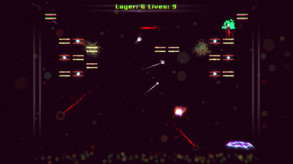
Energy Invasion - an arcade game inspired by the classic Breakout. Unlike the original game, your ball does not break blocks on its own, but can launch missiles in a chosen direction.
Modeled estimate, not a reported figure. How we estimate →
About
Stats
All-time low is the lowest price we've recorded for this game since we started tracking it.
Languages: English
Engagement
Hours played at review time, across 43 reviews with recorded playtime.
Reviews
Themes across 43 recent reviews and how positive each mention is. A keyword signal, not full sentiment analysis.
positive critical· bar length = how often the theme comes up
Reviews
只能讲我被这个游戏封面给骗了... 望诸位lsp引以为戒, 告辞(抱拳
No sé si es mi oído de viejo... o qué... pero la "música" me penetró los oídos como caballo a la caballa (? Eso, y re tosco el movimiento de la pelota y el toque con la paleta. Es re fácil perder aunque te estés moviendo bien.
Energy Invasion is an experimental take on the classic brick-breaking formula, developed and published by Sometimes You. At its core, it builds upon the foundation laid by timeless arcade staples like Breakout and Arkanoid but attempts to inject a new layer of mechanics and visual intensity to stand out in a genre that has remained relatively static over the years. Instead of simply bouncing a ball to clear blocks, the player now has an additional element to manage—a missile system linked to the ball’s trajectory. The concept is intriguing, promising to merge the reflex-driven satisfaction of brick breakers with the tactical precision of a shooter. Unfortunately, while the idea has creative merit, the execution feels uneven, resulting in a game that struggles to balance innovation with playability. The first thing that sets Energy Invasion apart is its control scheme. The player still moves a paddle at the bottom of the screen to bounce a ball upward, but now each bounce also enables the firing of an energy projectile in a direction controlled by the right analog stick. This introduces a dual-layered challenge: managing both the paddle’s position and the direction of attack simultaneously. It sounds dynamic in theory, but in practice, it often feels awkward. The paddle movement is sluggish, making it difficult to adjust for rapid rebounds, while the aiming mechanic lacks precision, leaving players feeling detached from their own input. The ball’s behavior is unpredictable, and the missiles—though central to the game’s design—don’t provide the satisfying impact one would expect. The result is a disjointed experience where you’re constantly torn between trying to survive and trying to attack effectively. Visually, Energy Invasion embraces a chaotic, almost psychedelic aesthetic. The game bombards the screen with vivid colors, flashing lights, and abstract geometric patterns that make each level look like a digital fever dream. At first, this style feels bold and futuristic, but it quickly becomes overwhelming. The visual effects often obscure the action, making it hard to track the ball or even see your paddle clearly in the midst of all the flashing energy. This overabundance of style diminishes the clarity that a fast-paced arcade game requires. The backgrounds, while artistically interesting, tend to compete for attention with the gameplay itself, turning what should be a test of reflexes into an exercise in visual endurance. While the art direction deserves credit for being distinctive, it ultimately sacrifices functionality for spectacle. The soundtrack continues the game’s sensory overload with an intense electronic score that drives the action forward. Composed in the style of pulsing techno and ambient noise, it creates a sense of urgency and fits the game’s neon-soaked visual identity. However, like the visuals, it can be a double-edged sword. Some tracks heighten the tension beautifully, while others feel too abrasive or repetitive over long play sessions. There’s an undeniable atmosphere to the presentation—Energy Invasion feels like an attempt to immerse players in a hyperkinetic audiovisual experience—but without the tight gameplay to anchor it, the presentation alone can’t carry the weight of the design. Structurally, the game offers three main modes: Invasion, Linear, and Endless. Invasion mode serves as the main campaign, offering a series of progressively challenging stages. Linear mode provides a more straightforward version of the experience, while Endless mode is aimed at score chasers who want to test their endurance. The variety of modes adds some replay value, but the gameplay loop remains largely the same across all of them. Once you’ve played a handful of levels, you’ve experienced most of what the game has to offer. The progression doesn’t introduce significant new mechanics or enemy types, and the levels begin to blur together as the visual chaos remains constant. The difficulty curve also fluctuates wildly, with some levels feeling far too easy and others punishingly chaotic without much warning. From a technical perspective, Energy Invasion performs adequately. Load times are short, and there are no major performance issues or bugs. The problem lies not in its stability but in its pacing and feedback. The game lacks the satisfying rhythm that defines great arcade design—there’s no tangible sense of impact when you destroy blocks, and the physics often feel disconnected from your inputs. Instead of being pulled into a hypnotic flow, as one might expect from a game like this, you often find yourself fighting against the mechanics. The lack of clear feedback also hampers progression; you’re never quite sure whether success is due to skill or luck, which undermines the sense of achievement that should come from mastering the gameplay. Despite its flaws, there’s a kernel of creativity at the heart of Energy Invasion. The attempt to evolve a classic genre is commendable, and the fusion of shooting mechanics with traditional brick-breaking could have yielded something special with more refinement. It’s easy to see what Sometimes You was aiming for—a modern, stylish reinterpretation of a retro formula—but the execution feels unpolished, as though the ambition outpaced the playtesting. Players looking for a short, visually striking, and inexpensive arcade diversion might still find some enjoyment here, particularly if they’re drawn to unconventional design. The game’s low price point makes it an easy impulse buy for those curious about experimental mechanics, even if it lacks lasting depth. Ultimately, Energy Invasion is an interesting experiment that doesn’t quite succeed at what it sets out to do. It tries to merge old-school simplicity with modern flair but ends up diluting both. The visuals and sound are loud and expressive, yet they overshadow gameplay that should be sharp and satisfying. The core mechanic of missile-based brick breaking has potential, but without the precision and rhythm that define great arcade titles, the experience feels more frustrating than fun. There’s value in its ambition and its attempt to break away from tradition, but the result is uneven—an energetic concept trapped inside a clunky execution. For players who appreciate experimental indie games or have a nostalgic love for the brick-breaking genre, Energy Invasion is worth exploring once, but it’s unlikely to hold attention for long after the novelty fades. Rating: 6/10
☀️
.
👉tuje👈
I had fun.. I just wish it let me save my progress
I just love how only 2.1% of players got the achievement of PLAYING THE GAME anyway mid game instantly quit after like 12 minutes
This game is a meme definition of "Unity game" in a bad sense: - Boring gameplay - ♥♥♥♥♥♥ graphics with post-processing such as chromatic aberration cranked to high - Horrible music (I initially thought there is some problem with its playback on Mac due to how bad it is - turns out, it's just the way it is) - My head literally started to hurt due to the combination of graphics and music - No saving. I quit the game after playing ~12 minutes and was not going to launch it again, but people in the reviews were saying there is no "save" and I wanted to check it. Confirmed - no save. The only good thing I can say about it is: + Performance - works smooth even on a 9-year old Mac with Intel 4000 built-in graphics
Clickbait lady screen
Related
Related
Trends
Concurrent players on Steam, sampled daily since tracking started.
Momentum
Pace estimated from the game's recent review growth (our daily snapshots) at its own sales-per-review ratio — a momentum signal, not booked sales.
Audience
Estimated from the language of this game's reviews — a proxy for where players are, not official Steam demographics.
Related
| Witch Story | $644 | 78 | 78% | $0.59 |
| IN THE BUILDING: CATS 3 | $646.7 | 84 | 82% | $1.99 |
| Strange Night ll | $638.9 | 86 | 44% | $0.49 |
| Space Pilgrim Academy: Year 2 | $638.2 | 61 | 90% | $0.69 |
| Unblock Me Car | $637.7 | 51 | 96% | $0.99 |
| Horny Alice: Gothic Run | $637.7 | 51 | 63% | $0.99 |