Step into a world of gothic and Egyptian horror and adventure, set in the campaign setting of Ravenloft. This series of entrancing horrors includes Ravenloft: Strahd's Possession and its sequel, Ravenloft: Stone Prophet.
Modeled estimate, not a reported figure. How we estimate →
Media
About
Stats
All-time low is the lowest price we've recorded for this game since we started tracking it.
Languages: English
Engagement
Hours played at review time, across 40 reviews with recorded playtime.
Reviews
Themes across 40 recent reviews and how positive each mention is. A keyword signal, not full sentiment analysis.
positive critical· bar length = how often the theme comes up
Reviews
Увы, по ходу у настроек DOSBOX из инсталляка для этой серии игр проблемы. А может и с чем еще. Иногда дробят ложные срабатывания левой кнопки мышки, обе игры слетают при входе на уровень из меню игры. Если игру удается запустить ковырянием в настройках DOSBOX-а от дефолтного (подобрав рабочие разрешения и настройки экрана), то игра иногда зависает на просмотре карты. Пришлось расчехлять старые DOS-box-овые версии из веб-архива - там всё идет нормально со старта и подобного геморроя нет. Даже и не знаю - продавать настолько дохлых тушканчиков под видом хоть и стареньких, но живых - совсем не найс. По поводу этой и других коллекций из серии игр SSI: Ко многим играм есть мануалы, гайды по прохождению или файлы с доп. помощью. Это в плюс. https://steamcommunity.com/sharedfiles/filedetails/?id=2958724528&tscn=1680847659 Игры серий довольно старые и на этот момент сильно на любителя. Тот геморрой, который мы получаем за свои же кровные не стоит этих проблем, если нет ностальгии или вы не ретрогеймер. Вы предсказуемо убъетесь об интерфейс, вопрос "шо делать" и вагон и маленькую тележку вопросов из разряда "а что делает эта хpeнь", а уж управление вас добьет точным выстрелом в голову... И даже собрать выпавшие после самоубийства зубы будет очень непросто - поскольку на мышь повешено столько всего, что иногда простое поднятие вещи может испортить вам монитор, опрокинутый внезапно прилетевшей на пердячем пару "рукой Бога"... А тут еще набегающие монстры имеют свойство не только терять на себе мышиный фокус, но и исчезать и в пылу боя не совсем понятно - они уже всё, или продолжают крутится за вашим экраном в попытке хорошего куся сзади... Большинство загадок из разряда "найди жирный пиксель. Эй, не жирный тоже надо..." и попыток разобрать что же такое лежит на экране и стоит ли это вообще трогать... https://steamcommunity.com/sharedfiles/filedetails/?id=2958724456&tscn=1680843872 Если же вы знаете что это такое - смело берите игры в любом другом месте, только проследите скачать именно CD-версию, разница в объеме контента довольно большая, например есть дополнительные квесты, у персонажей прорезается голос, видеовставки расширены и более индивидуальны игровые объекты.
First-person, real-time, action RPG's with free-movement (not grid-locked) are one of my favourite sub-genres, but much of the earliest games to do it are too rough around the edges to give many people a good time in 2024, and unfortunately [b]Ravenloft[/b] (1994) falls into this bunch of rough starters for me. Some people might instead still refer you to the [b]Ultima Underworld[/b] (1992-1993) games, but I feel that even those are a bit too clunky and slow to play in modern times. Some of these older games do hold up better than others though, but you need to go a bit further into the mid-ninties to find the gold: [b]Daggerfall[/b] (1996), [b]Lands of Lore 2[/b] (1997), [b]Lands of Lore 3[/b] (1999), [b]Everquest[/b] (1999) and [b]Might & Magic VI-VIII[/b] (1998-2000) (M&M is a mixture of real-time and turn-based) being some of the best examples of this genre -even today. I implore you to check those out instead if you haven't already.
Ich bin zwar in einer Welt aufgewachsen, in der Vampire oft nur kitschig rüberkamen (danke Twilight) aber Ravenloft hatte dieses Problem natürlich nie. Hier geht es um klassischen Vampir-Horror: düstere Stimmung, gruselige Abenteuer und Kämpfe gegen viele Unholde. Genau das bieten auch die beiden Spiele, die in dieser Sammlung enthalten sind. Deshalb eine blutige Empfehlung!
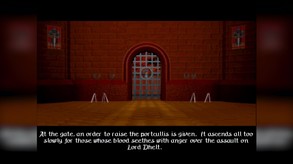
[b]TL; DR[/B] the Ravenloft series is good but has a few issues that can make it tedious. It is the sort of Dungeon Crawler I would recommend to someone who has already played the GOATs but is looking for more good games. Both of them can be played entirely with the keyboard, but there are a few mouse commands such as movement. These games play through DOSBOX and came out in the mid-90s so some features you might expect can be missing, however, there is a handy automap which even marks items for you. [h1] Story [/h1] [i]Strahd’s Posssesion[/i] begins with an attack! The lord you serve was assaulted when you were away, and his holy amulet was stolen. You rush after, swearing to not return until your quest is completed. However, as you reclaim the amulet, you are surrounded by grey mists and taken into Ravenloft. The amulet is missing, and you are trapped… Your adventures in Ravenloft will be told across cutscenes, dialogue and a lot of notes. This gives you a good idea of what is happening and also lets you form your own opinions on the major players, Strahd being the standout character. [i]Stone Prophet[/i] does the same sort of things, except that Anhktepot is very distant, and is basically just chilling in his tomb. Honestly, pretty relatable, but it does not make for a memorable villain. [h1] Presentation [/h1] How the game looks can be seen from the screenshots, but that does not show how it feels to play it. Once you immerse yourself there is a sense of foreboding and wrongness. Even the people you meet are generally aggressive and most refuse to even talk with you. You do not belong here. Another highlight is the music, there is a lot of it, in total it is about 4 hours. All of it is dungeon synth and it ends up working really well to enhance the Gothic or Egyptian atmosphere that the games are going for. It is also worth speaking on the voice acting, there is a surprising amount of it, but it is not particularly good. This is made worse by the default audio mixing since sometimes it can be difficult to hear characters speak over the music. But in [i]Stone Prophet[/i] you can change the audio levels, which is nice, I guess. I also liked the character creation screen, it is handled through a quick tarot reading, which I thought was very neat. It is more interesting than just picking classes and such from a list. Which brings us to the topic of the Vistani, they are based on depictions of the Roma and have since been revised in official material. Since this game came out before those revisions some parts could be considered offensive. [h1] Gameplay [/h1] The duology is based on AD&D 2nd edition, some experience is good to have, but the manuals and cluebooks gives you most information you need to create your parties and what spells does what. What you also need to know is that [i]Stone Prophet[/i] does not have a mage companion, and since you will be fighting undead for most of the games you will need a cleric. Added to that you can only create two characters which carry over and recruit two more from a selection of temporary and permanent NPCs. So, you should consider what classes your two characters will have. Check the cluebooks to see who you can recruit and give some thought into whether or not you want to multiclass. One really annoying thing is that the games change which party slots are the frontrow, in [i]Strahd’s Posssesion[/i] it is the two leftmost while in [i]Stone Prophet[/i] it’s the two in the centre. It is not a big deal, but it is confusing since you will not notice it before you enter the first dungeon in Har’Akir. Also, as you might be able to tell from the screenshots, this is using the same engine as Menzoberranzan, but rest assured as the Ravenloft games are way better in multiple ways. [h2] Exploration [/h2] I can confirm that there are dungeons in this Dungeon Delver and that they are filled with undead and traps. These dungeons are handled similarly in both games with a focus on finding keys, hidden buttons and secret walls. In [i]Stone Prophet[/i] they add a few more puzzles but these are generally easy, for example using [i]Speak with Animals[/i] to speak with an animal. Each game has McGuffins that are needed to complete it, so you should take care to explore everything and make sure you place items that seem important in a good spot! These are typically telegraphed very well, so you should have no issues. The major issue in your exploration comes from the grid-based movement system, some buttons are nearly impossible to see if you have it activated so you are forced to switch it on and off when you are exploring. Similarly, the spinners and slider traps can be difficult to navigate when using the grid-based movement. A larger difference is found in the overworld exploration. In [i]Strahd’s Posssesion[/i] you will be returning to Barovia over and over again since all dungeons connect back to it. This makes the village a great place to store spare consumables and items you do not think you will need right now. Meanwhile, in [i]Stone Prophet[/i], the world is open, and you have to explore a vast desert to find the remains of an ancient civilization. You can use Muhar as a similar hub as Barovia, but only because there is fast travel as you would otherwise have to travel fairly long distances. Traveling along the desert can be problematic since [i]Stone Prophet[/i] added a hydration system… which can be entirely circumvented by using a cleric with [i]Create Water[/i]. I would have liked the desert more if the draw distance was better, but as it is you might find yourself checking the automap every few steps to see if there is anything of interest around you. Luckily you can find a note with all important locations marked out, so make sure you do not throw that away. This also has some great dungeons, such as Castle Ravenloft, which is just amazing with its many traps, secrets, interconnected floors and all the fun enemies in it. The other standout dungeon would be the City of the Dead, which is also quite complex, with secret buttons I could not find on my own, unfortunately my party was very strong at this point, and so I breezed through its combat encounters. [h2] Combat [/h2] Ravenloft’s combat is very similar to other Dungeon Delvers, and to AD&D, but the movement system adds a few extra quirks to it. If you have step mode on you can only cast spells in the cardinal direction, but it also makes avoiding enemies easier. If you instead turn it off, you can use spells diagonally, but it feels really wonky to move around. As a result, you will find yourself switching between the modes whenever there is a large group of tough enemies in an open area. Melee combat also had a few odd design choices. You can click on enemies which cycles through your available attacks, but if you misclick or click after the enemy is dead than you will move or turn around, which is disorienting. It is more efficient to click the individual weapons whenever they can be used, not only does this save you from disorientation but it can also hit enemies in the squares to the left and right of where you are facing. This was often my preferred method to clear a dungeon, my party did take a lot of damage, but the dungeons are filled to the brim with potions. So, I never ran out of healing consumables, and I took to healing whenever I found them since my inventory was already filled with spares. Combat is also where we get into the more tedious details of the game. Level Drain, [i]Strahd’s Posssesion[/i] has a lot of level draining enemies. You cannot cure it and it turns some areas into slogs. The best you can do is cast [i]Negative Plane Protection[/i] but that only helps a little since it is removed whenever you are hit and will be fighting four enemies at a time. The bosses are also disappointing as they are no better than boring puzzle bosses especially Anhktepot who barely even qualifies as that.
Nostalgia is a poison at times and a game almost 30 years old is perfect example. What the team has done to make it functional is truly wonderful but given this was an attempt to have real time combat using D&D back in 94 was a clunker then (a hard admittance to my rose colored glasses) and even worse now. No using spells in combat effectively and using the arrow keys created too many issues just hitting a basic target that moved around. And this is in spite of remembering this was the king of re-loads anyway. IF (because I have only an inkling on how difficult it is to update any old game) they were able to map the keys to WASD with Q and E as turns then I could see diving back into a game that has everything else going for it given its age. Writing, voices, ideas, all lovely. But I cannot recommend flirting with this form of nostalgia as stands.
Better than Menzoberranzan, that's for sure. Some of the secret buttons in the first game are very difficult to spot and the level-drain without means to cure it makes it a horror game. The second game loses the red thread to follow and goes overboard with the fireball / lightning bolt slinging holes in the walls but is missing the irritating features of the first game. I would recommend these to anyone who liked any of the Grimrock or EoB games. edit: do not play the first Ravenloft without creating a cleric
"Avert your eyes!" "Shall I have you impaled?!" "I can taste your fear!" "Bow before me!" "Put down your weapon!" "For the Templar cross!" "Ha! Where did you learn to fight?" "Insolent beast!" "For the Cross!" "Am I to fight this woman?!" "Challenge!" "You reek of failure!" "You look like my squire."
Stone Prophet is really good
Juego antiguo muy adictivo.
A tough pair of games with a clunky old interface, but if you're in the mood for retro dungeon crawlers, this is a fun and streamlined one. Don't come here looking for open worlds or multiple choice decision-making - this is all about killing evil monsters, mapping, and solving (relatively simple) puzzles. There are some obnoxious old design decisions (like the level draining enemies), but they can be circumvented with a little bit of care and some help from the cluebook, which you should absolutely use, especially if you have limited time and don't feel like poking around for every hidden door. The stories are as straightforward as they get, but there are some fun details sprinkled throughout, and some of the "character" interactions are inventive and satisfying. These may not be the best of the "Gold Box" games (I don't think either of the Ravenloft games were released under that series), but they are a good time for anyone with the patience to navigate the sloppy UI.
Related
Related
Trends
Concurrent players on Steam, sampled daily since tracking started.
Momentum
Pace estimated from the game's recent review growth (our daily snapshots) at its own sales-per-review ratio — a momentum signal, not booked sales.
Audience
Estimated from the language of this game's reviews — a proxy for where players are, not official Steam demographics.
Related
| Oneiro | $4.9K | 50 | 96% | $4.99 |
| Gizmos: Steampunk Nonograms | $4.9K | 50 | 92% | $4.99 |
| Crushed | $4.9K | 196 | 54% | $0.99 |
| SOTANO - Mystery Escape Room Adventure | $4.9K | 50 | 68% | $6.99 |
| Colortone | $4.9K | 369 | 70% | $0.83 |
| Planet RIX-13 | $4.9K | 108 | 95% | $2.99 |