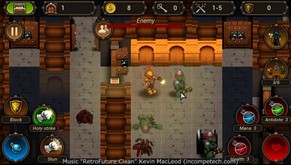
Many inhabitants wishing to get the tribute came back to the city. Only the time will show whether the main character will find the riches or he is fated to decorate one of the undercroft corners with his skeleton.
Modeled estimate, not a reported figure. How we estimate →
Media

About
Stats
All-time low is the lowest price we've recorded for this game since we started tracking it.
Languages: English
Engagement
Hours played at review time, across 40 reviews with recorded playtime.
Reviews
Themes across 40 recent reviews and how positive each mention is. A keyword signal, not full sentiment analysis.
positive critical· bar length = how often the theme comes up
Reviews
Pros: - Dungeon Crawler Cons: - No tutorial - Combat System is pretty much non existent - Price is not appropriate - Many Icons are not even on screen
Juego de Dungeons, musica buena (repetitiva unica en loop), graficos semi decentes, pero la jugabilidad es mala, controles deficientes, como de 1980-90 (el juego es del 2016), no da, simplemente esta todo muy mal optimizado y es francamente muy mal, lo mismo que el hud y cuestiones de inventario, es no recomendable. Puntos positivos, tiene cromos, y logros y es barato. 2.5/10
Um dos piores se não o pior jogo que ja joguei na steam, mecanica toda travada, graficos ruins, jogabilidade ruim, nada nesse jogo presta, não percam seu tempo.
gereksiz yapımlardan hiçbirşeye benzemiyor
I am 32 years old. My ex-wife and I have a daughter together, and we adopted our son together. Both are now 4 years old. When we were going through our separation, I felt lost and unhappy. I was self-destructive. One day, I was so angry with everything spiraling out of control that I punched a concrete wall in a moment of overwhelming emotion. This resulted in breaking my fifth metacarpal in my right hand—the hand I worked with, played games with, and used to carry my children to bed—the hand I desperately needed to ensure I could continue providing. Upon learning the severity of the self-inflicted damage, I became almost suicidal. Keep in mind that just a few months before this, I was the happiest man, with no history of depression or anxiety. I had never experienced anger outbursts, nor was I the type to break down and cry, but I was in a tough situation that truly prevented me from seeing the light on the other side. With nothing better to do, I looked for a game I could play WITH ONE HAND while recovering. Somehow, I stumbled upon this game and read some of the comments. I decided it was worth a try... I must admit I didn't beat the game, nor did I play as much as some of you. In fact, I may have played this game for only a day or two. That being said, after doing so, I had a new joy and hope for life. I managed to leave behind the pain and suffering that had been thrust upon me. I could experience the joy and happiness of other people. I relaxed for 5 ♥♥♥♥ minutes listening to this music, long enough to realize that I would be okay. After realizing this, I turned off the game and went back to work. My hand hurt a lot, but I was motivated. I stopped feeling so sorry for myself and became the father I needed to be at that moment, not the weak boy I was behaving like. Today, I am close friends with the mother of my children. We don't fight, argue, or say hurtful things to each other. We are parents and friends. Now I have 3 children. My third child is, wait, ALSO 4 YEARS OLD. The woman I am with was going through a very similar situation at the time of my separation, and we just unexpectedly stumbled into each other's lives. We have been dating for a year and are very happy together. Moral of the story: you never know what life has in store for you, and if I had given up when all odds were against me, I wouldn't be where I am today. This silly little game helped me realize that. Thank you.
i like mystic things, and this game so cool ) Recommend :D
Dungeon of Gain, developed by the Defroids team and published by Volens Nolens Games, is an indie roguelike dungeon crawler that attempts to channel the spirit of classic top-down RPG adventures through procedurally generated levels, randomized loot, and permadeath-driven progression. On paper, it carries all the familiar ingredients of the genre: a lone adventurer descending into dangerous underground corridors, battling monsters, collecting treasure, and hoping to survive long enough to grow stronger. The premise evokes nostalgia for early dungeon crawlers where risk and reward defined every step forward. However, while the concept aligns with genre traditions, the execution has proven divisive among players. At its core, Dungeon of Gain revolves around repeated dungeon runs. Each playthrough generates new layouts filled with enemies, traps, and loot, aiming to provide unpredictability and replay value. The structure encourages players to push deeper into the dungeon with each attempt, gathering equipment and experience along the way. Combat is straightforward, focusing on simple attacks and encounters that unfold in tight, often claustrophobic environments. Success depends on managing limited resources, navigating enemy placements carefully, and surviving long enough to acquire meaningful upgrades. The idea of procedural generation suggests variety and emergent gameplay, yet in practice, the randomness often feels more superficial than transformative. While layouts shift between runs, the fundamental mechanics and encounter types remain largely consistent. Enemy behaviors and combat interactions are relatively basic, which can make extended sessions feel repetitive rather than dynamically evolving. Without complex skill trees or layered systems to deepen decision-making, the game leans heavily on its randomization to sustain interest. For some players, this simplicity can feel accessible; for others, it may come across as underdeveloped. Progression systems in Dungeon of Gain are modest. Loot collection serves as the primary motivator for advancement, with weapons and equipment offering incremental improvements. However, the impact of upgrades sometimes feels limited, and character growth lacks the sense of transformative power that many modern roguelikes provide. The risk-versus-reward structure is present, but the feedback loop between effort and progression does not always deliver satisfying payoff. Because runs can end abruptly and without significant carryover benefits, players may feel that repetition outweighs tangible advancement. Visually, the game adopts a minimalist style that reflects its indie origins. Environments are functional rather than detailed, with dungeon corridors and rooms designed primarily for gameplay clarity. Character models and enemy designs are serviceable but lack distinctive personality. The presentation does not distract from the experience, yet it also does little to elevate it. Sound design and music remain understated, offering basic atmospheric accompaniment without becoming a defining feature of the game’s identity. One of the more controversial aspects of Dungeon of Gain lies in its development trajectory. Early Access origins and a prolonged period without substantial evolution have left some players questioning the depth and completeness of the final product. Expectations for roguelike games have risen significantly over the years, with players now anticipating intricate systems, varied builds, and refined balancing. Against this backdrop, Dungeon of Gain can feel comparatively sparse. While it captures the foundational idea of descending into procedurally generated dungeons, it does not expand significantly beyond that baseline. That said, there is a certain appeal in its stripped-down approach. For players who appreciate barebones dungeon crawlers or enjoy experimenting with smaller indie projects, the game offers a straightforward experience without overwhelming complexity. Its modest system requirements and simple mechanics make it accessible on older hardware and approachable for those new to roguelikes. When viewed as a lightweight experiment rather than a fully fleshed-out genre competitor, it can function as a short diversion. Ultimately, Dungeon of Gain represents an attempt to recreate classic dungeon-crawling tension within a modern indie framework. Its procedural structure, loot-driven progression, and permadeath mechanics align with established roguelike conventions. However, the limited depth of its systems and the repetitive nature of its encounters prevent it from fully realizing its potential. For players seeking a highly polished or mechanically rich roguelike experience, it may fall short. For those willing to engage with a more minimalistic and experimental project, it offers a glimpse into a foundational dungeon-crawling concept executed with modest ambition. Rating: 5/10
1/10
слабенько непонел как предметы одевать все кнопки перетыкал могаз страно роботает менюшка покупки просто весит и мешает обзору и её нека не убрать
прикольно
Related
Related
Trends
Modeled estimate over time, reconstructed from Steam's monthly review histogram.
Momentum
Pace estimated from the game's recent review growth (our daily snapshots) at its own sales-per-review ratio — a momentum signal, not booked sales.
Audience
Estimated from the language of this game's reviews — a proxy for where players are, not official Steam demographics.
Related
| Song of the Myrne: What Lies Beneath | $10.3K | 91 | 75% | $4.99 |
| Ghostlords | $10.3K | 78 | 91% | $4.99 |
| The House | $10.3K | 91 | 36% | $4.99 |
| Pushcat | $10.3K | 91 | 88% | $4.99 |
| Blade & Sword 2: Ancient Legend | $10.3K | 62 | 76% | $6.99 |
| The Counter Gambit | $10.3K | 72 | 72% | $6.99 |